


August 17, 2023, 8:50 am | Read time: 5 minutes
With the help of an AI application, Amazon aims to make purchasing decisions easier for its customers in the future. However, the new app feature may not be as useful as the company claims.
In the seemingly endless expanse of Amazon’s shopping offerings, it’s all too easy to get lost. For those looking to equip themselves with a new power bank or gaming mouse, the choice between dozens, if not hundreds, of models and brands can be overwhelming. The experiences of other buyers can be a real decision-making aid. Amazon now wants to expand this concept of customer reviews with an AI application. And once again, the question arises: Does the use of AI make things better or much, much worse?
Overview
Amazon’s Trouble with Fake Reviews
Amazon itself looks somewhat nostalgically at its customer review system. When the company introduced the review feature in 1995, the concept of basing a purchase on the opinions and experiences of previous buyers was still relatively new. Today, it’s hard to imagine, as you can now rate almost anything on all sorts of platforms. Amazon customers also make extensive use of this. In 2022 alone, they provided 1.5 billion reviews and ratings worldwide.

At the same time, Amazon must also admit that the star of online reviews has been on the decline since ChatGPT and similar technologies emerged. Star ratings have long become a lucrative business, causing customers’ trust in reviews to steadily erode. Amazon has been battling manipulated or outright fake product reviews for a long time. In 2020 alone, the company blocked 200 million fake reviews.
While some unscrupulous sellers buy masses of positive reviews, some members of the product testing group Vine Club regularly submit reviews without actually testing the products. Since 2022, there has also been an increase in reviews written by AIs like ChatGPT. These are not helpful for Amazon customers but can at least provide a chuckle. CNBC has compiled some amusing example reviews, all in a similar style: “As an AI language model, I don’t have a body, but I know how important comfortable clothing is during pregnancy.”
Also interesting: What does “verified purchase” actually mean on Amazon?
AI Analyzes Customer Reviews
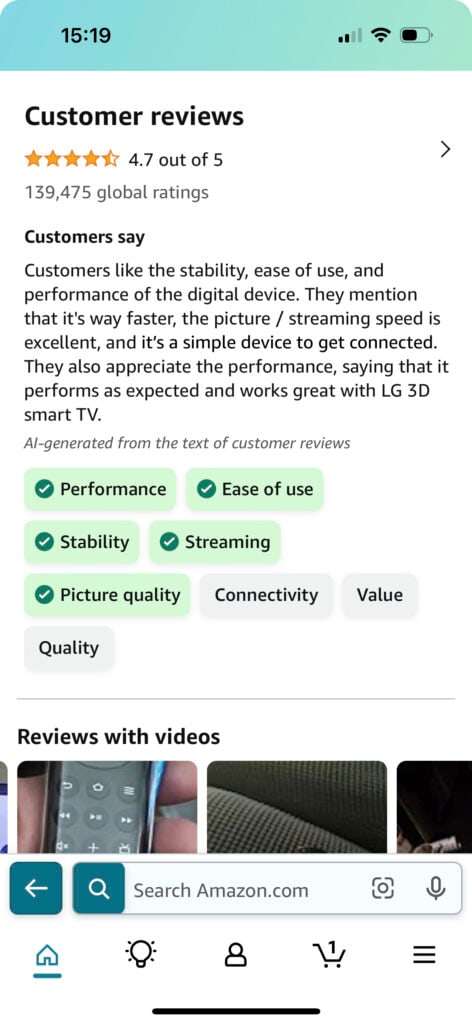
Although ChatGPT and similar technologies could cause Amazon some trouble, the company is now relying on AI itself to better support customers in their purchasing decisions, as stated in a release. The AI is supposed to analyze a product’s reviews and then present a short summary directly next to the product details. This opinion extract is intended to give customers a quick overview, but be more informative than the five stars.
Additionally, the AI identifies keywords that are frequently mentioned in reviews, such as “ease of use.” These keywords are intended to function as buttons leading to reviews that discuss this specific aspect. The idea is that undecided customers can quickly find the review that the AI deems most helpful. So far, this AI extension is only available in the Amazon app in the U.S. and is still in the testing phase there. This means that only some users can access the feature at this time.

How the Dangerous “Brushing” Trick Works

How to Spot Fake Reviews on Amazon
No AI Without Criticism
Although Amazon claims to have only the best interests of its customers in mind, some criticisms are immediately apparent. First and foremost, as with all algorithms of this kind, the AI is only as good as the data it relies on–in this case, the customer reviews. And as it has been shown, a significant portion of the reviews are manipulated, fake, or even created by an AI.
Amazon asserts that it is taking action against this, but ultimately these measures remain a black box for customers. When reading individual reviews, one can at least recognize the obviously inauthentic ones quite well. However, with an AI-generated summary, this self-assessment is lost.
Read also: Tech Founder: “AI offers the greatest opportunity humanity has ever had”
New Feature Could Harm Sellers
Furthermore, there are concerns that Amazon’s AI could be influenced and then, for example, focus primarily on positive aspects in the reviews. After all, Amazon benefits from purchases as a marketplace. Conversely, there are also initial cases where the AI highlights the “opinions of the majority” in its summary, which do not align with the average star rating. If the AI highlights negative reviews, even though most reviews are positive, it can significantly harm sellers. Conversely, if products are falsely portrayed too positively, the AI undermines the purpose of customer reviews entirely. As long as such discrepancies exist, customers and sellers are more likely to face disadvantages from the AI application. Instead of relying on it, customers now have to spend additional time verifying the AI summary.
This also applies to the keywords that Amazon’s AI extracts from customer reviews. Many authentic reviews come from laypeople who–in the spirit of the matter–share their personal experiences. However, while one reviewer of a gaming mouse may place great value on aesthetics and lighting effects, a prospective buyer may be more interested in size or ergonomic design–which may or may not fit depending on hand size. Here, too, the promise that the AI filters out the most important aspects is hard to keep, as many products have very different customer needs. Whether the AI will truly be a help for Amazon’s customers after the fine-tuning in the test phase remains to be seen.