


August 17, 2023, 2:17 pm | Read time: 8 minutes
Artificial intelligence has been a topic for some time. This year, however, it received a massive boost due to tools like ChatGPT and Google Bard. Why is that, and what will AI bring us in the future? TECHBOOK spoke with a tech founder and expert about it.
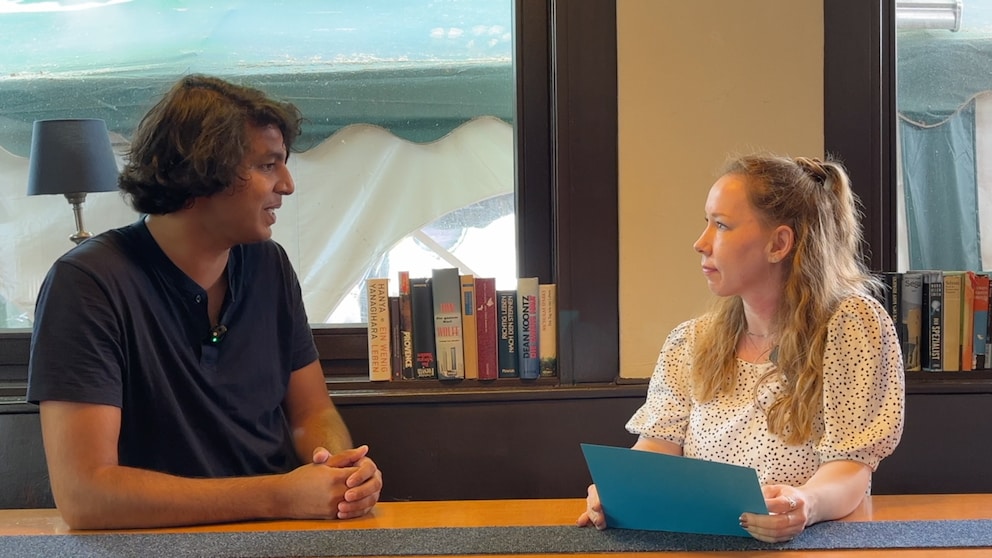
Large companies such as Microsoft and Google are currently investing a lot of time and money in developing AI solutions. AI is on the verge of completely transforming life as we know it–both personally and professionally. But what are current AI solutions doing differently than before, where does the hype come from, and are there limits to artificial intelligence? We discussed this with Bilal Zafar. He not only gives lectures on AI, but as a co-founder of richtiggutbewerben.de and the experience portal dab, he is also directly affected by these developments and can provide fascinating insights into dealing with AI.
Bilal, you hear about AI everywhere. You can’t avoid the topic anymore. So, to start, the question: What exactly is AI? Can you explain it briefly in two or three sentences?
Artificial intelligence is actually very easy to explain. It simulates human thinking. We as humans have eyes and ears, and in the same way, AI can be fed—with sensors and cameras. This is the first time a topic affects all areas of life. We are experiencing a paradigm shift; AI will dramatically influence and change all areas of life in the next five years.
How did you get into the topic of AI?
My brother and I have two internet companies. One is an online platform for leisure activities, and the other is an online platform for jobs. We’ve had the second startup for ten years now, and technology has always been present in a tech company. Artificial intelligence is a continuation of what we do anyway. And that’s why the topic is so relevant and directly affects us. It offers exciting insights into how to deal with AI.
When you give your lectures, are there certain questions that are repeatedly asked about AI?
There are often questions like, “Isn’t AI just a trend? Isn’t it that powerful? Isn’t it still flawed?” But we see the development. We have an exponential growth trend, almost vertical. We haven’t seen that before. In the past, we have already fixed many errors by the middle of the year.
As a technology editor, I’ve been following the topic of AI for a few years, for example, in certain smartphone functions. So AI is not a topic that was invented in 2023. Where is AI already being used? In areas we might not expect, and perhaps in products or sectors where we wouldn’t think of AI being used?
AI has been present in the healthcare sector for some time, such as in hearing aids to suppress background noise. You can say, I want to hear the conversation well, and then adjust the hearing aid accordingly. AI is also used in facial recognition. Some larger smartphone brands already have very advanced facial recognition technology. It sorts images by people, regardless of whether the person has a beard, long hair, short hair. The technology can recognize people. We have facial recognition with the help of AI—not yet fully developed AI, but algorithms that already show a tendency toward AI.
We should now take action. It’s not that many jobs will suddenly disappear, but new jobs will emerge. And I’m looking forward to that.
Read also: Translation AI “HeyGen” in Test: “Frighteningly Good”
This year, AI has made an incredible leap. What are the most important applications where AI is already being used? What can we still expect?
Currently, AI is heavily focused on repetitive tasks and large data sets. Many of the steps and tasks we do today are simply no longer necessary. If we look at it critically, we see that much involves data entry, repetition, and content generation—things computers can do much better. Take Excel, for example. Many people move numbers around in Excel. That’s no longer necessary. I would cautiously say it’s almost medieval that we still do that. A computer understands connections much faster.
And new products are also coming to market. It’s going to be very exciting. Many industries will change dramatically. In a positive way, I think. Because then we have more time for meaningful tasks.
Do you have a top 3 of applications where AI is already in use? You mentioned data processing, for example.
In large data sets, in texts. Humans can use AI to create texts. And in image creation. There are tools where you no longer need a photo model or a photographer. You can create both with a snap of your fingers. This is a paradigm shift, something that hasn’t existed like this before.
That actually sounds like a great opportunity, but I also have concerns. It feels like humans are becoming redundant in certain areas. If you can imitate voices or manipulate photos, doesn’t that also pose dangers?
The technology raises a big ethical question. Reality and fiction are blurring. Philosophers and people who deal with these topics need to answer that. I focus more on the benefits of how we can use AI. And we should also be careful because in Germany, we are quite critical. We should not stifle technological progress and leave this triumph to the Americans, the Chinese, and perhaps a third nation. We as Europeans should embrace technology and put aside what I now call data protection excuses. Data protection is important, but not as an excuse not to use AI.
We should take action now. It’s not that many jobs will suddenly disappear; new jobs will emerge. Jobs will be redefined. This was also the case with other technological advancements. The phone didn’t make people unemployed, nor did the computer or Photoshop or other tools that directly intervene in creative work. New jobs are being created.
Read also: Artist shows how deceased celebrities might look today with the help of AI
I also like to call AI the second Industrial Revolution. Back then, many were certainly skeptical—many manual tasks were taken over by machines. Now we have the transition to an intelligence that doesn’t come from humans but from computers. You say data protection should not be overlooked. Are there points where you say, despite all the advantages AI brings, we should still be a bit cautious?
There are weaknesses in AI, or artificial intelligence. A quote I like to use comes from Alphabet CEO Sundar Pichai: “The impact of AI will be more profound than the discovery of fire and electricity.” Many people don’t realize that. This is not a trend; it’s a complete paradigm shift.
However, there is the challenge that we have a black box with AI. This means you don’t always know why a certain output comes out because we’ve never had this before. In the past, you always knew if I do A and the algorithm is B, C comes out. But this time, there are these challenges that even the big tech CEOs see. That’s why Elon Musk says AI is more dangerous than the atomic bomb. And once you start thinking about it, you understand.
We should now take action. It’s not that many jobs will suddenly disappear, but new jobs will emerge. The jobs will be redefined. This was also the case with other technological things. The phone didn’t make people unemployed, nor did the computer or Photoshop or other tools that directly intervene in creative work. New jobs are being created.
Read also: Artist shows how deceased celebrities might look today with the help of AI
You briefly mentioned earlier that AI is causing certain jobs to disappear or be restructured. What new jobs do you think will emerge? What will the future of work look like?
The big internet and software companies like Google and Microsoft will create new jobs such as “prompt engineer.” People will learn what to input best and how to communicate with AI. AI has many human elements. If you had asked me two years ago if AI could think and feel, I would have said, “No way.” But now, maybe it’s not science fiction anymore. You might actually fall in love with an AI voice.

Where else will we see AI in the future?
Everywhere. In restaurants, in medicine, in driving. In the coming years, I believe things like accidents will dramatically decrease. I have a car with autonomous driving and AI, and I think it potentially saved a cyclist’s life by recognizing them as a human, not just another car or a piece of paper blown by the wind. AI is already intervening in our lives.
There are also people who say, “I don’t believe in AI.” Because Siri and Alexa aren’t that good. Sometimes you ask about the weather, and it doesn’t work. But that’s old technology. AI will surpass this technology. And when we have voice assistants equipped with AI, it will be really interesting.
Read also: Artist shows what the children of famous couples might look like