


October 4, 2023, 5:08 pm | Read time: 6 minutes
Google has refreshed its Pixel lineup with two new smartphones. On the hardware side, little has changed; the innovations are mainly found in Android and the Google Photos app.
At the “Made by Google” event, the company unveiled its new flagship smartphones, Pixel 8 and Pixel 8 Pro. Although we had already seen every little detail about the new devices in leaks, a few announcements still surprised us. Not only is artificial intelligence increasingly integrated into Google smartphones, but there’s also a new update promise,
Overview
Brighter Displays and New Temperature Sensor
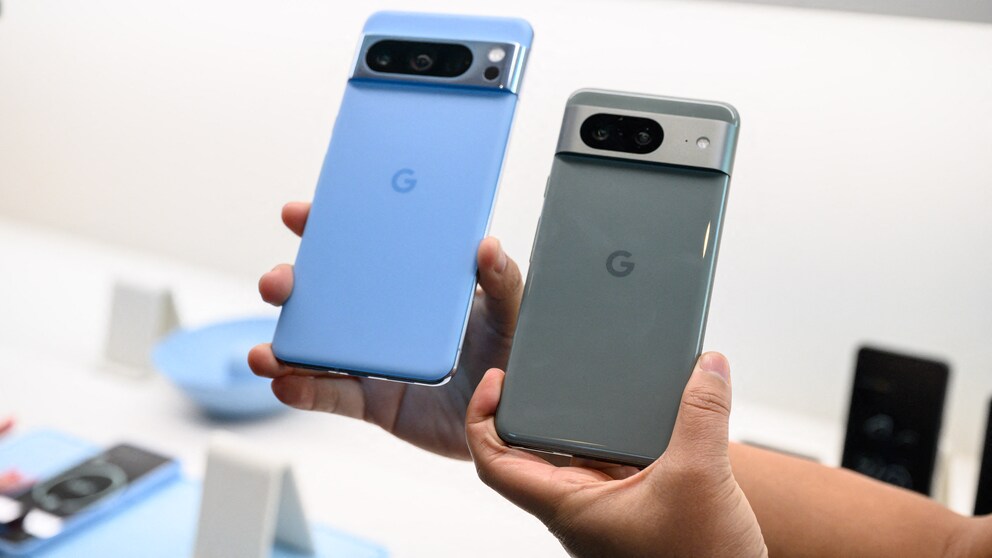
To get straight to the point: both internally and externally, there are hardly any noticeable changes in the Pixel 8 and 8 Pro. Both models are instantly recognizable as Pixel smartphones. However, Google has refined the design a bit. The glass back is now matte, similar to the iPhone 15, instead of glossy. There are also new color variants, including “Bay” blue.
Minor Changes to the Screens
In the Pixel 8 Pro, all three camera lenses are now behind an oval glass cover, giving the camera visor a more uniform look. Speaking of uniformity: the display edges on both new smartphones are finally the same width on all four sides. The bulky chin at the bottom is gone. In this context, Google has also increased the radius of the displays, making the cases more rounded and less angular than their predecessors.
The display itself in the Pixel 8 Pro is almost unchanged from the 7 Pro, with one exception. With 1,600 nits of brightness and up to 2,400 nits of peak brightness, it has become significantly brighter. It is a full 400 nits brighter than the already excellent display in the iPhone 15 Pro. Otherwise, the LTPO panel still supports refresh rates between 1 and 120 hertz.
The Pixel 8 also gets a brighter screen, which can go up to 2,000 nits. Additionally, the panel now finally supports 120 hertz. However, due to the lack of LTPO technology, it can only switch between 60 and 120 hertz.
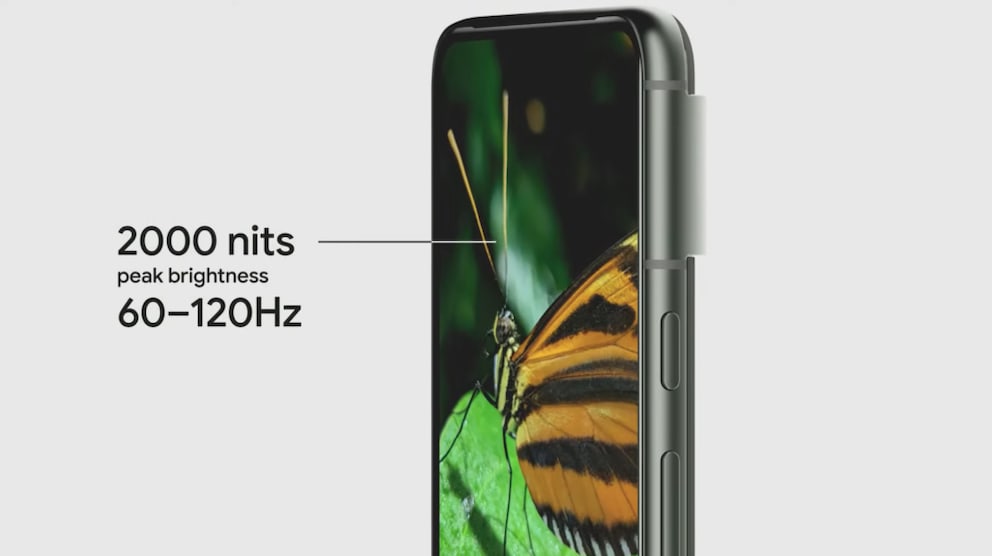
Google calls the new displays “Actua” (Pixel 8) and “Super Actua” (Pixel 8 Pro). However, this seems to be just the designation for super-bright screens.
Third-Generation Tensor
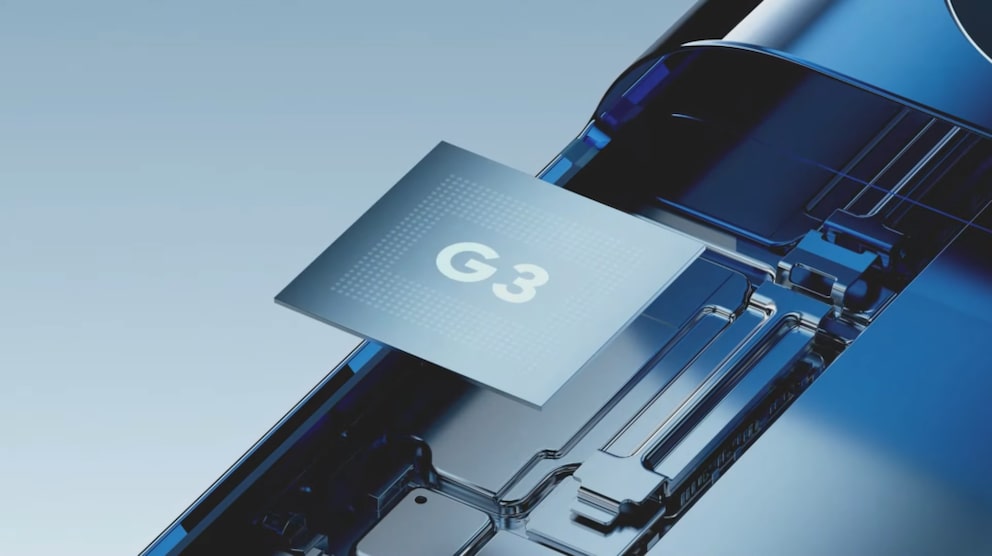
The Tensor chip, introduced with the Pixel 6, has now reached its third generation. However, Google does not provide any information about higher performance, longer battery life, or better heat dissipation. The data sheet only shows that the CPU of the chip is clocked slightly higher and a newer GPU model from manufacturer ARM is used.
However, Google emphasized at the launch event that twice as many machine learning models run in the background with Tensor G3 as with G2. This is an initial indicator of the numerous ML- and AI-based functions of the new smartphones.
New Temperature Sensor Only in Pixel 8 Pro
As leaked beforehand, the 8 Pro is indeed equipped with a temperature sensor on the back in the camera visor. Google described some applications for the sensor at the event. It is supposed to be suitable for reading the temperature of a pot, a baby bottle, or other surfaces. Google is currently seeking permission from the U.S. FDA to use the sensor as a body thermometer.
Also interesting: Does the Google Pixel Fold mark the breakthrough for foldable smartphones?
New Camera Features and Video Boost
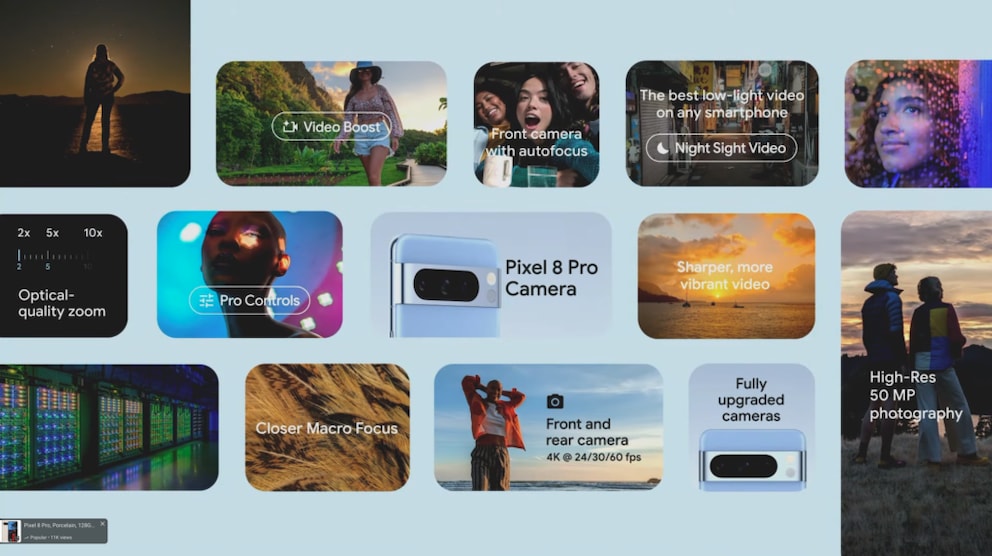
The camera hardware in the Pixel 8 and 8 Pro is almost unchanged from their predecessors. However, there are small adjustments here and there, mainly to deliver more consistent results across the individual cameras.
New Sensor in Pixel 8 Pro, More Field of View in Pixel 8
The 8 Pro still has a 50-megapixel main camera and a 48-MP telephoto camera. However, both now have a larger aperture to capture more light. New in the Pro is the sensor for the ultra-wide-angle camera, which also has a 48 MP resolution and can capture more light.
In the Pixel 8, almost everything remains the same. Google has slightly increased the aperture of the 50-MP main camera. The more important innovation, however, is the ultra-wide-angle camera, which now has a wider field of view of 126 degrees.
Both smartphones receive a new selfie camera, which, although it has a slightly lower resolution of 10.5 MP, features autofocus.
Many New Software Features
The higher machine learning performance of the Tensor G3 enables a range of new video and photo features. These mainly occur in post-processing and allow for extensive editing of recordings.
Similar to the Magic Eraser, Google has introduced the Audio Magic Eraser. This allows unwanted background noise to be removed from video recordings. The tool splits the audio in a video into separate tracks, which can be individually adjusted in volume. This allows for the reduction of sounds like dog barking, music, or wind noise.
Best Take, on the other hand, is the evolution of Live Photos and allows users to select the best shot for individual people in group photos. If everyone is smiling and one person has their eyes closed, Best Take can replace only that person’s face with a better shot.
Another interesting innovation is Video Boost. When the feature is activated, the Pixel 8 records videos with more image information. Users can then upload it to Google Photos as usual. With the power of Google’s servers, the app creates a better version of the video with more details and HDR+.

Pixel 10 Models in First Review–What Google Is Doing Differently

Pixel 11a Leak Reveals Technical Details
Generative AI Becomes Part of the Android Experience
Google had already presented the Magic Editor at the I/O developer conference and announced the generative AI for the Pixel event later in 2023. Magic Editor offers users a range of editing options for their photos, largely based on artificial intelligence. For example, people and objects in photos can be freely repositioned or even enlarged or reduced.
The generative AI fills the gaps created by cutting out with completely new generated fill images. Instead of unsightly artifacts that previously remained when using Magic Eraser, now realistic-looking backgrounds appear that are hardly distinguishable from the rest of the photo.
Exclusive to the Pixel 8 Pro, Zoom Enhance will also be available later this year. Who remembers the CSI series where pixelated images were magically enlarged and sharpened to reveal every tiny detail? This will soon no longer be magic but a Pixel feature. Google’s AI can recognize what is in digitally enlarged images and automatically generate a sharp image.
Prices and Availability
The Pixel 8 is available in the colors Hazel, Rose, and Obsidian, starting at 799 euros for the 128-gigabyte version. For a moderate 60 euros more, you can get 256 GB. The 8 Pro comes in the colors Bay, Obsidian, and Porcelain and costs 1,099 euros with 128 GB of storage. For 60 euros more, you can also get 256 GB of storage here. The version with 512 GB of storage costs 1,299 euros. Both models are available for pre-order now and will be delivered next week.