


May 11, 2023, 12:01 pm | Read time: 6 minutes
Foldable market leader Samsung faces competition from a serious challenger: Google. Alongside a series of other announcements, the company has unveiled its first foldable Pixel smartphone.
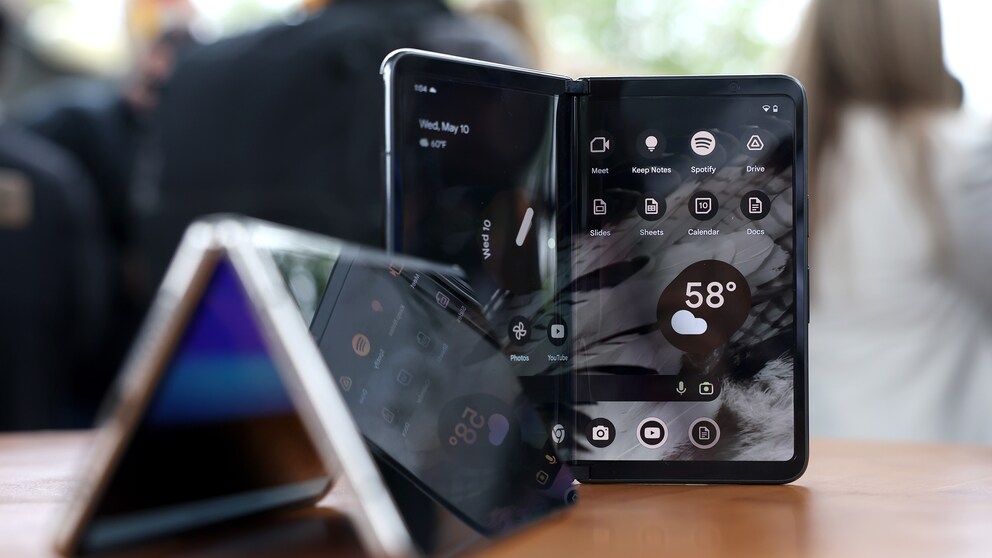
With the Pixel Fold, Google is the latest player in the foldable smartphone market. The company had been working on developing its own foldable smartphone for some time, with a prototype already in development in 2019. After a series of leaks where we learned practically everything about the new device, Google officially presented it at its I/O developer conference on May 10, 2023.
Overview
Compact Outside, Full Tablet Inside
The outer display makes the Google Pixel Fold relatively compact with a 5.8-inch diagonal. Even the new Pixel 7a is significantly larger at 6.1 inches. Nevertheless, the device is expected to feature a triple camera that aligns with the sensors in the Pixel 7 Pro. With a selfie camera on both the inside and outside, there are a total of five cameras.

When unfolded, the Google Pixel Fold becomes a tablet with a 7.6-inch diagonal. However, we wonder if even more screen space could have been possible, as the bezels appear rather wide compared to other modern foldable smartphones. This might be Google’s attempt to make the device as durable–and thus as mass-market friendly–as possible. After all, the company promises “the most durable hinge for foldable smartphones.” The frame is somewhat reminiscent of the first-generation Galaxy Fold. At least the camera is already integrated, taking up no space on the screen.

Google has managed to design the hinge so that no gap forms between the halves of the case when folded. This is a common problem that Samsung still faces with its Fold 4 and Flip 4. Recently, manufacturers like Oppo with the Find N and Honor with the Magic Vs have found a solution to give the display enough space despite a flat design.
The adapted Android interface for Pixel smartphones is striking. In tablet mode, the dock at the bottom of the screen offers more space for additional apps. Additionally, the Google search bar moves above the dock–while it is usually found below on Pixel smartphones.
Also interesting: YouTubers build the first iPhone with a foldable display
Technical Specifications
The data sheet for the Google Pixel Fold is nothing new–as it has already been fully leaked to the public. Therefore, there are no surprises in the features.
- Displays:
- Outside: 5.8-inch OLED, 17.4:9 ratio, 1080 x 2092, 408 PPI, 120 Hz refresh rate
- Inside: 7.6-inch OLED, 6:5 ratio, 1840 x 2208, 380 PPI, 120 Hz refresh rate
- Chip: Tensor G2, Titan M2 co-processor
- RAM/Storage: 12 GB, 256/512 GB (UFS 3.1)
- Cameras:
- Main camera: 48 MP, ƒ/1.7, 0.8 μm
- Ultra-wide: 10.8 MP, ƒ/2.2, 1.25 μm
- Telephoto: 10.8 MP Dual Pixel, ƒ/3.05, 1.22 μm, 5x optical zoom
- Outside: 9.5 MP, ƒ/2.2, 1.22 μm
- Inside: 8 MP, ƒ/2.0, 1.12 μm
- Battery: 4821 mAh, 30-watt charging
- Dimensions:
- 139.7 mm x 79.5 mm x 12.1 mm (closed)
- 139.7 mm x 158.7 mm x 5.8 mm (open)
- 283 grams
- Other: IPX8, USB-C 3.2 Gen 2
- Colors: Obsidian, Porcelain
Notably, the smartphone is quite heavy at 284 grams. For comparison, Apple’s largest model, the iPhone 14 Pro Max, weighs 240 grams. Even the Galaxy Z Fold 4 weighs “only” 263 grams. However, Google claims the Pixel Fold will last 24 hours–or even 72 hours in extreme power-saving mode. This is likely not due to a more efficient chip, as the foldable smartphone is expected to feature Google’s Tensor G2, which is already found in the Pixel 7 and Pixel 7 Pro, as well as the recently introduced Pixel 7a.

Honor takes aim at Samsung with new foldable smartphone

The 13 best smartphones under 150 euros at a glance
Will Google Achieve a Breakthrough with the Pixel Fold?
With nearly 14 million units sold, the sales of foldable smartphones last year fell significantly short of the expected 50 million units. Reasons for this include restrictive prices and the high repair susceptibility of foldable displays. The Google Pixel Fold will not be able to solve these two problems either, as it is even more expensive than the competition and does not set new accents in screen technology.
However, where Google can make a mark is in software. Unlike Apple, Google is primarily a software company. It wasn’t until the Pixel 3 in 2018 that the company seriously entered the hardware business. Previously, other manufacturers such as HTC and LG were always commissioned with production.
So far, Google has shown little interest in optimizing its Android operating system for foldable smartphones. Apps for large-format foldables are often based on the tablet version of the respective app. However, these are sometimes not at the same development level as their smartphone counterparts. For example, the YouTube app on larger foldable smartphones still lacks the ability to post Shorts. Other apps, meanwhile, have not been adapted for wider screens for years–whether in foldable devices or tablets. The most prominent example is Instagram. The app can either be opened with a heavy zoom or with thick bars on both sides of the feed.
Even when Google integrates important features for foldable devices into Android, developers are slow to adopt them. One example is App Continuity, which allows seamless use of an app when switching between the inner and outer screens. Countless apps still do not support this feature. As a result, an app first restarts in a larger format when switching to the large inner display. This is no surprise, as it is extremely difficult for smaller developers to design their apps for all possible sizes and formats.
However, there is now hope that the Google Pixel Fold will spur development for foldables on the software side. At the I/O launch, the company announced that it had already optimized 50 of its apps for the Pixel Fold. These apps support continuity between the two screens. Through further efforts to better align Android and many apps with foldable smartphones, Google could also encourage other developers to adapt their apps. After all, the hardware in foldables is now quite mature–only the software needs to catch up.
Availability and Price
The leaks were not only correct regarding the design and features. They also accurately predicted the price for the Google Pixel Fold. The foldable smartphone starts at 1,899 euros for the 256-gigabyte version. Google is asking 2,019 euros for the 512-GB variant. The entry price of 1,899 euros is the same as the Galaxy Z Fold 4 when it launched in August 2022. However, Samsung has significantly reduced the price to 1,599 euros.
Therefore, Google’s Pixel Fold will have a hard time competing against the competition, both technically and due to the higher costs. The Google Pixel Fold is now available for pre-order. Delivery is expected to begin at the end of June.