

March 8, 2024, 4:03 pm | Read time: 5 minutes
Once viewed skeptically a few years ago, contactless payment is now the absolute standard. NFC technology makes it possible. TECHBOOK explains how NFC works and where else it is used.
Contactless payment via card or smartphone has long been part of everyday life for many people. This convenience is made possible by NFC–Near Field Communication. Not to be confused with NFTs. Unlike technologies like Bluetooth, no user input is required for data exchange via NFC. Simply approaching an NFC receiver is enough for confirmation. This makes data exchange simple and fast. But NFC is used for more than just payments.
TECHBOOK provides an overview of how NFC works, whether paying with it is really secure, and where else NFC is used.
Overview
Standard for Smartphones
First, two major distinctions in application should be made: NFC is used in both devices like smartphones and in plastic cards, such as credit cards. Nowadays, full NFC capability is standard in modern smartphones and smartwatches. For smartphones, devices with Android 4 or later and iPhones from the iPhone 6 onward have an NFC chip.
For NFC transmissions to work, you need an NFC chip and a device that can read it. Since the iOS 13 update, iPhones from generation 7 can read NFC chips. Android smartphones have had this function since Android 2.3. This means modern smartphones can function as both a chip and a reader, for example, to read an ID card or to send and receive payments. If you’re unsure whether your smartphone is NFC-capable, you can check under “Connections” in the settings.
Contactless Payment with NFC
Paying via NFC is now standard for many bank cards, but you can also settle bills with cards stored virtually in an eWallet. Bank cards are equipped with a symbol similar to the WiFi sign. In wireless transmission technology, data is encrypted and sent over a short distance–10 to 20 cm–at a maximum of 424 kilobits.
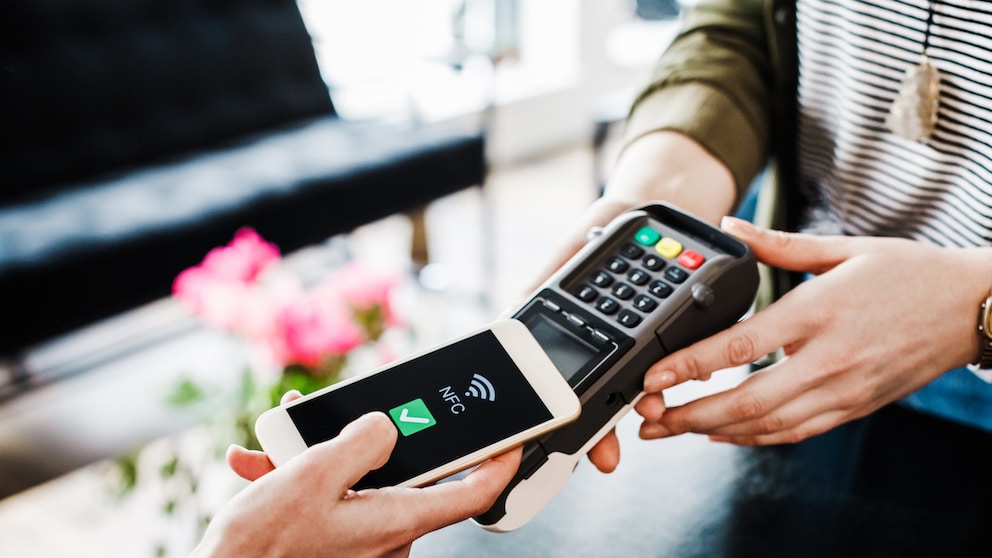
In practice, this means: The cashier enters the amount into the payment terminal and initiates the payment. The buyer then only needs to hold their smartphone close to the payment terminal–just like with contactless card payments. After the payment is completed, a visual or acoustic signal indicates that the money has been debited from the account.
Behind the scenes, a coiled antenna in the payment terminal generates an electromagnetic field. Through inductive coupling, the data from the NFC chip can now be transmitted. This usually results in instructions for the receiving device, such as establishing a data connection, executing the payment order, or opening a website.
Also interesting: What is (e)SIM-Swapping and how can you protect yourself?

What data is stored on bank cards and credit cards, and where is it stored?

Why Signatures Are Nearly Obsolete in Card Payments
Fraudsters in a Crowded Subway?
In general, paying via NFC is very secure. To disrupt the payment process at the checkout, a third party would have to bring a reader conspicuously close to the card or smartphone. Conspicuously close means at least twenty centimeters. The transmitted information is also encrypted, so it doesn’t necessarily benefit the fraudster. Therefore, you don’t need to worry about data theft during payment, whether by card or smartphone, as long as you follow common security rules. These include regular updates and a secure internet connection for smartphones.
But what about unauthorized transactions? Is it possible for a fraudster to secretly initiate a debit via NFC, for example, if you carry your smartphone or wallet in your pocket on a crowded subway? The answer is yes and no. At least in theory, fraudsters could initiate a debit with a reader. In practice, however, they would need to get very close to the NFC chip with their reader (e.g., a smartphone). Additionally, many payment providers have set a limit between 25 and 50 euros. For larger debits, a second verification, such as entering a PIN, is required.
In practice, this form of fraud is therefore very unlikely. Incidentally, transactions usually automatically abort if multiple NFC chips are near the reader. So if you have several NFC-enabled cards in your wallet, you should be on the safe side. If you still feel uneasy, you can secure your cards or smartphone with an RFID protective cover.
For virtual cards, it also applies: At least Android users can turn the NFC function on and off at will. However, this requires an additional step at the supermarket checkout before payment works. If that’s too cumbersome, but you still want to be safe, you should instead avoid the function that allows NFC payments even when the screen is locked. If the smartphone is stolen or lost, it cannot be used for payment when locked.
Ticket, Door Opener, eID
NFC chips are now common in various cards. These include office and hotel room key cards, as well as health cards, tickets, and even library cards. The electronic ID card also has NFC functionality and can be read by a home smartphone. In theory, this enables a range of practical online functions such as identification, vehicle registration, and access to pension information.
But the use of virtual tickets and key cards stored on smartphones is also steadily increasing. Through NFC, tickets can not only be paid for but also issued virtually. Manual ticket validation is then unnecessary. Visitors or customers simply place their smartphone on a reader at the entrance and are registered as present. Additionally, event organizers can send current messages or event information to the ticket holder’s smartphone via electronic tickets. By the way, wireless charging of smartphones and similar devices also works via NFC. With NFC tags, you can also make your home a bit smarter.