

March 16, 2024, 7:33 am | Read time: 4 minutes
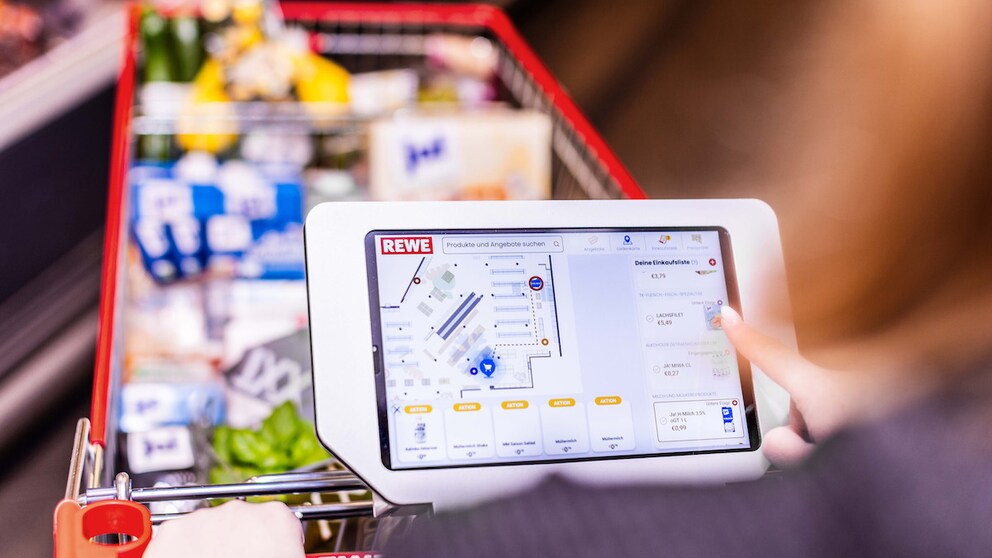
Are you one of those people who likes to be inspired by the displayed offerings at the supermarket? Or do you shop with a specific purpose–perhaps with a list? In both cases, Rewe aims to enhance the shopping experience with a new digital shopping cart. Developed by an Israeli tech company, the “shopping companion” is currently in the testing phase, appearing as a tablet on the physical shopping cart. TECHBOOK explains the background.
Even in your regular supermarket, there are times when you can’t immediately find a product you’re looking for. Wandering through the aisles and possibly wasting time? Rewe, the grocery retailer, apparently doesn’t want to subject its customers to that anymore. A digital shopping cart in the form of a tablet is designed to guide them to the products–and do much more than that.
What can Rewe’s digital shopping cart do?
“Efficient product search, navigation through the store, and personalized product suggestions”–these are the core competencies of Rewe’s digital shopping carts, which are already in the testing phase. More details can be found in a recent press release.

The technology behind the tablet, briefly called Catch in the release, is based on artificial intelligence (AI) and comes from the Israeli company Catch Retail. Based on the products searched for, the digital shopping cart “understands” what the customer likes and not only helps them find these items but also suggests others that might be of interest. Shoppers don’t have to laboriously type in their shopping list–according to Rewe, they can simply scan it. A camera on the back of the tablet recognizes barcodes and even handwritten notes.
Also interesting: Netto tests unlocking shopping carts via app

Will Shopping Carts Soon Only Be Unlocked With Smartphones?

Are Supermarkets Getting Rid of Self-Checkout Lanes?
Real-time data for improved service offerings
The whole system is intended to save customers time and create an “intuitive shopping experience.” While offline shoppers have traditionally been drawn to the same offers, Catch goes beyond these typical options–”it rethinks the shopping experience,” says Catch Retail CEO Shlomi Dayan. “Our AI-based platform personalizes retail by considering individual preferences, creating unprecedented convenience and efficiency in the shopping process.”
Customers need not worry about their data, which is not stored permanently anyway. Personal information (such as names and ages) is not required to unlock the tablet. However, the information provides the store with “better insights” in the short term, which can be used for expanded service offerings in the future, explains a store manager at the Rewe location in Cologne-Bickendorf, where Catch is currently being tested as a pilot project.
No more contact with employees desired?
Still, the question remains: why? After all, few people who shop offline do so to fiddle with a technical device. And constant product suggestions can already be annoying in an online-driven world. On the other hand, it could certainly enhance a menu if the digital shopping cart suggests additional items based on the main components of a dish, which might even be on sale.
TECHBOOK sees the product search similarly ambivalently. As mentioned at the beginning, customers could simply ask a “real” employee. In the Cologne store, employees are “always approachable on the floor–and that will remain so,” according to Rewe. It can’t be any other way: even the use of self-service checkouts, which have been around for some time, still regularly requires assistance from trained store staff. It’s also likely necessary to keep an eye on the proper handling of the devices.
It remains to be seen how the project will be received. This will likely determine whether it will be rolled out across the rest of Germany.