

February 12, 2024, 8:04 am | Read time: 7 minutes
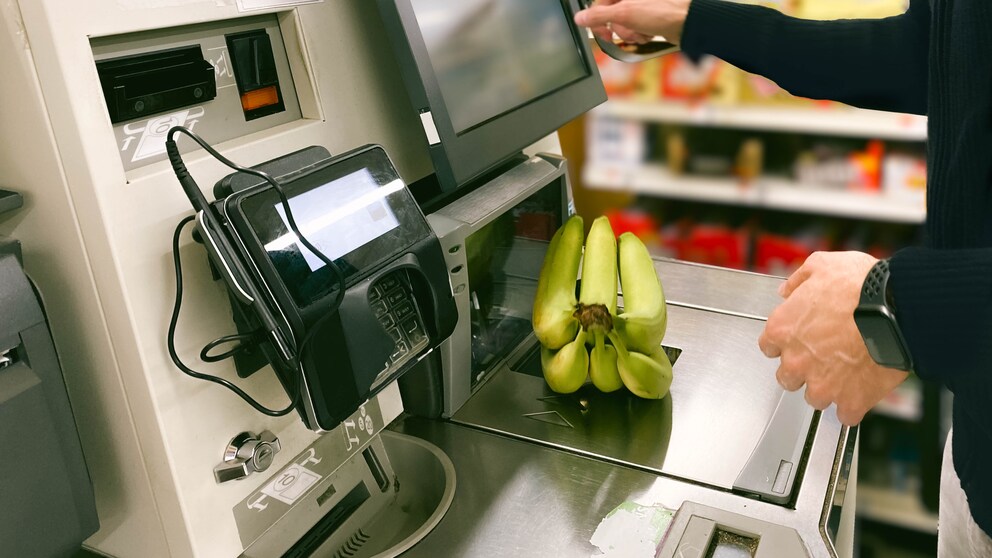
So-called self-checkouts (SCO) are primarily used in supermarkets in major cities. The idea: Instead of lining up at a traditional cashier, customers can scan and pay for their items at terminals themselves. All major supermarkets in Germany have these stations widely available. However, there is also criticism of these checkouts, especially abroad. What is the reason for this, and does it affect self-service checkouts in supermarkets here?
Self-Service Checkouts in Supermarkets Offer Advantages
Lines at supermarket checkouts are a daily occurrence for many. Especially during peak times, the congestion in stores can be significant. Calls for another open checkout quickly arise–if that’s even enough. A solution to this is the aforementioned self-checkouts.
These are intended not only to widen the bottleneck at the checkout but also to relieve staff. Many supermarkets, as well as drugstores, hardware stores, and various other retail businesses, have introduced self-service checkouts in recent years. Often, a dual approach is taken. In addition to SCOs, there are still regular checkouts. This allows customers to choose where they prefer to line up.
Self-service terminals have also been significantly expanded abroad. However, reports are currently increasing that many companies are returning to traditional checkout operations.
Major Stores in the U.S. and UK Report Problems
The BBC (British Broadcasting Corporation) currently reports that Walmart, Dollar General, and Booths are dismantling some stations. This is under the title: “The Spectacular Failure of Self-Checkout Technology.” It sounds like quite a disaster. But what’s behind it?
Primarily, it’s likely due to disappointed expectations. Often, the terminals don’t work properly or aren’t as intuitive to use as expected. Many customers need help operating them, so staff aren’t relieved, and higher costs arise. And there’s another problem: theft.
Companies like Dollar General now want to counteract this. One step is to hire more staff for the checkout area and reduce the number of self-service checkouts. Another consideration is to introduce a limit on the number of items at the SCOs or–if already in place–to reduce it.
Also interesting: Rewe tests new digital shopping carts

Kaufland’s K-Scan Aims to Fundamentally Change Shopping

Aldi Nord Tests New Payment System
How German Supermarkets Are Faring with Self-Service Checkouts
In Germany, these problems don’t seem to exist. According to a 2020 survey by the EHI Retail Institute, SCOs had no significant impact on inventory discrepancies. And while there is talk of dismantling self-service checkouts in the U.S. and UK, there’s no such talk here. On the contrary.
Systems where customers can scan their items themselves are on the rise. There are three main variants. The classic self-service checkouts, as seen in many places. Additionally, there are increasingly hand scanners provided by the stores or even apps, allowing customers to scan items with their phones.
Growing Adoption and Customer Acceptance
General customer acceptance for self-service checkouts in supermarkets and other stores is also growing. Parallel to this, the number of stores with such systems is increasing. More and more are also adopting a so-called self-scanning system. This includes offerings like the K-Scan at Kaufland or the Scan&Go function at Rewe and Edeka. Customers can scan their purchases directly with a handheld device when they want to place the product in the cart. Some carts even have this function built-in.
The positive impression is confirmed by the markets upon request. Rewe spokesperson Thomas Bonrath told TECHBOOK: “In more than 850 Rewe stores (out of 3,800 nationwide), there are now self-checkout stations. Installation is strictly location-specific, where it makes sense. Especially in city supermarkets, there is a high demand for these express checkouts to pay for purchases (usually a smaller number of items) more quickly and avoid standing in line.” According to Bonrath, there are Rewe supermarkets where, on average, every second customer completes their purchase at a self-service checkout. This is strongly dependent on factors like customer structure and location. For theft prevention, they still rely on personal supervision of the SCOs by staff. Additionally, Rewe employs control routines and exit gates.
Also interesting: What is the best payment method for online shopping?
Scan Systems for Customers as an Efficient Solution
The location-specific sensibility was also emphasized by Edeka and Kaufland upon request. Key factors include location, customer structure, and the structural conditions on-site, explained Kaufland company spokesperson Michael Strotthof to TECHBOOK.
Due to the cooperative structure at Edeka, regional operators are free to design their markets independently in this regard. A company spokesperson also stated: “We are specifically focusing on technological innovations to continuously improve the shopping experience for our customers. This includes new solutions for faster payment processes. Numerous Edeka stores already have numerous self-service or self-checkout (SCO) stations in use, as well as smart shopping carts and other mobile solutions with our Edeka app.”
Kaufland indicated similarly positive experiences upon inquiry. Since 2015, they have relied on self-service checkouts in selected branches alongside traditional staffed checkouts. These are thus “an additional service and offer a quick and contemporary alternative, especially for small purchases.” Customer feedback has been very positive, Strotthof emphasized to TECHBOOK. Therefore, they are gradually expanding the offering.
There is also no longer a shift in age groups. “We increasingly find that older people also like to use self-service checkouts. They can pack their purchases at their own pace and don’t have customers standing directly behind them. They can also pay with cash at the self-service checkouts, which is important to them.” Currently, there are self-service checkouts in more than 170 Kaufland supermarkets nationwide. In the respective branches, about 40 percent of customers use the SCOs, according to Strotthof. In about 70 branches, the previously mentioned K-Scan is also available, which is linked to the use of self-service checkouts. “Our experience so far: Those who have tried K-Scan once usually stick with it. The reuse rate is very high, especially for large weekly purchases,” said the company spokesperson.
Do the Current Developments Affect Germany?
Looking at the problems reported mainly from the U.S., the following is noticeable: Many of them do not apply to Germany. Because self-service checkouts have been used in supermarkets there for much longer, a different level of familiarity has developed. Among other things, this led to staff reductions, which are now lacking. Todd Vasos, CEO of Dollar General, himself concluded: “We have become too dependent on self-service checkouts in our stores.” Instead of primarily using the SCO terminals, they should be more of an alternative, according to Vasos. This aligns with the approach many companies here are taking.
There, self-service checkouts are more of an addition for customers with smaller, hurried purchases. In complicated cases, such as large purchases or redeeming coupons or returns, customers tend to prefer staffed checkouts. Alternatively, most supermarkets have enough staff available to resolve any issues at the self-service checkouts. Complaints about increased theft rates are also rarely heard in this context here.
Therefore, it is not expected that the current strategy in Germany will change; on the contrary. One can rather expect an increase in the number of self-service checkouts in supermarkets. However, this should not affect staffing needs. As Thomas Bonrath from Rewe told TECHBOOK: “Like every industry, the grocery retail sector faces the challenge of a shortage of skilled workers (…). Assuming customer acceptance, digitization can take over simple to monotonous tasks in the supermarket, allowing employees to focus on more demanding, complex, and customer-oriented tasks.”