


August 28, 2025, 6:44 am | Read time: 3 minutes
In digital everyday communication, emojis and emoticons are indispensable. But don’t the terms mean the same thing? That’s actually not the case.
The written—or more precisely, typed—word is no longer enough for many in today’s connected world. To aid expression, people often use emojis or emoticons. TECHBOOK explains the difference between these similar terms.
Emojis and Emoticons Are Not the Same
Essentially, emojis and emoticons provide an additional stylistic tool in digital communication to express thoughts and especially emotions. When plain words seem too dry or even misleading in certain situations, symbolic representations offer a solution. Many also use them out of convenience.
This is the commonality between emojis and emoticons: Instead of describing laughter with the verb “laugh” or an expression like “ha ha,” both use alternatives meant to be understood visually. However, while emoticons remain at the level of punctuation marks, emojis function graphically.
Emoticons Are Characters as Symbols
Emoticons are thus the spiritual predecessors of emojis. The term combines the English words “emotion” and “icon” and describes the symbolic use of various key combinations.
The most well-known example is the smiley, which can appear as a sideways smiling face in the form of “:)” or “:-)”. Emoticons are a mix of image and text, as they use common characters and punctuation marks like colons, hyphens, or parentheses.
The use of typographic symbols as a pictorial expression of emotions dates back to at least the mid-19th century. At that time, Morse code was occasionally used in a similar way.
The modern digital version based on ASCII characters, however, traces back to a message in an old computer messaging system by Scott Fahlman, a U.S. computer science professor. On September 19, 1982, he proposed “:-)” and “:-(” to indicate irony or seriousness in text messages.
Also interesting: What the Heart Colors Mean on WhatsApp

Key Chat Abbreviations You Should Know
Many People Always Use These Emojis Incorrectly!
Emojis Are the New Standard from Japan
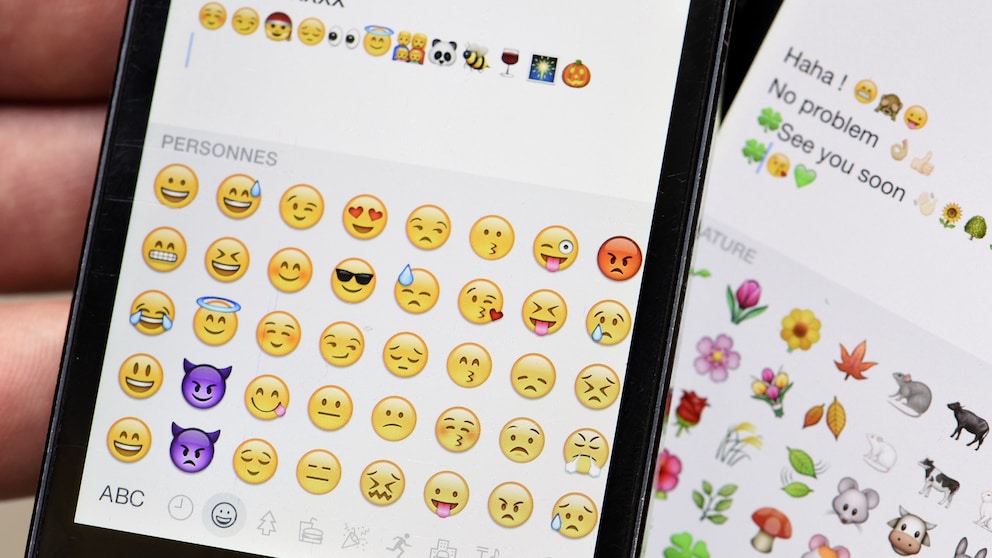
The relationship between emojis and emoticons is evident not only in their shared digital communication function. In fact, many modern programs and applications now automatically convert the latter into the former. For example, the emoticon “:)” becomes a small graphic of a smiling face “🙂”—an emoji. These visualizations can cover a wide range of topics: emotions, food, animals, weather, objects, and places can be represented succinctly.
Unlike their Western counterparts, these come from Japan. The word is a combination of the sound “e” for picture and the word “moji,” which means character. The similarity between the words emojis and emoticons is purely coincidental. When exactly they began and who is responsible is unclear due to differing opinions and poor records from the early days.
The earliest emoji set is considered to be the one found on the mini-computer PA-8500 by Sharp. The device was launched in 1988. The Japanese Shigetaka Kurita is often credited as the inventor of modern emojis, as his designs from 1999 proved highly influential. However, he has disputed this designation in the past.
Where Do Emojis Come From and What Do They Really Mean?
While emojis and emoticons can essentially express the same thing, there’s more to consider with the small graphics from Japan. In fact, you’re probably using these emojis wrong. It’s best to familiarize yourself with their true meaning and test your newfound knowledge in our Emoji Quiz. You might not have known where emojis come from either.