


April 16, 2026, 12:34 pm | Read time: 4 minutes
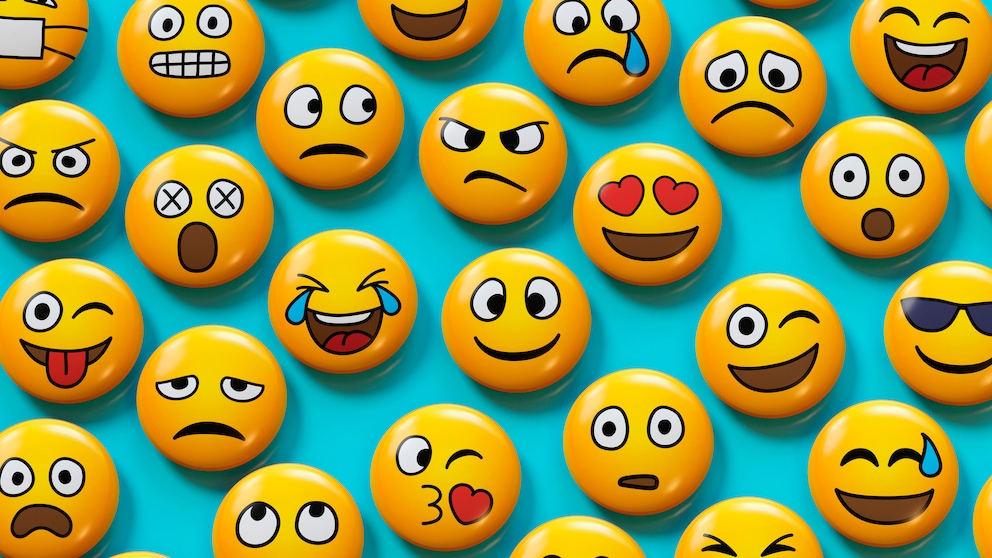
Everyone knows and uses them–emojis. But how long have these small symbols been around, which can express almost every emotion today? TECHBOOK takes a look at the origins of these symbols–and they go incredibly far back.
Laughing with tears, giving the okay, closing eyes, or showing a flag: More than 3,600 emojis are now available for digital communication. The selection on topics like food on WhatsApp and similar platforms now resembles an all-inclusive buffet.
Initially Just Eyes and Mouth
At the beginning, things looked quite different. But where exactly does it start? The New York Museum of Modern Art (MoMA) prides itself on owning the “original” collection of emojis. In 1999, designer Shigetaka Kurita created 176 pictograms for the Japanese mobile provider NTT Docomo–including zodiac signs, hearts, and weather phenomena.
The faces, with their unmistakable manga comic influences, consisted only of eyes and mouth–without a circle. Only a burger could be served, and the digital zoo had just two cats roaming. However, the arrow symbols “Soon” and “End,” still known today, were already included.
“Simple, elegant, and concise,” writes MoMA about the 12 by 12 pixel symbols. “Kurita’s emojis planted the seeds for the explosion of a new visual language.” The word “emoji” comes from the Japanese characters for “e” (picture), “mon” (expression), and “ji” (letter).
What Is the Difference Between Emoji and Emoticon?
Many People Always Use These Emojis Incorrectly!
Worldwide Triumph Begins
Initially, Kurita’s tableau was only available in the Far East. It wasn’t until more than a decade later that the pictograms began their worldwide triumph. In 2010, emojis finally secured their place in Unicode, the standard for digital encoding. Hundreds of symbols were already available, landing on Apple and Google phones, platforms like Facebook and Twitter–and have been multiplying ever since. A Unicode committee regularly gives a thumbs up or down when it comes to adding new symbols.
Even though designer Kurita’s influence on today’s emojis cannot be underestimated, the origin goes back further. At a developer conference in 2016, programmer Mariko Kosaka recalled the Japanese telecommunications company Softbank. Its pager, released on Nov. 1, 1997, already featured 90 icons, including the legendary poop emoji.
Delving deeper into digital archaeology, one encounters sideways smileys that can be created using a standard keyboard. “I propose the following character sequence for joke markers :-),” recommended Scott Fahlman from Pittsburgh on Sept. 19, 1982, to simplify communication. “It was a bit silly,” the U.S. professor later said in an interview. “It was ten minutes of my life.” Fahlman is considered by many as the forefather of digital smileys.
Are You an Emoji Expert? Take the Test!
Did Lincoln Use Emojis?
But much earlier, a “;)” can be found–in 1862 in the “New York Times.” In a speech by President Abraham Lincoln, the newspaper printed “(applause and laughter ;)” as the audience’s reaction. A typo? Experts note that newspaper texts at the time were set from individual matrices, making errors unlikely. In this context, historians examined how semicolons and spaces were used in the mid-19th century. There is no consensus on whether the Lincoln text truly represents a wink.
And now a big leap into the past: In Turkish Karkamis near the Syrian border, Italian researchers unearthed an almost 4,000-year-old clay jug from the Hittite period. On it: two eyes and a curved mouth. The find is considered the oldest known smiley. As lead archaeologist Nicolò Marchetti noted in 2017, the vessel was intended for a sweet fruit drink.
It becomes clear: Emotions have been translated into symbols since time immemorial. Kurita’s 176 symbols have left perhaps the strongest footprint in our digital communication. Today, there is hardly an emotion, facial expression, or gesture that cannot be depicted. The calendar emoji was not designed by the Japanese creator. Nowadays, the symbol shows July 17–also known as World Emoji Day.