


September 9, 2025, 8:18 pm | Read time: 4 minutes
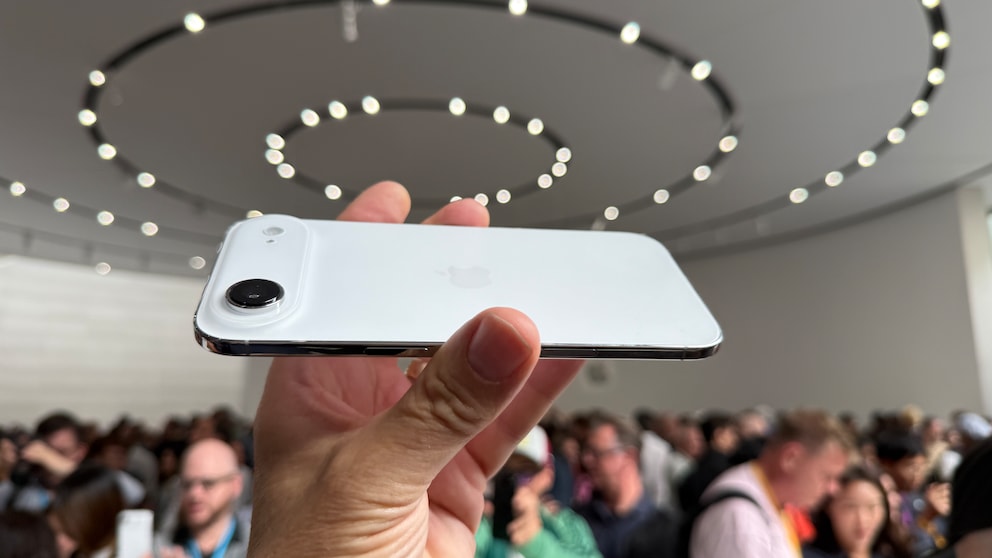
To boost the somewhat disappointing recent iPhone sales, Apple has introduced a completely new model: the iPhone Air. Super thin, super elegant, super impressive–at least from a technical standpoint. But this isn’t a tech demo; it’s a finished smartphone intended for buyers. However, for what it offers, it’s hopelessly overpriced.
The Air is supposed to offer customers something novel, with features like lightweight and ultra-slim casing. However, the design requires compromises. It mainly brings technical limitations, but I also have issues with the aesthetics.
Thin Air, hefty price
TECHBOOK extensively reported on the rumors about the iPhone Air beforehand. So, what Apple ultimately presented at the September event was nothing new to me. I had already expressed my opinion on the flaws in the Air’s design. However, the price wasn’t known then–and the iPhone Air’s price is quite something.
With a price tag of 1,199 euros, the new smartphone hits the market. That’s the exact same price Apple charged for the iPhone 16 Pro. Sure, the Pro had only 128 gigabytes of storage, while the Air has 256 GB. But it has two fewer cameras. A single camera for 1,199 euros? For a smartphone that Apple claims comes “with Pro Power,” that’s unacceptable. The currently cheapest model, iPhone 16e, costs 699 euros and has only one camera. That might be acceptable for the price, but for nearly double?
iPhone Air, Watch Ultra 3, AirPods Pro 3 – Highlights of the Apple Event

Apple Unveils iPhone 17 Pro and Pro Max: All the Details at a Glance
iPhone Air faces strong competition–from Apple itself
For many, the iPhone has become a camera replacement, which is why most models now have two or even three different lenses. For the iPhone 17 Pro, Apple explicitly lists eight different focal length options, ranging from ultra-wide to main camera to telephoto lens. The Air offers one and two times zoom–no ultra-wide option, which is standard even in the 250-euro cheaper iPhone 17. Dramatic city and landscape shots or artistic portrait shots are thus not or only limitedly possible.
The Air has received a camera island that Apple calls a “plateau.” The justification for the thick strip spanning the entire width of the casing: Besides the camera, it houses the A19 Pro chip and other system components that require more space. This is supposed to leave more room for a new “high-density” battery in the rest of the casing. According to Apple, this enables 27 hours of battery life. Far from the 30 hours in the iPhone 17 and the 37 hours in the 17 Pro Max.
Read also: iPhone 17 Air, Watch Ultra 3, AirPods Pro 3–the highlights of the Apple event
The camera strip itself isn’t a problem. However, other manufacturers like Google solve the design better. The lenses don’t protrude further from the strip but are flush with it. Sure, integrating the 48-megapixel camera into the super-slim, 5.6 mm thick casing is challenging. But Apple has a gigantic budget–a mere 30 billion U.S. dollars–for research and development. Shouldn’t more be possible?
For 1,199 euros, Apple delivers too little
Aside from the A19 Pro, there’s not much “Pro” about the iPhone Air. Now that even the 17 ProMotion with 120 hertz, Always-On, and 256 GB storage are standard, the Air can’t stand out with that. For me, it’s not really worth the extra cost. Especially since the iPhone 17, with its two cameras, offers more in an area that is more important to users than more performance. The A19 is also more than sufficient for gaming, and there’s more battery life to boot.
The iPhone Air is an interesting design study on how much technology can fit into a small space. Perhaps its novelty will pique the interest of some buyers. However, I can’t imagine it appealing to the masses. Those who want to spend their hard-earned money wisely should avoid the iPhone Air and instead invest in the iPhone 17. Or pay 100 euros more and get a future-proof iPhone 17 Pro, whose camera will still hold up in five years.