

September 15, 2025, 6:26 am | Read time: 5 minutes
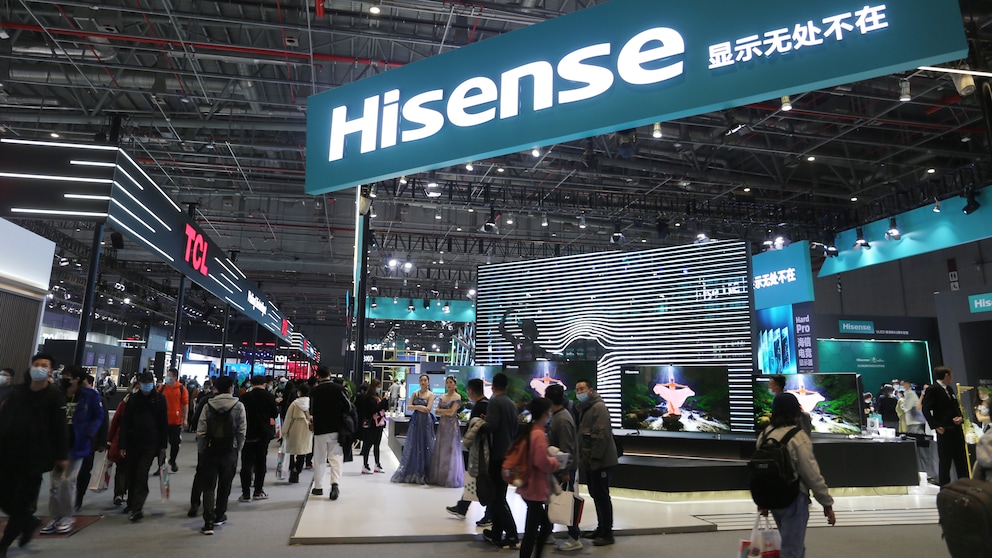
When the name Hisense appeared with the slogan “#Feel Everything” during the 2016 UEFA European Championship in France, some might not have realized what was being advertised. Today, less than ten years later, Hisense is already a household name, even in Germany.
According to a report released in early July 2025, the Chinese electronics company Hisense has ranked eighth for the ninth consecutive time in the Top 10 of the “Kantar BrandZ Chinese Global Brand Builders.” This ranking of the 50 Chinese brands with the highest global brand value is compiled annually by Google and Kantar, the world’s leading marketing analysis company.
Hisense is now one of the largest TV manufacturers worldwide. According to Omdia, a consultancy specializing in the technology sector, it ranked second globally in TV shipments from 2022 to 2024 and first in the segment of televisions with a screen size of more than 100 inches.
The company has rapidly expanded and now operates in more than 160 countries. It specializes in multimedia products, household appliances, and smart IT information. Brands like LG, which was long the number two behind Samsung, as well as former Japanese market leaders like Sony, Panasonic, or Sharp, have long been surpassed, likely permanently. Only TCL, another Chinese provider, can still keep up.
“Made in China 2025” Set the Course Early for the Rise
Hisense was founded in 1969 under the name Qingdao Number 2 Radio Factory in Qingdao. But how did a local radio manufacturer with few employees become a global electronics corporation in such a short time? The story of Hisense is not unusual for a Chinese company. Whether it’s cars (such as Byd, MG), motorcycles (such as CF Moto, Voge), smartphones (such as Xiaomi, Honor), or consumer electronics (such as Hisense, TCL)—Chinese manufacturers have quickly caught up technologically with competitors from Japan/South Korea, the U.S., or Europe, and in some cases, even surpassed them.
“Chinese companies are entering industrial sectors where Germany was long a global leader,” the “Handelsblatt” recently judged. The Chinese government set the course for this rapid rise about ten years ago with the state-controlled industrial strategy “Made in China 2025,” according to the business newspaper.
But back to Hisense. After producing radios for ten years, the company merged with other electronics manufacturers in 1979 and was renamed Qingdao General Television Factory. In 1994, another and final name change followed, giving birth to Hisense. Three years later, in April 1997, the company’s shares were traded for the first time on the Shanghai Stock Exchange under the official name Hisense Electrical Co. Ltd.
Read also: How to Find the Ideal TV Size for Your Home
How Germany Became the Cradle of TV Sets–and Nearly Lost It All
Is LG Disappearing From the TV Market?
Soccer Made Hisense World-Famous
In the following years, Hisense developed into a globally operating technology company. Just in time for the 2006 FIFA World Cup, it partnered with the Hanover-based company Quadral, which introduced Hisense TV sets to the German market for the first time. In 2008, the company acquired the home appliance manufacturer Whirlpool, and in 2018, it purchased 94 percent of the shares in Slovenian Gorenje, also a manufacturer of refrigerators, washing machines, etc., for 293 million euros.
Speaking of soccer: Hisense recognized early on the importance of sports sponsorship for successful market positioning outside Asia and has relied on the appeal of soccer since the mid-2010s. And at the highest level. In 2016, Hisense became the first Chinese company to sponsor a UEFA European Championship. The aforementioned slogan “#Feel Everything” made the company widely known in Europe.
Because it worked so well, the company decided to sponsor the subsequent European Championships in 2020 and 2024 in Germany. They were convinced that what succeeded in Europe would also work in other markets. Thus, Hisense also sponsored the 2018 FIFA World Cup in Russia and the 2022 World Cup in Qatar. The first-ever FIFA Club World Cup, held in the summer of 2025 in the U.S., also saw the company as a sponsor. For Jia Shaoqian, Chairman of the Hisense Group, this “meeting of excellence perfectly aligned with the goal of further elevating the company and brand to world-class status.”
“Clarity in the Moment of Truth” with Manuel Neuer
Since EURO 2024, none other than German record goalkeeper Manuel Neuer has been serving as a brand ambassador to increase visibility and reach. And Neuer delivered. Hisense’s brand awareness increased by 15 percentage points during the 2024 European Championship, according to brand consultant Valicon Brand Research. This was something to build on, enthused Sühel Semerci, Executive Vice President of Hisense Gorenje Germany GmbH, at the International Consumer Electronics Fair (IFA) in Berlin in the fall of 2024.
“With Manuel Neuer as the face of the brand, we offer excellent recognition,” said the European Vice President of Hisense. “Clarity in the Moment of Truth” is the motto of the elaborately produced commercial, which aims to associate the brand with attributes of top performance, success, and excellence. And if the above-mentioned figures from Omdia are taken as a benchmark, the campaign can indeed be considered “successful.”