

April 22, 2024, 6:11 am | Read time: 5 minutes
A series of strange symbols accumulate in the smartphone’s status bar. TECHBOOK provides an overview of what LTE, E, 5G, and others actually mean next to the mobile signal bars.
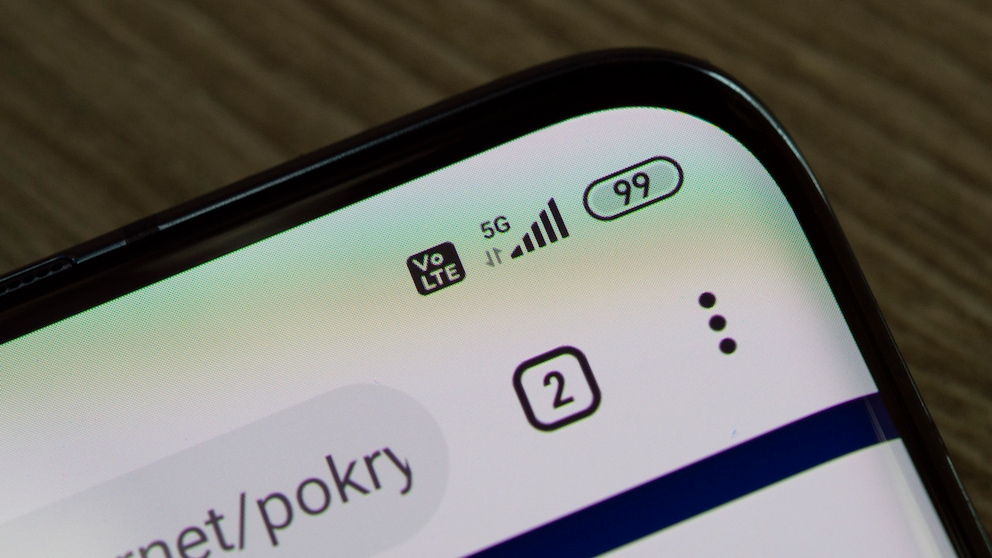
In the smartphone’s status bar at the top of the display, various symbols and notifications accumulate. Depending on the smartphone and operating system, a combination of numbers and letters such as 5G or LTE usually appears next to the mobile signal icon. These indicate the mobile standard the smartphone uses to connect to the respective mobile network and provide information about the speed of the mobile internet (as long as your internet connection is not throttled). TECHBOOK provides an overview of what each term means.
Overview
Relics from the 2000s
Admittedly, not everyone will remember the terms UMTS, HSDPA, and HSDPA+. UMTS (Universal Mobile Telecommunication System) refers to one of the third-generation (3G) mobile standards and was widely available in Germany since 2008–around the time the first smartphones hit the market. HSDPA (High Speed Downlink Packet Access) and its evolution HSDPA+ are the next stages of 3G.
The goal of HSDPA was to enable DSL-like speeds in the UMTS mobile network. On most smartphones, the technology was abbreviated with an H. Only on Apple’s iPhones was 3G still displayed–the higher speed was available regardless of the designation. HSDPA+ even allowed for double the download rate.
Initially, the download rate was 384 Kbit/s (kilobits per second), which increased to 7.2 Mbit/s with HSDPA and finally to 14.4 Mbit/s with HSDPA+. For comparison, today’s 5G mobile standard allows–ideally–a download speed of up to 10 Gbit/s. The 3G network was finally shut down in Germany in 2021.
5G standard is not yet for everyone
Currently, about 91 percent of the country is covered by at least one network operator with 5G. The operators include Telekom, Vodafone, and O2, as well as 1&1, which has a smaller coverage area. However, just because 5G is available doesn’t mean all users can access the modern standard. A 5G-capable smartphone and a corresponding plan are required.
The first 5G-capable smartphones appeared in 2019 and have since become standard among major device manufacturers. Network operators have also integrated 5G into most of their plans. However, third-party providers that use the networks of Telekom, Vodafone, and O2 often charge an extra fee if the plan includes 5G access–if they offer 5G at all.

How Do I Know if My Smartphone Is Operating on a 5G Network?

How Does a Mobile Network Actually Work?
What is correct – 4G or LTE?
If you don’t have a 5G-capable smartphone or are in an area with poor coverage–which can happen on some train routes–you’ll see the letter combination LTE next to the mobile signal bars in the status bar. This abbreviation, much snappier than HSDPA, stands for Long Term Evolution, which network operators have been working to spread widely since 2011. With LTE, data transfers of up to 100 Mbit/s are possible. LTE Advanced is an extension of LTE and allows data transfers of up to 1 Gbit/s.
In everyday language, LTE and 4G are often used interchangeably, but there is a fine distinction between them. 4G refers to the international mobile standard established at the World Radiocommunication Conference in Geneva in 2012. LTE, on the other hand, is the mobile technology that was initially only available from network operators Vodafone, Telekom, and Telefónica Germany (O2). Only with the shutdown of the UMTS network did budget providers include the LTE network in their offerings. In the smartphone’s status bar, the terms LTE and 4G are often used synonymously and mean the same thing in this context: a solid internet speed.
2G and Edge
GSM, also known as 2G, is the technical foundation for telephone networks in Germany and dates back to the 1990s. GPRS refers to a data transmission technique in the GSM network. GPRS stands for General Packet Radio Service, and GSM stands for Global System for Mobile Communications. On smartphones, this standard was displayed as G or 2G and represents the slowest level of mobile internet.
Data is transmitted at a maximum of 55.6 Kbit/s. A one-minute voice message on WhatsApp is about 200Kb in size. The speed is comparable to earlier ISDN connections. Unlike 3G, the 2G network is still active in Germany. In fact, there are even three 2G networks from different providers. However, for mobile browsing, 2G is almost irrelevant today.
EDGE refers to a technology for increasing data transmission in the GSM network. It is abbreviated with an E. With a maximum transmission rate of 236.8 Kbit/s, the speed is sufficient for browsing mobile websites with few images. The speeds indicated for each mobile standard are usually only achievable under ideal conditions. Depending on the distance to the nearest cell tower and the number of devices connected to the internet nearby, the speed can be significantly slower.
While in some parts of Germany people still stare desperately at the frozen loading bar, science and industry are already working on the next generation, 6G. The new standard is expected to allow up to 400 Gbit/s and be deployed in Germany starting in 2023.