



January 24, 2026, 8:04 am | Read time: 6 minutes
Almost nothing works without a smartphone these days. Whether for 100 euros or well over 1000 euros, not only is the choice of manufacturers vast, but especially the range of models is enormous. Things used to be different. Just a few decades ago, a cell phone was a real luxury.
Cell phones and smartphones are part of everyday life today. Almost everyone in Germany owns a cell phone. But what is taken for granted today was a real innovation at the end of the 1980s. The equivalent of today’s iPhone was known as the “bone,” and a single minute of call time was prohibitively expensive. Travel back in time with us and gain an insight into an era when mobile networks were just being set up in Germany, and mobile telephony was still in its infancy.
Overview
The Beginning: Phones From the Car or Suitcase
Public mobile phone networks have existed in Germany since the 1950s. The analog A network was introduced by Deutsche Bundespost in 1958 and existed until 1977, when calls still had to be switched manually. The A-network was compatible with car telephones, which weighed about 35 pounds and were priced similarly to half the cost of a car.
Users were able to dial their own telephone number for the first time in 1972 with the introduction of the B network, although this was not yet cellular. Callers, therefore, had to assign their location to one of the 150 existing zones, each of which had a diameter of up to 150 km. The B network also allowed mobile telephony abroad for the first time, although this was limited to the Netherlands, Luxembourg, and Austria.
A few years later, in the 1980s, the C network followed, heralding the beginning of classic cell phone use. The first manufacturers, including Motorola as a pioneer, began to develop portable phones during this time. The DynaTAC 8000X, which was approved in September 1983, is considered the forefather of today’s cell phones. It weighed just under 800 grams, had a battery life of around one hour, and cost around 4000 US dollars.
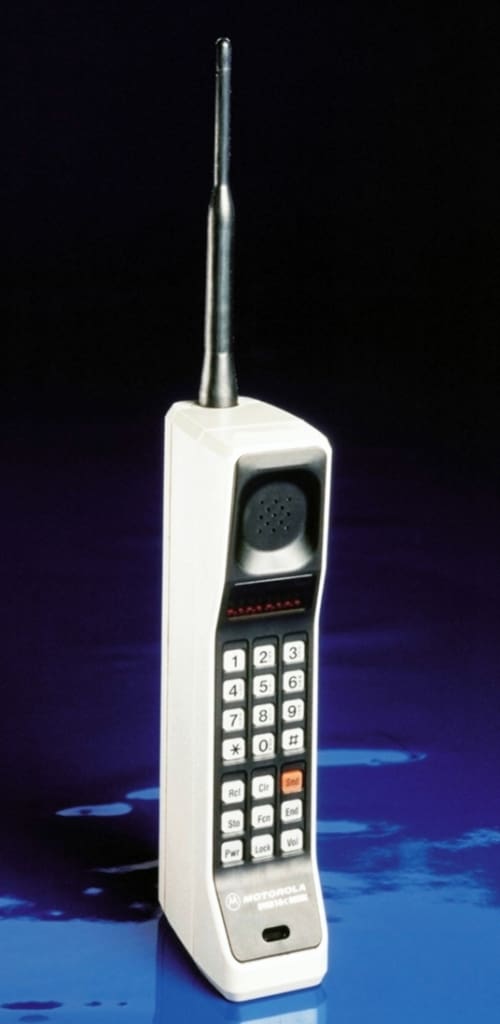
With the introduction of the C-network in 1985, users could be reached under their own number throughout Germany for the first time. Phones were no longer exclusively tied to cars, but became more portable. They came in small cases with a carrying handle, handset, and a longer antenna.
However, the real starting signal for modern mobile networks was not given until four years later with digital transmission and the introduction of the D2 network in Germany.
The First Private Mobile Network in Germany
On December 7, 1989, one topic dominated the evening news: On this day, the German government awarded the first private GSM license. This marked the start of competition against Deutsche Bundespost, which until then had had a monopoly on mobile telephony.
Many large German companies applied for the license. The contract was finally awarded to a consortium led by Mannesmann (now Vodafone Germany), which also included Cable & Wireless, DG Bank, and Pacific Telesis.
The abbreviation GSM stands for Global System for Mobile Telecommunications. In the early years, however, it was jokingly reinterpreted as “God send Mobiles!”
In 1990, the first GSM phone call was made on the D2 network, and in June 1991, trial operation began in 15 metropolitan areas. At the beginning of 1992, the D2 network was fully operational—the first private mobile network was officially launched.
The mobile network was further expanded in the following years. The D network was divided into the D1 network (operated by Telekom) and the D2 network (operated by Mannesmann Mobilfunk). The first E-category network, E-Plus, followed in 1993, and Viag Interkom (now O2) received its license in 1997.
The First Cell Phone for the Masses – the “Bone”
What was still missing in 1992 for the use of the new mobile networks in Germany were suitable cell phones. In June of the same year, the first manufacturers, including Ericsson and Motorola, received Europe-wide approvals for their devices.
On June 30, 1992, Mannesmann Mobilfunk and Vodafone launched the first cell phone for the German market: the Motorola International 3200. This model had little in common with today’s smartphones. It was also known as the “bone” because of its chunky shape. It weighed about 1.15 pounds—almost four times the weight of today’s smartphones.
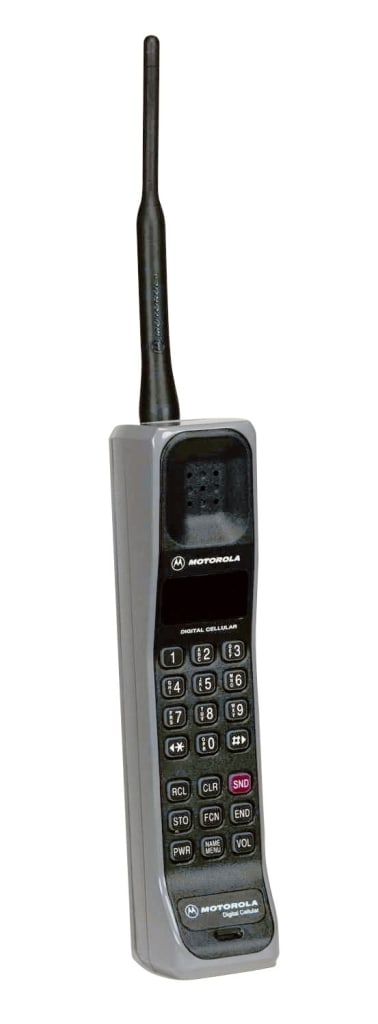
The price was also hardly comparable with today’s devices: the provider charged between 3,000 and 8,000 Deutsche Marks, which included a contract for the phone. Even Deutsche Telekom had this model in its range.
Despite its weight and price, the first cell phone enjoyed great popularity. For the first time, it enabled users to make calls on the move without having to rely on a telephone box. The first 1000 commercial cell phones were delivered in the summer of 1992 and immediately sold like hot cakes.
What Actually Happened to Mannesmann?
How Do I Know if My Smartphone Is Operating on a 5G Network?
Mobile Phone Prices Then and Now
The prices for cell phones in the 1990s are almost unimaginable from today’s perspective. The first D2 phones cost between DM 2500 and DM 3000, which was considered comparatively cheap at the time. Car phones from the C network were considerably more expensive at around DM 10,000.
With the launch of the D2 network, Mannesmann Mobilfunk wanted to make mobile telephony affordable for everyone. In 1992, customers were charged for a minute of call time as follows:
- 1.44 Deutsche Marks during the day
- 0.49 Deutsche Marks between 7:00 PM and 7:00 AM
- Monthly basic fee: 77.52 Deutsche Marks
It was also possible to send short messages via the Short Message Service (SMS) from the early 1990s.
In the years that followed, the cost of mobile telephony fell continuously. At some point, all-net flat rates became the standard, covering both call minutes and text messages at a fixed price. This made cell phone use attractive for more and more people. While there were just under 1 million mobile phone users in Germany at the end of 1992, by 1998 there were already 14 million.
Today, There Are More Mobile Phone Connections Than People
At the end of 2016, the Federal Network Agency counted around 130 million mobile phone connections in Germany—a figure that, according to Statista, will have grown to 185 million by the end of 2023. The number of mobile connections worldwide has long since exceeded the number of people. While the UN counted 8.16 billion people on Earth on July 1, the number of mobile connections at the end of 2024 was around 9.14 billion.
In Germany, network operators are constantly expanding their mobile networks. In order to create new capacity for faster and more powerful connections, they are gradually saying goodbye to outdated technologies. This not only includes the once highly praised 3G network, which was switched off throughout Germany on June 30, 2021, in favor of 5G. GSM, the basis of the first German mobile network, is also to be gradually switched off in Germany over the coming years. At the same time, new networks are also being created, such as 1&1’s own network.