


January 26, 2023, 11:10 am | Read time: 8 minutes
Anyone who goes online with their phone has likely noticed: Sometimes the internet speed is displayed as 4G, sometimes as LTE, and increasingly as 5G. TECHBOOK explains the differences and how to check if your phone is actually operating on the displayed network.
In addition to the widely used LTE plans, more and more smartphone users are opting for a 5G plan. On their device’s display, the connection is accordingly marked as 4G, LTE, or even 5G. Colloquially, the first two standards are often lumped together. However, LTE and 4G are actually two different mobile communication standards. But how exactly does LTE differ from 4G? And what exactly is behind LTE Advanced and 5G?
Overview
Mobile Internet with Gigabit Speeds
The history of mobile internet goes back a long way. As early as the 1980s, it was possible—albeit rudimentary by today’s standards—to access emails on the go with early mobile computers via the then-analog mobile network. When GSM was officially introduced in 1990, internet access via mobile phones became possible. However, the data connection was based on an inefficient and particularly slow CSD connection (Circuit Switch Data). It wasn’t until the global launch of the GSM extension GPRS in 2001 that mobile data transmission speeds reached a usable level—it was essentially the starting point for the mobile internet as we know it today. However, few could have predicted back then that two decades later, data transmissions at gigabit levels would be possible over mobile networks.
These gigabit speeds have been possible in this country since the introduction of LTE Advanced in 2014. At least theoretically. Because users have to share the available bandwidth within a cell, the maximum speeds are rarely achieved in practice.
LTE and 4G – Differences in Detail
Often lumped together by many providers for marketing reasons, many today understand LTE and 4G to mean the same thing. But in fact, the terms have different meanings:
The mobile standard LTE, short for Long Term Evolution, was first introduced in 2010 as part of the third mobile generation (3G). Thus, LTE belongs to the class that also includes UMTS and HSPA. Accordingly, it was designated as 3.9G. Initially, LTE networks allowed a maximum transfer rate of 50 Mbit/s (megabits per second), which was expected to triple to 150 Mbit/s within the next three years.
However, it wasn’t until the introduction of LTE Advanced in 2014 that the maximum possible data rates rose to the aforementioned gigabit level. LTE Advanced, also known as LTE-A or LTE+, is an extension of simple LTE and belongs to a new, fourth mobile generation (4G). Existing LTE networks could be relatively easily upgraded to LTE Advanced via software updates, but the difference between the two generations was still significant. Compared to LTE, LTE Advanced allows usable transfer rates of 1000 Mbit/s or 1 Gbit/s for downloads and up to 500 Mbit/s for uploads. The new standard supports so-called carrier aggregation, allowing network operators to use the available radio spectrum flexibly. Furthermore, the response times, known as latency times, are significantly lower, and radio cells have more capacity, allowing more users to benefit from high performance simultaneously.
In summary, this means:
- LTE in Germany does not meet the criteria for the 4G standard and is therefore technically only 3.9G—contrary to much advertising. The maximum download speed is 150 megabits per second.
- 4G stands for the fourth-generation mobile standard, introduced in 2014 with LTE Advanced, and is internationally agreed upon with various criteria. 4G is a placeholder for “International Mobile Telecommunications-Advanced.”
Meanwhile, there is also an enhancement of LTE Advanced—namely LTE Advanced Pro, also called 4.5G. This optimized level significantly boosts network performance. For example, the network operator Vodafone benefits from its plans with up to 500 Mbit/s.
Also interesting: This network operator offers the best reception

What LTE, 5G, and HSDPA+ Reveal About Mobile Internet
AVM Unveils Three New Fritzbox Models
5G – Much Faster, but Different Frequencies
But it gets even faster: The latest mobile standard is called 5G. For the first time, it separates from the previously used systems and frequencies. 5G is not easily retrofittable on existing mobile masts. The reason: the so-called “millimeter wave technology.” The 5G mobile waves are between 1 and 10 millimeters long, making them much more compressed than previous mobile waves (several centimeters). To relieve the existing network, higher frequencies between 6 and 300 gigahertz (GHz) are also used. For comparison: The current mobile network operates in the spectrum between 0.8 and 2.6 GHz.
However, there are still some obstacles to bringing the higher frequencies and shorter waves to the user:
- Since the waves can no longer easily penetrate walls and obstacles, a multitude of antennas is needed, and the radio cells must be arranged more densely.
- For fast response times under one millisecond, more antennas per cell than users are needed (MIMO).
Also interesting: Many 5G smartphones have trouble operating on 5G
However, critics fear higher radiation exposure from 5G and thus not yet calculable health effects.
How to Tell if Your Smartphone is Using 5G
To actually use 5G, the standard must be available in the region where you are located. Additionally, the corresponding device must have the technical capabilities, as well as the subscribed mobile plan. If all three conditions are met, you can check through the phone settings whether the device is now actually operating on 5G. This is possible on both Android and iOS, although the terminology differs slightly between the systems.
Here’s how to check the 5G status on Android:
- Go to the settings menu and select “Connections.”
- Then choose “Mobile Networks.”
- Afterward, you will find the relevant information under “Network Mode.”
Here’s how to check the 5G status on an iPhone:
- Go to the settings menu and select “Cellular.”
- Then open the “Data Options” or “Settings” tab.
- Then go to “Cellular Data.”
- Finally, you will find the relevant information under the “Data Options” tab.
5G Display Not Always Accurate
Meanwhile, 5G coverage has already started in many countries—including Germany. However, it often relies on 4G networks here, meaning it is not offered as a stand-alone standard (NSA, stands for Non-Stand-Alone). The real advantages of 5G—such as high speeds and low latency—are thus only available in certain expansion areas in Germany. Moreover, the expansion is often still limited to urban centers. And it brings some advantages over previous mobile technologies there:
- Theoretical speeds of up to 100 Gbit/s (100 times faster than 4G), with the fastest speed measured so far being 1.8 Gbit/s.
- Very low latency times for real-time reactions.
- Use of higher frequency ranges with simultaneously increased frequency capacity.
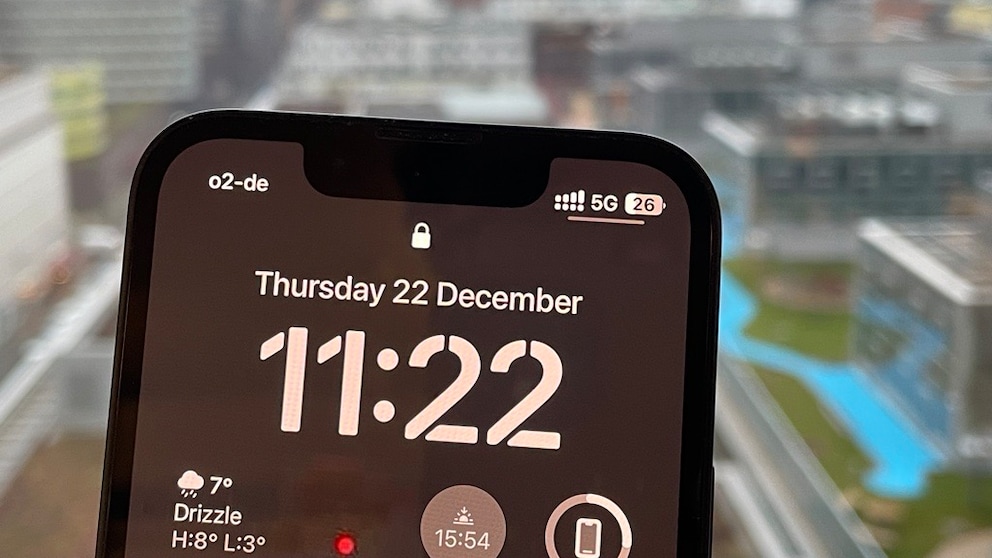
The aforementioned NSA approach can sometimes create problems and confusion for users. If the settings confirm the 5G option, a 5G symbol should also appear in the menu bar at the top of the home display. Typically, this symbol is located right next to other network information, such as which network from which provider you are using.
However, you need to be cautious with this symbol. If it says 5G, it can also mean that due to the nature of the German 5G network, components of the 4G network are still being used, which then affects performance accordingly. This display error can be caused by the mobile phone itself or by the network operators or providers.
From 1G to 5G: The Significance of Mobile Standards
Even with previous standards, there was often confusion about the designations. TECHBOOK explains what the mobile abbreviations mean:
- 5G: The fifth mobile generation is currently being expanded worldwide. In Germany, the standard is already available in more and more regions and cities. Both O2 and Telekom, Vodafone, and 1&1 offer corresponding plans.
- 4G, LTE Advanced (2014): The expansion stage of LTE marked the transition to the fourth mobile generation 4G. Download speeds of up to 300 to 400 Mbit/s and up to 1000 Mbit/s or 1 Gbit/s for uploads are possible here. At the same time, latency times were reduced, and radio capacities increased. By bundling frequency bands, a speed of theoretically up to 500 Mbit/s in downloads can even be achieved, which corresponds to LTE Advanced Pro or 4.5G.
- LTE (2010): This standard builds on the UMTS infrastructure. The first expansion stage LTE is sometimes also referred to as 3.9G and allows a maximum bandwidth of up to 50 Mbit/s (download).
- 3.5G, HSPA (2006): Extension of UMTS with bandwidths up to 42 Mbit/s.
- 3G, UMTS (2004): This mobile standard enables simultaneous sending and receiving of multiple data streams through a new radio access technology. Bandwidth: initially up to 384 kbit/s. The 3G networks in Germany have largely been shut down in favor of newer 4G/5G networks.
- 2.75G, EDGE (2006): Further development of GSM through the use of a more efficient modulation method. The first iPhone used EDGE, bandwidth: usually up to 150 kbit/s.
- 2.5G, GPRS (2001): Digital data transmission. The packet-switched technology achieves higher bandwidths by bundling multiple GSM channels, primarily up to 55 kbit/s.
- 2G: Digital voice transmission in the D-Netz (1992) with the internationally successful GSM standard. Transmission is circuit-switched, bandwidth: 9.6 or 14.4 kbit/s. With the D-Networks, the Federal Post Office gets its first private competitor (D2 Mannesmann).
- 1G: Mobile telephony in the first generation still worked with analog voice transmission: A-Netz (1958), B-Netz (1972), and C-Netz (1986). In the A-Netz, connections had to be manually switched. From the B-Netz, participants could dial themselves. The C-Netz could hand over active radio connections when changing a radio cell.