

July 10, 2023, 10:49 am | Read time: 5 minutes
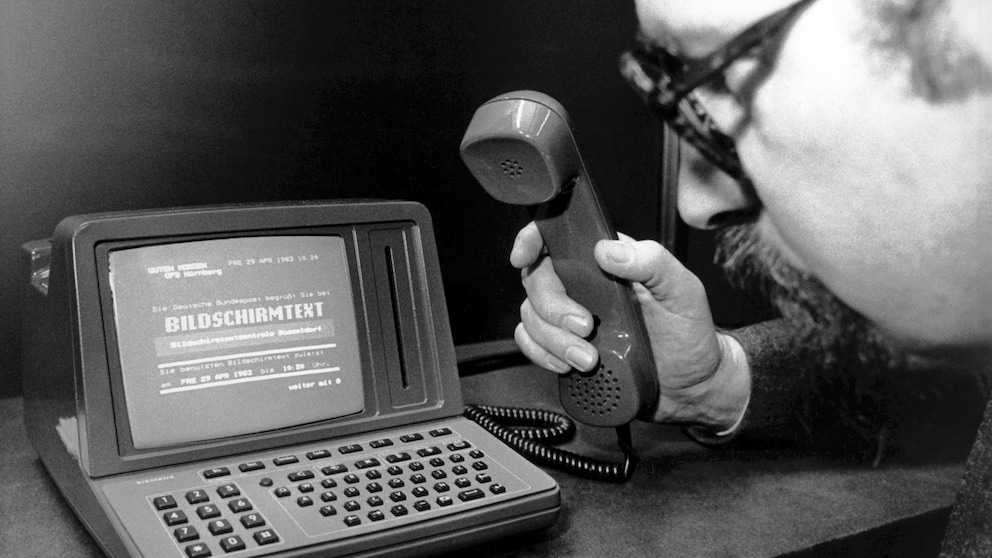
The father of the German internet is named Kurt Gscheidle. Never heard of him? The SPD politician was responsible in the 1970s under Chancellor Helmut Schmidt for the position of Federal Minister for Post and Telecommunications. It was he who introduced the new postal service “Bildschirmtext,” or BTX for short, at the International Radio Exhibition in Berlin in 1977.
What Kurt Gscheidle couldn’t have known at the time: It would take six years before Bildschirmtext actually launched. With it, West Germans got a taste of the impending internet boom. However, a Bildschirmtext boom existed only in the wildly exaggerated dreams of some postal executives. The Deutsche Bundespost was never known for bringing technical innovations to market quickly and easily. It took several years before the postal service’s own pebble-gray rotary dial phone was available in salmon red and fern green. So it’s no surprise that Bildschirmtext, as a precursor to today’s internet, got off to a sluggish start.
Overview
Bildschirmtext Based on British Technology
The Bildschirmtext story doesn’t begin in Germany but in another country, the United Kingdom. There, experts had been working since 1972 on a so-called “press telephone”–PRESTEL for short. This technology officially saw the light of day in 1979 and served as a model for the later Bildschirmtext in the Federal Republic.
The technology found its way to West Germany thanks to a technical article. It was read by postal employee Eric Danke, who played a significant role in the introduction of Bildschirmtext in the Federal Republic of Germany. Incidentally, in 1995, he took over the management of T-Online, the online service of Deutsche Telekom.
On September 1, 1983, it finally happened: Bildschirmtext–or BTX for short–opened its doors nationwide. Customer interest was, to put it mildly, restrained. Deutsche Bundespost expected one million BTX customers by the mid-1980s. This milestone was only reached ten years later, and only because the BTX offering was now operating under the name T-Online in the new internet frontier. From 1995, BTX was coupled with the new offering, including email and internet access, until Bildschirmtext was finally shut down at the end of 2001.
Read also: The History of Teletext–and Who Still Uses It?
The Three Major BTX Problems
The fundamental first problem: BTX was expensive. Deutsche Bundespost saw Bildschirmtext as a money-printing machine. In addition to the setup fee of 55 Deutsche Marks, there was a monthly basic fee of 8 Deutsche Marks. Additional fees were incurred to access a page in the “German internet.” A page view cost between 1 Pfennig and 9.99 Deutsche Marks. Instead of paying for individual pages, some providers charged a time fee. Here, costs ranged from 1 Pfennig to 1.30 Deutsche Marks per minute. Quite steep.
Problem number 2: By the time a BTX page appeared in pixelated glory on the TV screen, users could comfortably brew a pot of coffee in the kitchen. The data transfer rate was 1200 bits per second. The pixels trickled onto the screen. For comparison: Today’s home internet transfer rates are in the megabit to gigabit range.
The third problem: As already hinted, the terms innovation and Deutsche Bundespost were in stark contrast. Some third-party providers already had a BTX interface for common home computers, such as the Commodore C64. However, in the early years, the Bundespost did not allow external modem providers. This systematically prevented technical innovation.

150 Years of the Telephone: How Bell’s Invention Changed Communication

The Beginnings of Mobile Communications – How the World of Cell Phones Came About
Shopping, Chatting, Online Banking via Bildschirmtext
That’s why Bildschirmtext was doomed from the start. Yet, BTX allowed products to be ordered and delivered to homes as early as the 1980s. All major mail-order companies like Quelle or Otto offered their catalogs on Bildschirmtext. Users could also chat with each other, even though the term didn’t exist back then. Additionally, messages could be sent back and forth. With a lot of imagination, this process could be compared to writing an email.
One service could actually be called an innovation. Banking transactions could also be conducted via Bildschirmtext. When the internet later began its triumphant advance in the 1990s, BTX formed the technical basis for online banking. Dialing in via Bildschirmtext was long considered the most secure access method.
That’s why the million-user mark eventually fell. Besides online banking, however, no one was interested in the technically outdated Bildschirmtext anymore. BTX developed into a kind of technology zombie. It wasn’t until 2007 that Deutsche Telekom, the successor to Deutsche Bundespost, finally closed the service for good.

Read also: 12 Tips to Get the Most Out of Google Search
Bizarre BTX Stories
On the internet, you can still find relics from former BTX customers who were billed monthly maintenance fees by Telekom for years. This includes Günter Löscher, who paid the maintenance fee for a MultiTel from 1991 to 2010 without realizing it. How this could happen is reported by the “Welt.” The Telekom bill landed on his accountant’s desk every month. It listed a charge of 17.10 euros for “Maintenance No.: 000011/0000000 from 28.01.1991,” which she never questioned. But when the accountant was on vacation and Löscher himself reviewed the bill, the 62-year-old businessman noticed the charge. Over the years, Telekom deducted a total of 4,052.70 euros for a device that was long obsolete and had not been in use for years.