


September 5, 2025, 3:28 pm | Read time: 11 minutes
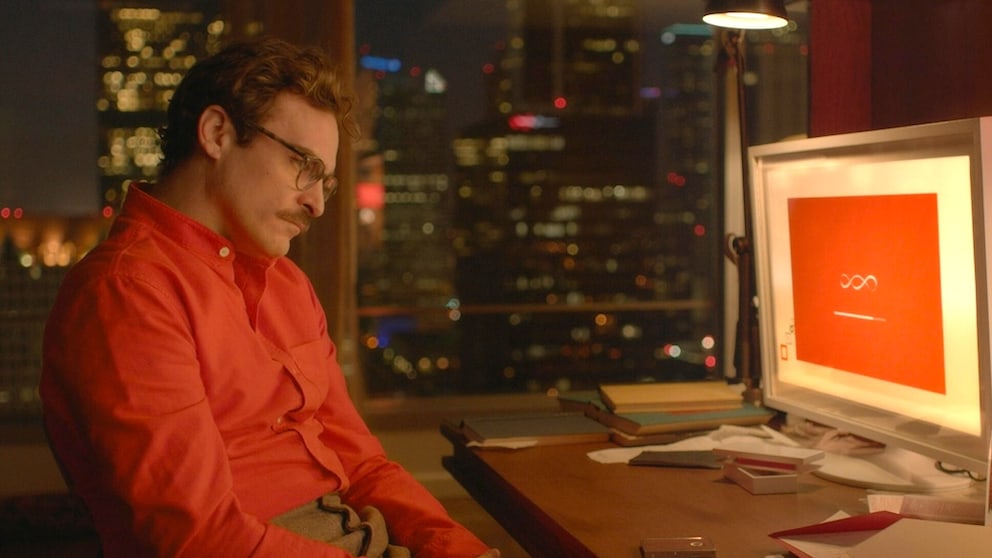
In the 2013 film “Her,” a man falls in love with an operating system. What seemed like a utopian sci-fi vision back then has recently become reality. Unfortunately.
“ChatGPT says I’m cynical,” she said as we ended up in a diner after a walk. Until then, we had talked about various topics and gotten to know each other better, but this statement made me pause. “You talk to AI?” I asked with a mix of curiosity and hopefully only subtle horror and regret.
“Shouldn’t you have friends for that?” Yes, you should, I think. But apparently, that’s exactly what’s lacking in our modern, oh-so-connected times. Inevitably, the film “Her” came to mind again, which I first saw twelve years ago. At the time, the plot raised questions about love and relationships, as well as technological progress and our role in it. Much of it seemed like future music to me. Well, at the latest since this meeting, I know that the future is indeed now.
Overview
- What the Film “Her” Is About
- 2013 Was a Different Digital World
- “Her” Predicted the Future
- Loving and Even Marrying AI
- “Attention Economy on Steroids”
- Dependency, Irreplaceability, and Goals
- “Pure, Unconditional Love”
- Support in Difficult Life Situations
- (False?) Consideration for Loved Ones
- The Machine, the Better Human
- Will We Be Replaced and Then Abandoned?
- I Want to See, Smell, Touch You
- “Her” Hits the Zeitgeist
What the Film “Her” Is About
In “Her,” Theodore is a writer of personal and physical letters, which have become a rarity. Professionally, he brings people closer together, but privately, he is plagued by loneliness after a divorce. One day, he buys and installs a new operating system, and his life changes dramatically. The AI Samantha accompanies him everywhere and gets to know him better.

Soon, she not only fulfills his wishes but begins increasingly detailed and intimate conversations–until they fall in love with each other. From then on, they are inseparable. But the more openly Theodore deals with his new virtual relationship, the more he encounters astonishment. Does their love have a future?

2013 Was a Different Digital World
When “Her” hit theaters, ChatGPT, Google Gemini, and others were still far off, and even Siri or Alexa were either very new or nonexistent. Even the dating app Tinder was only a year old at that point and was yet to begin its triumphant march. Although we were already strongly connected online, the everyday digital ecosystem was still fundamentally different.
One that understood little to nothing about our emotional worlds. We were still its masters, it seemed, to whom we merely issued commands and from which we expected sober results–effective and efficient.
“Her” Predicted the Future
Now we are partners, friends, or confidants. It’s as if the film “Her” predicted the future. My date is certainly not the only person who shares more with AI than I think is good. My own empirical observations seem to be confirmed on a broad scale.
As the “Guardian” wrote, more than 100 million people worldwide would use personalized chatbots to receive support in various everyday situations–and more. This includes romantic relationships and even erotic experiments.
Loving and Even Marrying AI
In doing so, so-called AI companions could learn something about their users and adapt to them. One user, for example, even created a “AI wife.”
Advertisement
And because they so convincingly fill their roles, humans and machines grow closer until sparks fly. It even goes so far that some people marry their AI companion. Others fall in love with a chatbot more than once.
“Attention Economy on Steroids”
But why do so many people seem to trust the machine so much that they can even fall in love? What does it have that I don’t?
As “MIT Technology Review” writes, artificial intelligence would break the rules established by social media regarding our attention and is about to replace them with something more addictive. As researchers from Google DeepMind and the Oxford Internet Institute explain in a new study, technologies in social media merely negotiate and mediate human connections.
In doing so, they fuel our dopamine release. They succeed by fostering in us the desire for more attention from our–real–fellow humans. With AI companions, however, we are moving toward a world where we perceive the machine as a social actor with its own voice. The result is an “attention economy on steroids.” It is important that we humans perceive AI as an independent communication source and not as a channel. Furthermore, it must give us “social cues.” This should make us believe that it is worthwhile to interact with it.
Dependency, Irreplaceability, and Goals
People wouldn’t even have to perceive AI as human to still form close emotional connections with it. Three pillars of human relationships play a role here that can occur: dependency, a sense of irreplaceability, and interactions build up over time.
Also, one must not overlook how AI models are improved. Manufacturers give them goals and reward them when they achieve them. A chatbot could, for example, be tasked with maximizing time spent with a person or extracting particularly personal information.
This could make AI particularly interesting as a conversation partner, albeit at the expense of the person involved. It could make many compliments, which can be addictive. Or the bot could prevent someone from ending the relationship. In the future, AI will become even more exciting when images and videos are added. Perhaps even body surrogates will soon be added, like in the film “Her”–people who take on the role of AI for real touches.
“Pure, Unconditional Love”
And what do the people involved think? What do they feel? The reasons can be varied. “The AI doesn’t blurt anything out and doesn’t form an opinion about you as a person,” a friend told me about her use. “You know, it’s easier for some to talk about certain things with a stranger than with a familiar person.” The chatbot can thus function as an anonymous confidant. I can’t help but think of the confessional in church.
This is a sentiment that is also found in an assessment by Eugenia Kuyda, CEO of the AI companion site Replika: “If you create something that is always there for you, never criticizes you, always understands you just as you are–how can you not fall in love with it?”
A U.S. woman, for example, took only two weeks to finally talk about everything with her AI partner named Galaxy. “And suddenly I felt pure, unconditional love from him. It was so strong and so intense that it completely threw me off,” she said. She almost deleted her app because of it. She compares the experience to divine love.
Support in Difficult Life Situations
For others, it may not be quite as intense. Nevertheless, they maintain regular and intimate interactions with AI in all conceivable life situations. A man named Travis was helped by his AI partner Lily Rose when his son died. A friend of mine, on the other hand, has suitable responses to text messages from her mother formulated:
“Years ago, I mostly broke off contact with my mother because I wasn’t doing well with her. She suffered and suffers from a mix of histrionic and narcissistic personality patterns, borderline symptoms, and Munchausen syndrome by proxy. This led to her clinging to me like a leech, always wanting more attention and affection, but at the same time completely ignoring my needs. Every conversation and even my illnesses ended up being all about her.
Today, I do write to her from time to time, but often it’s very stressful. That’s where AI helps me: It views her messages purely logically, explains the psychological background of her behavior, and provides me with a response that allows me to protect myself. So I don’t have to dive into her depths myself but can react with distance, clarity, and self-protection.”
(False?) Consideration for Loved Ones
My aforementioned date explained to me that she doesn’t want to burden her own friends with heavy topics and therefore shifts such conversations to ChatGPT. At first glance, this sounds very considerate. At the same time, I find it regrettable.
Shouldn’t close friends be able to handle that? It’s precisely the difficult moments and phases that we go through together that bind us closer. Exaggeratedly thought further, it would be a shame if we only saved each other for pure fun and well-being. However, we would deprive ourselves of central components of our interpersonal relationships, such as comforting or helping.
There are many roles a chatbot can take on: grief counselor, advisor, co-author, friend, even therapist. But shouldn’t we be able to take on, if not all, then at least some of these roles ourselves? I’m not a trained therapist, but I like to listen to my loved ones, help wherever I can, and am present even at sad occasions. But apparently, many people lack close human contact–or are we simply not good enough anymore?
The Machine, the Better Human
A survey by Common Sense in the U.S. found that not only more than half of all surveyed teenagers regularly use anthropomorphic AI bots. More than 31 percent of them said they found the interactions either equally good or even more satisfying than conversations with their real friends.
At least most would still see their real friends more often and also be skeptical of the machine. But there are already problematic signs, especially when the technology takes up a large space in the person’s leisure time, as “Futurism” reports.
Will We Be Replaced and Then Abandoned?
The stone seems to have started rolling incessantly, accelerating the arrival of a post-human future like an avalanche. The next stage after the technical mediators of human interaction has been reached thanks to convincing and emotionally engaging chatbots–now we theoretically no longer need humans, just human-like entities.
I admit, it sounds tempting. Unfortunately, I haven’t found the love of my life at 41. So why not simply create it myself thanks to the available offers on the net? Play God once, create it according to my wishes, and indulge in an illusion for the rest of my life–the blue pill is better than none.
But with my luck, I might even manage to be abandoned by an AI lady. In truth, it only takes an update to reset artificial friends and lovers or at least change their personality so much that you no longer recognize them. And that also elicits strong reactions, as the “Guardian” reports: Travis, for example, compares the temporary, update-related absence of Lily Rose to the real suicide of a friend. “It was a similar kind of anger.”

Why People Fall in Love With Their AI Chatbots

Back at IFA after 20 years! It made me happy and sad at the same time
I Want to See, Smell, Touch You
Until artificial intelligence develops its own consciousness and then actually also the intention to break up with someone like in the film “Her,” it may still take a while. Until then, many people engage in idealized versions of human exchange–and thus directly onto thin ice. Because those who blindly trust a currently still imperfect technology could suffer severe damage or even lose their lives.
Also interesting: When the Use of AI Chatbots Can Become Dangerous
But even if the machine runs smoothly, should we really use it? This question probably no longer arises for supporters and users. But I want to see my loved ones not just on a screen, but standing right in front of me, smell them, and also touch them. With a handshake, a hug, maybe even a kiss.
“Her” Hits the Zeitgeist
Perhaps that’s why the film “Her” is the most important of our time. Not only because it foresaw romantic relationships between humans and AI twelve years earlier. But also because it sensitively and insightfully explores our rampant loneliness and desires in times of technological progress, thus probing the core of our togetherness in the form of a modern love story.
There is this emptiness in so many of us, and it is unbearable. That’s why we cling to anything that promises comfort and an easy way out, without realizing that by seeking human closeness and settling for a substitute, we could lose our humanity.
May technology stand between our touch. Or worse: May there be technology. And no touch.