

July 20, 2025, 2:48 pm | Read time: 16 minutes
In its early years, television portrayed police officers, detectives, and lawyers almost exclusively as always shining, yet one-dimensional heroes. Eventually, viewers became oversaturated with such flawlessness. By the time the U.S. series “Hill Street Blues” aired, screenwriters began focusing on more realistic characters with lives beyond their jobs. Characters with quirks, flaws, and imperfections, who were far from perfect. Men and women traumatized by the evil they faced weekly. Today, it’s rare to find a TV cop without some physical or emotional scars. This trend continues to captivate audiences, as shown by the success of series like “True Detective” or “Dept. Q.” TECHBOOK presents ten of these damaged TV law enforcers.
Department Q (Dept. Q): DCI Carl Morck – Traumatized Jerk

“Department Q” (original title: “Dept. Q”), the British Netflix series success based on the literary work of Jussi Adler-Olsen, serves as a blueprint for a crime drama featuring a police officer who could charitably be described as behaviorally challenged. DCI Carl Morck (Matthew Goode), an Englishman serving with the Edinburgh police, might objectively be considered a nuisance. However, to many of his colleagues, the TV cop is an unbearable jerk. A constant know-it-all, his analyses are often spot-on.
While the broad strokes of the literary source (or the Danish film adaptation) remain the same, the creators of “Dept. Q” skillfully added their own touch to the plot and characters. The atmosphere is largely defined by the monochrome gray of wintery Edinburgh, making the charming Scottish capital feel like another main character. Yet, it’s the characters themselves that lend “Dept. Q” its perceived authenticity.
As with other outstanding English crime dramas (“Broadchurch,” “Sherwood,” or “Happy Valley”), “Dept. Q” avoids literal stereotypes. While Hollywood productions sometimes struggle to make viewers forget the star behind the role, the actors in “Dept. Q” largely disappear into their characters. Viewers almost feel as if they’re dealing with real people of flesh and blood.
Der Fahnder: Hannes Faber – Unconventionality Light
“Der Fahnder” was Hannes Faber (Klaus Wennemann), an undercover detective in a West German city in the early ’80s. It felt like a Ruhr area metropolis, but it was filmed in Munich and its surroundings. Faber, usually addressed by his last name, was the ‘unconventional cop’ type. He never strictly adhered to the rules and would sometimes literally go overboard if he thought it served the cause.
To avoid any misconceptions: Faber’s unconventionality was, in a way, a light version. The series aired in the early evening, obligating the commissioning ARD to maintain certain standards regarding sex and violence. Faber’s peppermint drops, which he always carried in a tin to offer to anyone at any time, were almost the pinnacle of extravagance. Nevertheless, the character exuded youthful charm and flair, giving the series a unique appeal. This was largely thanks to its creator. Dominik Graf, who later became known for critically acclaimed cop thrillers like “Die Katze” and “Die Sieger,” developed the concept. Graf, now one of Germany’s most prominent film and TV directors and a ten-time Grimme Prize winner, directed eleven episodes.
While “Der Fahnder” had a long run (the series aired from 1984 to 2005), Faber held the record with ten years and 91 episodes before, according to the script, moving to Ireland. He was followed by three other incarnations of “Der Fahnder,” played by Jörg Schüttauf (as Thomas Becker), Michael Lesch (Martin Riemann), and Martin Lindow (as Thomas Wells). For many fans from the early days, however, the “Highlander” dictum applied: “There can be only one” – Hannes Faber!
Sherlock: Sherlock Holmes – A “High-Functioning Sociopath”
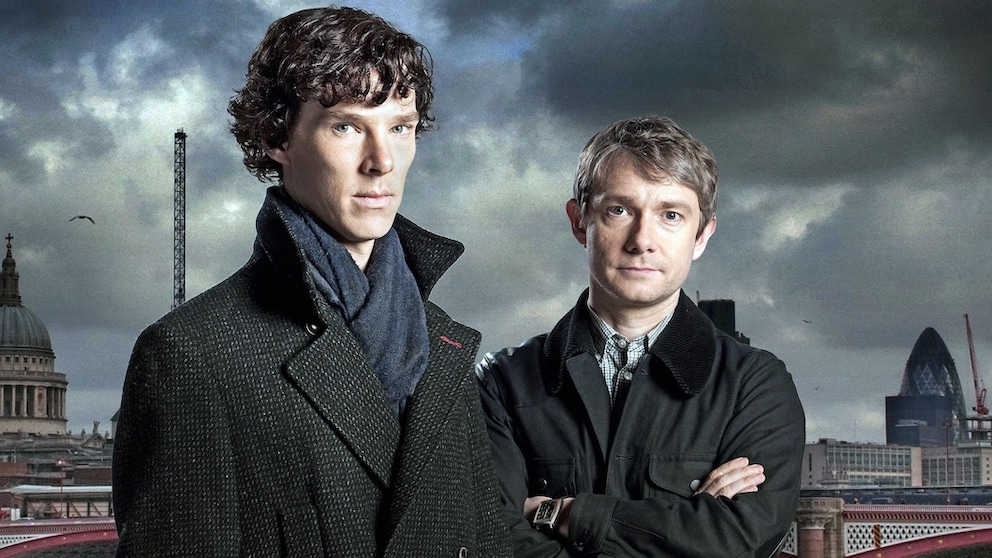
In the countless film and TV adaptations of “Sherlock Holmes,” the famous detective created by Sir Arthur Conan Doyle was always portrayed as a clever, yet perfectly mannered English gentleman. In short, Sherlock Holmes seemed untouchable. To adapt the character for a modern audience, Steven Moffat and Mark Gatiss relocated the originally Victorian England setting to 21st-century London for the BBC series “Sherlock.” The duo also subjected the original myth to a radical overhaul. This tour de force produced a TV cop who, while just as brilliant as the original, also displayed some rather unappealing character flaws.

Thus, the Sherlock Holmes played excellently by Benedict Cumberbatch is anything but a sympathetic character. Cumberbatch’s TV cop is an arrogant jerk who leaves no doubt that he considers the police officers he’s supposed to assist as hopelessly overwhelmed, if not incompetent. He also tends to use people for his purposes and sometimes treats even his few friends, like Dr. Watson, harshly and condescendingly. It’s almost no wonder that Holmes refers to himself as a “high-functioning sociopath.” His nicotine addiction and apparent willingness to indulge in harder drugs complete the picture of a ruthless, barely empathetic person.
Incidentally, since 2017, the end of the fourth season, fans of the series have hoped that “Sherlock” might take up the fight against evil once more. Moffat, for one, would be on board immediately. “I’d do it tomorrow,” the writer said in an interview some time ago. “I mean, Arthur Conan Doyle wrote 60 novels. It’s not a format that wears out, and I’m ready.” But he added, “You need the two big stars. And that’s the problem.” Indeed, the willingness of Cumberbatch and Freeman seems questionable. Whether it’s scheduling conflicts or perhaps other, more personal reasons for letting “Sherlock” rest, only the two of them can answer.
Columbo: Inspector Columbo – Quirky TV Cop with a Guarantee of Success
A whodunit, where the audience guesses who the perpetrator is, was never part of “Columbo.” What made “Columbo” unique was that the audience knew the perpetrator from the very start. Right from the beginning, viewers were, so to speak, ‘live’ as the crime occurred. “Columbo” became a major series success primarily due to the seemingly parodic character of Inspector Columbo (Peter Falk). Columbo, whose script didn’t even grant him a first name, appeared literally rumpled. In his shabby trench coat and with his disheveled hair, he always looked as if he’d just fallen off a cot at a homeless shelter.
Logically, perpetrators often underestimated this peculiar policeman, feeling superior to him, as the crime was usually a sophisticated, meticulously planned act by a mastermind. Columbo’s apparent handicap was actually his greatest strength. He was consistently underestimated, partly because he sometimes seemed clumsy. He also became a real nuisance during investigations. His “Just one more thing…” as he was almost out the door became a running gag that drove his counterpart to the brink of despair.
The role of the villain was always played by former Hollywood luminaries, giving each episode a special charm. Stars like Janet Leigh (Hitchcock’s “Psycho”), Ida Lupino, one of the few women in Hollywood to have a career both in front of and behind the camera, Leonard Nimoy, better known as “Mr. Spock,” or horror film legend Vincent Price, all took turns in the series.
For Peter Falk, “Columbo” was the role of a lifetime. His performance was a typical case where actor and character seemed completely identical. When you think of Falk, a highly talented actor from the New Hollywood movement, you inevitably think of “Columbo.”
Cracker: Dr. Edward Fitzgerald – Self-Destructive Tendencies
Today, eight or nine out of ten TV cops might be heroes with significant flaws. But when “Cracker” aired in 1993, featuring the unconventional and often unsympathetic criminal psychologist Dr. Edward “Fitz” Fitzgerald (Robbie Coltrane), such an anti-hero was almost unique in TV programming.
The heavily overweight chain-smoker drinks like a fish and is also a gambling addict, making it fair to say he has self-destructive tendencies. He’s also an adulterer, a cynic, and sometimes even a true misanthrope. But Fitz is also a brilliant mind. A powerful profiler who repeatedly manages to delve deep into the psyche of the perpetrator, providing the police with crucial insights. Here, it’s mostly about the “why?” while the “who?” is already known to the audience, similar to “Columbo.” In English police jargon, such a man is called a “cracker,” someone who “cracks” the culprit, revealing their motivation. Fitz consistently demonstrates great empathy, which, ironically enough, is extended to murderers, racists, and child molesters, while he keeps his own family emotionally distant.
Besides the main character’s ambivalence, it’s this intellectual approach and the portrayal of the most heinous crimes that almost physically pains the viewer, setting “Cracker” apart from other crime dramas of the time. From today’s perspective, one might even say that “Cracker” could have been a forerunner for “Sherlock” (Holmes), which appeared 20 years later. Like Holmes, Fitz assists a police force that seems lost without help. And like Holmes, Fitz, who could use a psychologist himself, is haunted by his own demons.
Ironside: Robert T. Ironside – TV Cop in a Wheelchair
Police officer Robert T. Ironside (Raymond Burr) is shot in an attack and is paralyzed from the waist down. Nevertheless, Ironside wants to continue working for the police and offers his services as a freelance consultant to the San Francisco Police Department. He assembles a small team and, from his wheelchair, makes life hell for criminals.
When “Ironside” aired in the late 1960s, a hero with a handicap was an absolute exception in the uniformity of TV series. Only the two Western series “Tate” and “The Man Without a Name” had attempted heroes with disabilities a few years earlier (loss of an arm here, memory loss there), but without success. One might have assumed that a TV cop in a wheelchair would have little chance of success among the many virile crime heroes. The opposite was true: “Ironside” ran in the U.S. for over eight years, producing eight seasons with 199 episodes.
The popularity of “Ironside” at the time was evidenced by toy car manufacturer Corgi Toys. Under the name “Ironside Truck,” Corgi released a miniature version of the van that “Ironside” used as a mobile office. This practice—creating a toy car for a TV series or movie—was reserved for the biggest box office or ratings successes, such as “Batman,” “James Bond,” “Kojak,” or “Starsky & Hutch.”
Monk: Adrian Monk – Obsessive Compulsions by the Dozen
With a bit of imagination, Adrian Monk (Tony Shalhoub), the titular character of the comedy-crime series “Monk,” could be seen as a successor to Inspector Columbo and “Ironside.”
Like Robert T. Ironside, Monk is a former San Francisco Police Department officer who had to resign. However, not due to a physical injury, but because of severe trauma caused by the murder of his wife, Trudy. For three years, Monk didn’t leave his apartment, developing a dozen compulsions and phobias. Gradually, he tries to reintegrate into everyday life and offers his services—another parallel to “Ironside”—to his former colleagues as a consultant on particularly difficult cases where conventional police work reaches its limits.
The cops may sometimes laugh at his compulsions—Monk, for instance, has a cleanliness obsession—but they appreciate his excellent memory and brilliant perception. His unconventional methods often lead to solving a case. Monk’s former boss, Captain Leland Francis Stottlemeyer (Ted Levine), holds Monk’s approach in high regard, even if he doesn’t always understand it. The captain overlooks the fact that Monk isn’t always a likable character. His counterparts must endure Monk’s occasional ruthlessness and lack of empathy.
Like Columbo, Monk is considered a unique oddball by those around him. This often leads to him being underestimated, just like Columbo. A man who needs to wash his hands every few minutes isn’t taken seriously and might even be mocked. But in the end, it’s always Monk who laughs and, for a moment, forgets his self-imposed compulsions. What sets “Monk” apart from all the other series mentioned here is its humor. While Monk’s fate and illness are taken seriously, the occasional situational comedy adds a certain lightness. Perhaps Monk could be seen as a “sad clown” in this context—though that’s just the author’s subjective opinion.
Shalhoub won three Emmys, the most prestigious TV award in the U.S., for “Monk.” An even greater success, however, is that the term “Monk” has entered common parlance. In 2024, the “RedaktionsNetzwerk Deutschland” defined what one’s “inner Monk” means. “It refers to the part of you that you must stop from removing lint from your boss’s jacket without being asked, the part that makes you park 70 times at the supermarket until the car is perfectly parallel to the parking lines, and the part that compels you to straighten pictures in a museum despite a potential alarm. The part that only rests when everything is perfectly structured and sorted.”
True Detective: Rust Cohle – TV Cop as Sisyphus in Purgatory
Let’s get this out of the way: The first season of the crime anthology “True Detective” is among the best that television has produced. Without a doubt, this first season is one of the most powerful, intense series experiences ever. However, this tour de force demands a lot from the viewer, partly because the narrative spans three time periods.
Police officer Rust Cohle (Matthew McConaughey), who lost his daughter in an accident, is a man without any hope. He knows he will never win the war against evil permanently. One can imagine him as Sisyphus in purgatory, and his sharp reflections on the morally decayed state of the world have an almost philosophical character. His rough-and-tumble partner Marty Hart, on the other hand, tries to take whatever this world still offers someone like him. He cheats on his wife and sometimes resorts to bitter sarcasm in response to Cohle’s musings.
Both Cohle and Hart are (war) casualties, with Cohle’s outward transformation alone indicating that he seems to have given up on himself. Initially, he appears fit, always clean-shaven, wearing a suit, tie, and side part. But later, none of that remains. Cohle then sports an unkempt mustache and ties his greasy long hair into a ponytail. The chain-smoker appears almost neglected, and it’s evident that he indulges in alcohol more than is good for him.
“True Detective” is a complete work of art, with Nic Pizzolatto’s script and Cary Joji Fukunaga’s direction being brilliant. McConaughey and Harrelson play with an intensity as if their lives literally depend on it. But it’s McConaughey who delivers perhaps the most outstanding performance of his career. For the actor previously typecast in romantic comedies due to his good looks, “True Detective” was the definitive breakthrough as a character actor. He had already shown his true potential with the AIDS drama “Dallas Buyers Club” and “The Wolf of Wall Street.”

11 Police Series That Changed the Genre Forever
When Cops Become Criminals: 11 Police Films That Hit Home
Endeavour: Endeavour Morse – A Hopelessly Damaged Man
It’s important to know that “Endeavour” provides the backstory to a British crime series that was very successful in England between 1987 and 2000. “Inspector Morse” told the story of the criminal cases that the aging Inspector Endeavour Morse (John Thaw) solved in Oxford over eight seasons. This Morse was a brilliant analyst but also a loner and introvert. But how did he become this man?
The answer came in 2012 with “Endeavour,” a prequel set during the time when former Oxford graduate Endeavour Morse (Shaun Evans) joined the city’s police force. He gained his first experiences and rose from a simple Detective Constable to Sergeant and later to Detective Inspector during the 1960s. Morse quickly proved to be unusually cultured and intellectual—knowledgeable about “La Traviata” as well as the Punic Wars—which initially made him an outsider. However, colleagues and superiors soon came to appreciate his quick wit and empathy, which allowed him to understand the mindset of criminals.
In fact, Morse could be a kindred spirit to Rust Cohle. Like the “True Detective” character, the young Morse is a hopelessly damaged man. A man who, over the years, will abandon all hope. He realizes that he cannot eradicate horror from the world and that his sole task must be to bring justice to the victims. Evans himself once described his character: “I don’t see Morse as a hero. I see him as a man trying to make sense of a world he doesn’t really fit into.” This is indeed his dilemma, which threatens to break him. He begins to drink, becomes careless, and his few friends threaten to turn away from him. He repeatedly seeks salvation in love but always fails, sometimes tragically.
The Bridge: Saga Norén – Promiscuous Autistic
When a female body is found on the Øresund Bridge, which connects Danish Copenhagen with Swedish Malmö, Swedish detective Saga Norén (Sofia Helin) and Danish inspector Martin Rohde (Kim Bodnia) must work together to find the murderer. The body was not only placed exactly on the border between the two countries, but it also consists of two parts that don’t belong together. The upper body is from a city councilor from Malmö, while the lower body is from a prostitute from Copenhagen who was murdered 13 months earlier…
Similar to “Monk,” Saga Norén (Sofia Helin) is a police officer with a mental disorder. Saga is autistic and shows signs of Asperger’s syndrome. She struggles to form interpersonal relationships, partly because she lacks empathy. This often leads to situations where Martin seems to despair. Saga’s indiscriminate one-night stands also struggle with the blunt directness of the promiscuous detective.
However, that’s the only vague parallel to “Monk.” Unlike the comedic character of the U.S. series, “The Bridge” is pure Nordic Noir. The images remain gray, if not dark, much like the weather. The once-praised social achievements of Scandinavian countries now show deep cracks. Saga’s own story, revealed during the first season, highlights this. Years ago, she couldn’t prevent her sister, with whom she had a deep bond, from taking her own life. After her father’s death, her mother, who also suffered from a mental disorder, committed suicide. This was doubly painful for Saga: besides the painful loss, she had to endure being initially suspected of her mother’s murder and spending a year in prison until her innocence was proven.