

May 21, 2023, 3:00 pm | Read time: 4 minutes
In the late 1960s, the floppy disk was developed and became an indispensable storage medium for the next two decades. Today, the floppy disk is considered obsolete, but it hasn’t completely disappeared. Some industries still rely on it.
A book on the technical development of storage media could be titled: “How Do I Completely Disappear?” Today, mobile storage is almost invisible or outsourced, such as cloud technology. A significant chapter in history is claimed by one storage medium: the so-called “floppy disk.” For nearly 20 years, floppy disks were indispensable. The name “floppy disk” refers to the soft plastic cover that protects the magnetic disk underneath. Later, the floppy disk was encased in a hard shell before the CD became the preferred storage medium. However, the disk hasn’t completely vanished from the scene.
Overview
The Early Years of the Floppy Disk
The first floppy disk in 1969 measured a substantial 8 inches, roughly the size of a tablet. Its storage capacity was 80 kilobytes, equivalent to about 1,000 punch cards—a common unit of measurement in the early days of computing. By today’s standards, more than ten such disks would be needed to store a smartphone photo.
In the mid-1970s, a slightly smaller version of the floppy disk became established. The 5 ¼-inch diskette was especially popular among Commodore 64 owners, as diskettes and a corresponding drive significantly enhanced gaming on home computers. The square floppy disk could now hold up to 1,200 kilobytes, a multiple compared to the first version. By today’s standards, however, still meager. At least now, only one diskette would typically be needed to store a smartphone photo.
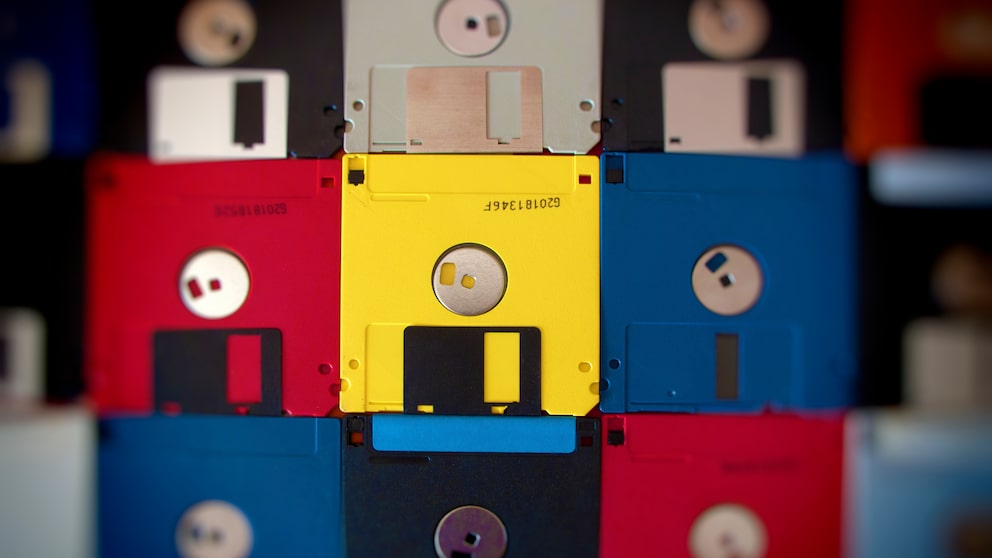
In 1982, the disk’s casing changed from “floppy” to “hard.” The 3.5-inch diskette was now the size of a beer coaster. The storage capacity didn’t change much. The new generation of diskettes could hold up to 1,440 kilobytes. If digital cameras had existed back then, one photo would have filled the disk. In 1989, the compact disc—or CD—emerged as a storage medium. At this point, we could end our article on the floppy disk. After all, the world no longer needs diskettes. But far from it. Some industries still rely on the floppy disk, and that is unlikely to change anytime soon.
This Industry Still Uses Floppy Disk Drives
People with a fear of flying need to be brave: Some airplanes still in operation today have floppy disk drives. These serve as interfaces to update necessary data. This can include the following information:
- Flight paths,
- Airports,
- Flight schedules,
- Navigation, or
- Runways.
The Boeing 747-400 is one such aircraft, where every 28 days a technician uses eight 3.5-inch disks to update the data. Why so cumbersome?
Simply put, the first models of this aircraft were built in the late 1980s. At that time, engineers used the latest technology to update the aircraft’s database with current values. That’s why floppy disk drives were installed in the planes. This method hasn’t changed to this day—following the motto: Never change a working system.

Why Is the First Drive on a Computer Called C and Not A?

C64 – The First Successful Home Computer in Breadbox Format
Old Machines and Modern Technology of the Past
Even within the clothing or metalworking industries, there are machines that still rely on diskettes—such as knitting or crocheting machines and milling machines. Similar to aviation, engineers focused on designing machines for long-term use.
Even the control of nuclear weapons was until recently carried out via diskette. The computers used for this date back to the 1970s. At the U.S. military, experts have since responded. The computers are still old, but the storage medium now meets modern standards.
However, new problems are emerging. The supply of available diskettes is dwindling by the day. New disks have not been produced since 2010. Verbatim held on to production for a while, but after various ownership changes, production was halted.
“The Last Man Standing in the Floppy Disk Business”
There are still 10-packs available online. However, with prices starting at 20 euros and up, only nostalgists are buying them. These include mainly artists. In the creative scene, the floppy disk, along with music or video cassettes, finds a new purpose as a work of art.
And then there’s the American Tom Persky. The self-proclaimed “last man standing in the floppy disk business” currently has about half a million disks of all sizes in stock. He now runs his business online at www.floppydisk.com.
Indeed, you can still find 8- or 5 ¼-inch diskettes there. The largest share consists of 3.5-inch diskettes, which are hand-recycled by Tom Persky. For the floppy disk fan, it’s clear: “Floppy disks are much more stable and reliable than USB drives.” To that, we can only add: The floppy disk is dead, long live the floppy disk!