

June 17, 2026, 1:00 pm | Read time: 5 minutes
We often don’t think much about certain things and just accept them. But have you ever wondered why the hard drive on a Windows system is labeled C? Why not A or 1? The answer lies in the early days of the computer age.
Older generations remember: The beginnings of the Windows operating system are closely linked to one of the first PC operating systems sold by IBM, with PC DOS or later MS-DOS. Until 1992, up to version 3.11, Windows was merely a graphical extension of MS-DOS. To start Windows, the start command “Win” had to be manually entered into the MS-DOS command line. In later versions like Windows 95, ME, or Windows 98, the command is executed automatically on the DOS side. However, the story of drive letters begins more than 20 years earlier.
Overview
A Programmer Sets the Standard
In the early 1970s, American Gary Kildall programmed the operating system CP/M, which stands for Control Program for Microcomputers. The programmer mainly used the open-source code of an operating system developed by IBM in the late 1960s called CP/CMS.

Computers at that time typically had two fixed floppy disk drives. Therefore, the programmer used the letter A for the drive to boot the operating system and B for the drive used to exchange data. No one thought of C back then because there was no other commercially usable storage medium.
Floppy Disks as the Preferred Storage Medium
In the 1970s, floppy disks were the storage standard. Entire operating systems fit on a small, flexible plastic disk. An operating system was no larger than a megabyte back then. Floppy disks in the 5.25- and later 3.5-inch formats were completely sufficient for this.
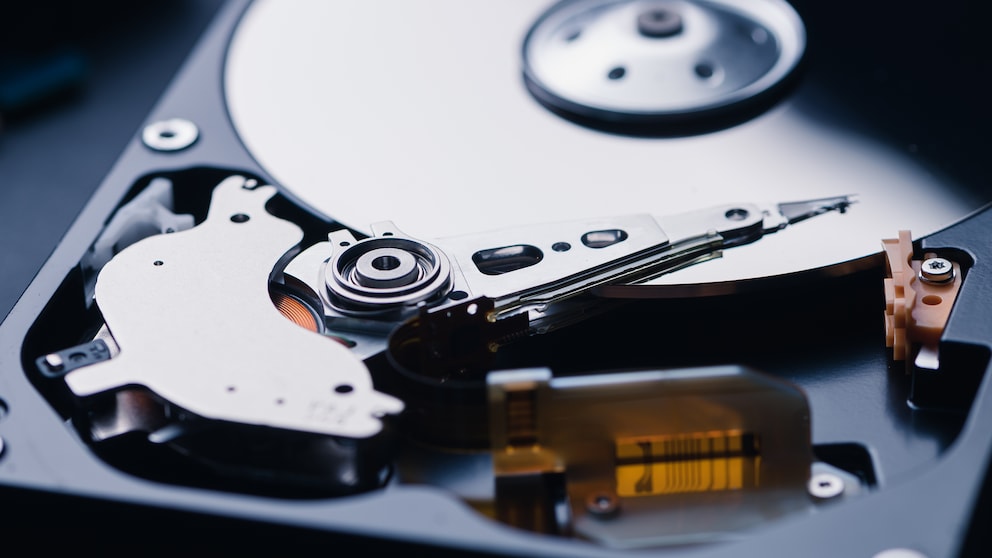
Today’s common hard drives were still completely unknown for use in mass-market computers. In 1956, IBM introduced the first hard drive. The IBM 350 drive stored about 3.5 megabytes of data and measured 173 x 152 x 74 centimeters (HxWxD). Above all, the IBM hard drive was unaffordable, unwieldy, and incredibly heavy.
As a common storage medium, floppy disk drives therefore ranked naturally ahead of the hard drive in the naming hierarchy. To this day, even though there is no longer any reason for it. Floppy disk drives have long since disappeared into computer museums.
The persistence in naming is closely linked to the further development of PC operating systems.
New Operating Systems Adopt Drive Names
Initially, there was little interest in the CP/M operating system developed by Gary Kildall himself. IBM showed interest in the mid-1970s, but that was it. As a result, the programmer founded his own company called Digital Research. And lo and behold: Suddenly, many computer manufacturers were interested in the new operating system.
Due to the success of CP/M, IBM representatives suddenly returned to Gary Kildall and his company Digital Research. IBM recognized the potential of personal computers in the early 1980s. To market them commercially, the company wanted to use the CP/M operating system.
At that time, rumors circulated that IBM was planning an update to the CP/M 86 format. The number 86 referred to the then-current Intel 8086 microprocessor generation. Tim Patterson found the process too slow. The American programmer sat down at his computer and wrote his own operating system, initially calling it QDOS, short for quick and dirty operating system.
Also of interest: Why “Floppy Disks” are still indispensable today
Why Floppy Disks Are Still Indispensable Today

Installing Alternative Operating Systems on a Mac
Microsoft Makes MS-DOS the Standard
Tim Patterson quickly changed the name to 86-DOS, perhaps in reference to IBM’s planned update. A company called Microsoft became interested in this developed operating system. The then-unknown U.S. company bought the rights to 86-DOS for a one-time sum of $50,000. Programmer Tim Patterson joined Microsoft as well.
As a result, the paths of IBM and Bill Gates, founder and CEO of Microsoft, crossed in the development of a marketable operating system. The rest is history.
In August 1981, Microsoft introduced its DOS development MS-DOS, effectively setting a new standard for PC operating systems. IBM licensed this operating system from Microsoft and marketed it for a while under its own name, PC DOS. From the 2000s onward, IBM stopped doing so and used the now globally recognized name MS-DOS.
Habits Change Slowly
Throughout this long DOS development history, much has changed in computer technology. Hard drives have become the new standard, taking the letter C on the computer and replacing floppy disks as the first drive. Since then, the letters A and B have served as tombstones for an extinct storage technology.
Although the current version of Windows has long had nothing to do with the codes of the original MS-DOS predecessor CP/M, the naming order of the drives remains unchanged out of habit.
At least in Windows 11, there are signs of change. If you click “Update Driver” in the Device Manager, the search for suitable drivers on your own computer no longer offers drive A. The search now begins directly on the system drive named C.