

November 18, 2026, 2:53 pm | Read time: 2 minutes
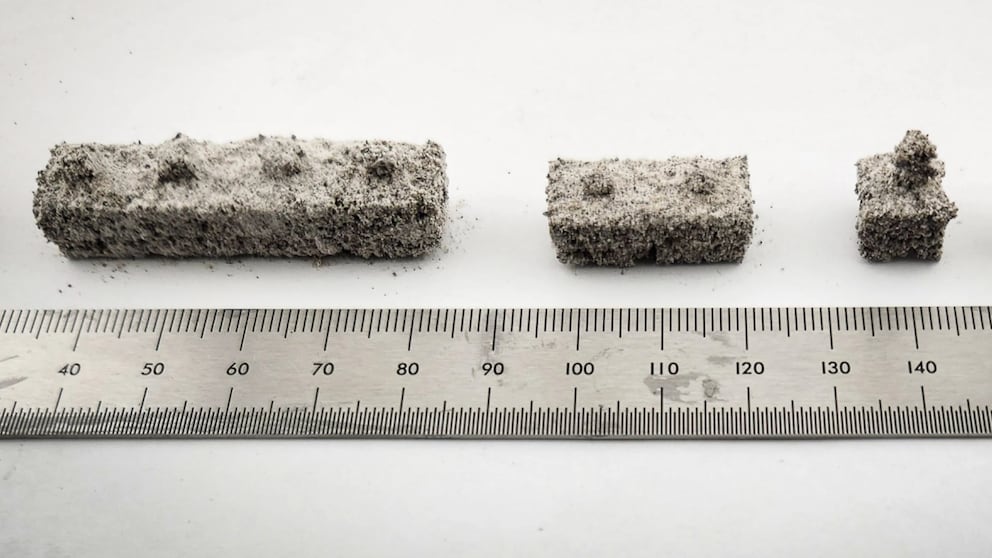
In the future, components for constructions on the moon could be produced directly on-site. Researchers have created small LEGO-like bricks using 3D printing. The base material is a substance that mimics lunar soil. The scientists do not need additional binders for their process.
Lunar Soil Could Become a Building Material
In space travel, the weight of the cargo is crucial, as a lower mass reduces fuel consumption. Transporting heavy materials from Earth to the moon for construction projects would therefore be impractical. That’s why scientists are exploring whether the lunar soil, known as regolith, can be used as a building material.
However, some methods require additional binders, which would also need to be brought from Earth. A team from the University of Arkansas led by Wan Shou is pursuing a different approach, using 3D printing with the “Laser Powder Bed Fusion” method.
In this process, the component is created layer by layer. First, powder is spread over a smooth surface. A laser selectively fuses the areas that will form the desired building block. The surface is then lowered slightly, and the next layer of powder is applied. The laser again processes the designated areas. This process repeats until a solid component is formed.

Will iPhones and Apple Watches Soon Come from a 3D Printer?

Scientists Discover Method to Restore Old Batteries
Researchers Replace Metal Powder with Lunar Soil Imitation
Typically, fine metal powder is used in this type of 3D printing. For their experiment, the researchers instead used Lunar Highlands Regolith Simulant. This commercially available material replicates lunar soil and is based on regolith samples from the Apollo missions.
Also of interest: Deutsche Bahn prints its own spare parts
To bond the material, a laser with relatively low power is sufficient. The result is centimeter-sized building blocks that can be assembled like LEGO bricks to form larger structures. Therefore, no additional binder is necessary in this process.
Compressive Strength Is Still Low
However, there is a significant limitation for practical use on the moon: The manufactured bricks currently achieve a compressive strength of only 3.4 MPa (megapascals). In comparison, concrete used for residential buildings reaches about 25 MPa.
Thus, the building blocks are currently much less compressive. Wan Shou still believes that with further research, the method could be interesting for applications on the moon.