

October 8, 2026, 11:44 am | Read time: 3 minutes
Can whisky mature faster in space than on Earth? An international team of researchers aims to find out with an unusual experiment in Earth’s orbit starting in 2028.
Whisky typically takes many years to develop its characteristic flavors. Scientists from the University of Glasgow and the Kyushu Institute of Technology now want to test this process under conditions that are hardly possible on Earth. Their joint project is called “Space Puffin” and is set to launch in 2028.
The plan is to transport a small CubeSat satellite to the International Space Station (ISS). From there, it will be deployed into its own orbit and is expected to circle the Earth for up to five years. On board are whisky ingredients such as barley, water, and yeast, as well as distilled liquid and small wood fragments from whisky barrels. The entire experiment takes place in a very confined space, as the satellite can only hold ten milliliters of liquid.
Extreme Temperatures Instead of Years of Aging
During its flight, the satellite will orbit the Earth every 90 minutes, constantly alternating between sunlight and shadow. According to the researchers, this results in temperature fluctuations between minus 75 and plus 90 degrees Celsius.
The team suspects that these extreme changes could accelerate the maturation process. The interaction between alcohol and wood is of particular interest. On Earth, many of a whisky’s flavors develop only during years of barrel aging. In orbit, the wood fragments could have a much faster effect on the contents due to the recurring temperature changes. According to Dr. Gilles Bailet from the University of Glasgow, this could result in very pronounced flavor notes.
Also of interest: America now has weapons in orbit
Artificial Tongue Analyzes the Whisky
To monitor changes during the mission, the satellite will be equipped with a so-called artificial tongue. This is a sensor made of gold and aluminum that continuously examines the composition of the liquid. It can detect even the smallest changes in chemical compounds that are important for aroma and taste.
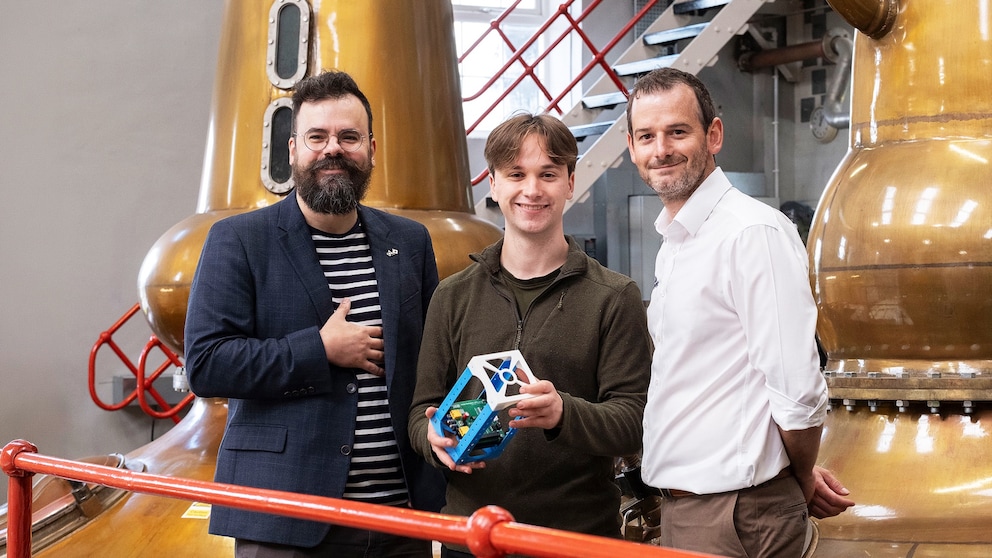
The development of satellite technology is already underway. Seven students from the University of Glasgow are currently working with Japanese colleagues on batteries, radio technology, and onboard computers for the mission. The stay is funded by a scholarship from the consulting firm Allen Associates. The planned space whisky is already named “L’Oro di Scozia,” which translates to “The Gold of Scotland.” If the experiment succeeds, the specialty is likely to become one of the most exclusive whiskies in the world.