


February 26, 2023, 6:48 pm | Read time: 7 minutes
Murders, unsolved crimes, supernatural phenomena, and other bizarre stories. These nine Wikipedia entries are creepier than many horror films.
In the depths of the internet, you can find some curiosities. Often, you don’t even have to search long: The online encyclopedia Wikipedia is a true repository for stories about paranormal phenomena, shocking criminal cases, and obscure events. We have selected nine of these eerie entries and present them in more detail.
Overview
1. Hinterkaifeck Murders
One of the most gruesome and puzzling multiple murders in German criminal history took place in the Upper Bavarian province: In 1922, six people on a farm were bludgeoned to death with a pickaxe by an unknown assailant. Even before the night of the crime, the residents of the remote Hinterkaifeck farm observed unusual events: Footprints in the snow led to the property but not away from it, a house key was missing, and footsteps were heard from the attic at night.
After the night of the murders, the perpetrator apparently stayed on the farm for some time–when the bodies were discovered four days later, the bread supplies were depleted, and the livestock had been freshly tended. The Wikipedia entry reads like a true-crime case.
2. Black-Eyed Children
Since horror film classics like “Village of the Damned” and “The Shining,” it’s clear that children can be incredibly creepy. This Wikipedia entry proves it. It concerns a myth that is especially popular in the U.S.: According to eyewitness reports, several American households were visited in the 1990s in the middle of the night by Black-Eyed Children.
The eerie visitors, aged about six to 16, reportedly knocked on doors under the pretense of needing to use the bathroom or phone. Understandably, the suspicious homeowners did not comply, after which the children disappeared as mysteriously as they had arrived. None of these visits could be verified, so the myth is generally attributed to “urban legends,” which also include the Slenderman.
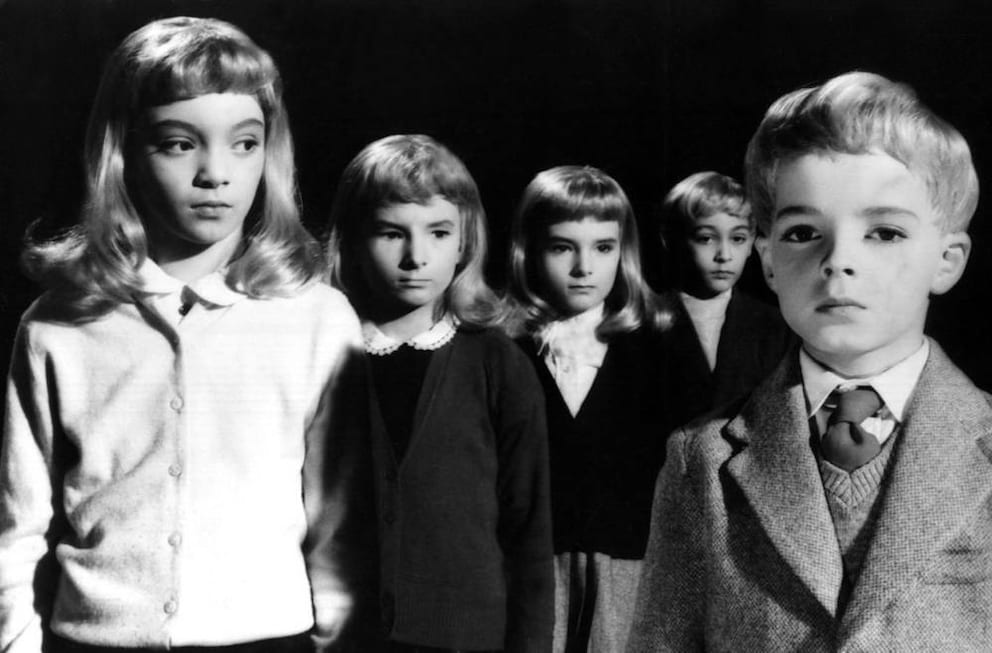
Photo: Picture Alliance
3. Therapy Cat Oscar
Oscar is actually a very cute cat, but he is probably the creepiest cat on Wikipedia. Until his death in February 2022, he predicted deaths. As a therapy cat in a nursing home in Rhode Island, Oscar regularly made his own rounds with the patients. When he sensed that one of them would die in the next few hours, he would lie down with them and stay until the patient passed away. Cat experts believe Oscar reacted to the chemicals released during the dying process.
Oscar’s predictions were so accurate that the nursing home staff would call the relatives as soon as he lay down with a patient. Incidentally, he was not particularly friendly to other residents and visitors.
Read more from our colleagues at PETBOOK: These things cats can’t stand
4. Dyatlov Pass Incident
The Dyatlov Pass Incident remains a mystery to this day. In 1959, nine experienced ski hikers embarked on a trek through the Ural Mountains–their bodies were found weeks later in the snow. Investigation reports stated that the hikers’ tents were slashed open from the inside, and their lightly dressed bodies were discovered hundreds of meters away. Three of the deceased had fatal injuries that could not have been caused by human hands, yet there were no external wounds. No traces of other living beings were found nearby.
The clothing of the dead showed increased levels of radioactivity. Relatives later claimed that the deceased were deeply tanned and their hair had turned completely gray. The official cause of death is still listed as “compelling natural force.” The cause of the catastrophe was never conclusively determined. In early 2019–60 years after the incidents–the prosecutor’s office in the Ural region announced it would reopen the investigation. However, in July 2020, the case was closed again without new findings.
Also interesting: “Tatort Reise”–the true-crime podcast from our colleagues at TRAVELBOOK.de
5. Post-Mortem Photography
What seems like the stuff of nightmares today was common practice in the 19th and early 20th centuries: After loved ones passed away, their relatives had them photographed to remember them. Since photography was not yet widespread, these photos were often the only images the bereaved had of deceased children. The dead were usually shown as if they were sleeping. Sometimes they were deliberately posed “alive,” with family members or favorite items like toys.
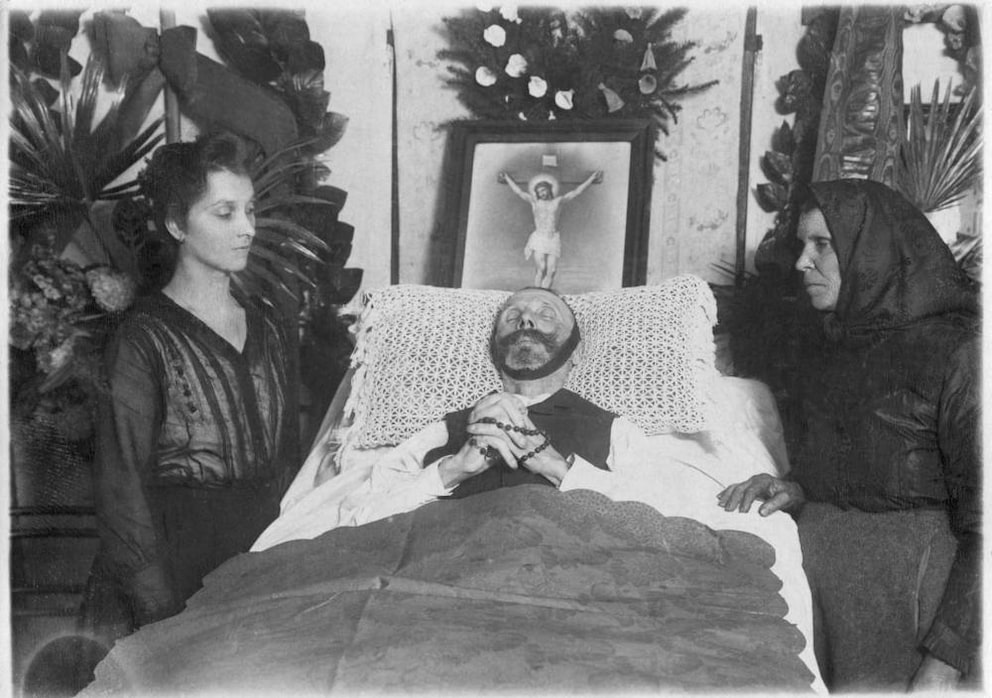
Photo: Picture Alliance
6. Somerton Man
In December 1948, the body of an unknown man was found on Somerton Beach in Adelaide, Australia, who apparently died of poisoning. The well-dressed and groomed man in his mid-40s had no identification on him, and the labels on his clothing had been carefully removed. In an additional sewn-in pocket of the man’s pants, a small piece of paper with the words “Tamam Shud,” a Persian phrase meaning “the end,” was found. The paper itself was torn from a book, and a nationwide search also uncovered the volume to which the scrap belonged. Someone had thrown it into a doctor’s car the evening before the body was discovered.
The book was a collection of poems, with part of the last poem’s page torn out. On the back cover, handwritten letters were found, suggesting a code. However, it remains unsolved to this day. For a long time, it was also unclear who the deceased was and what happened to him. In May 2021, the body was exhumed to obtain a DNA profile. Based on this data, the Somerton Man was later identified as Carl “Charles” Webb, who was reportedly born in 1905 in Melbourne. He was an electrical engineer and instrument maker. It is now believed that Webb took his own life.
7. Aokigahara
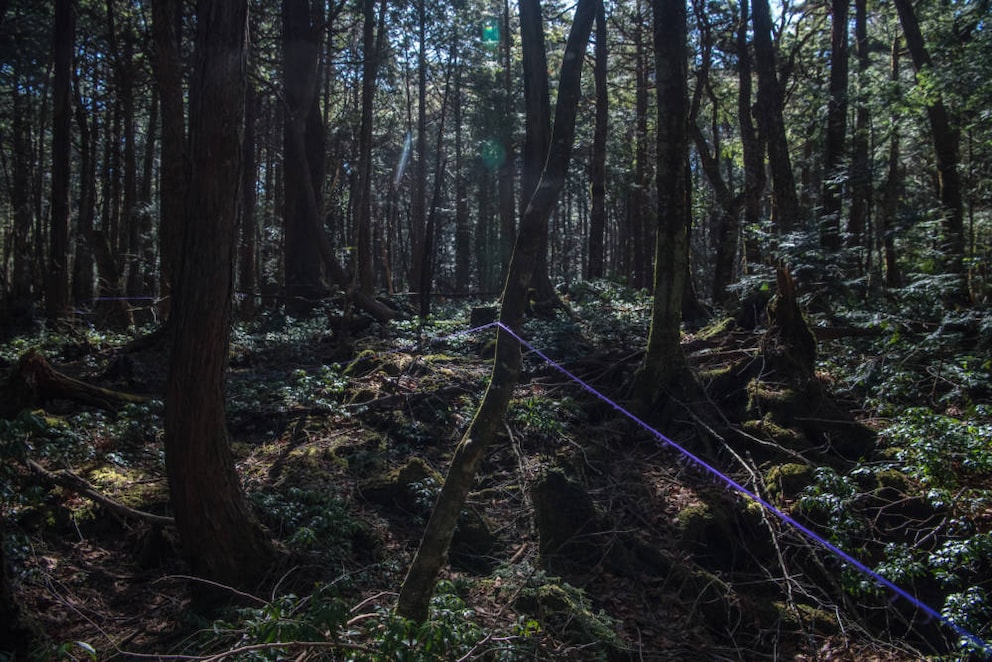
Aokigahara is perhaps the most famous forest in the world–for a tragic reason: For decades, people have been drawn to the Japanese forest to end their lives in the depths of the undergrowth. As early as the 19th century, families reportedly abandoned the elderly and children in the dense forest during famines, leaving them to die. Since the 1960s, it has increasingly attracted those contemplating suicide, prompting regular search parties to scour the supposedly cursed forest. Each year, several dozen bodies are recovered, but many missing persons are never found.
You might also be interested in: 7 things you should not Google

Thanks to Netflix documentary! Missing girl reappears after 6 years

When Cops Become Criminals: 11 Police Films That Hit Home
8. June and Jennifer Gibbons
The identical twins June and Jennifer Gibbons puzzled their family and medical professionals: Inseparable from birth, the girls soon began to isolate themselves from the outside world and communicate only with each other in their own language. As the only dark-skinned people in their school, they were shunned, excluded, and bullied. This eventually led them to leave school early. Later, they even synchronized their movements, causing people around them to fear the girls.
After the sisters, who had an interest in creative writing, became involved in criminal activities, they spent several years in secure facilities, where they were sedated with medication. There, they revisited a pact they had made in their youth. It stated that if one of them died, the other would begin to live a normal life. After Jennifer died in 1993 from myocarditis, which can be caused by drug abuse, June began her normal life and gave interviews to Harper’s Bazaar and The Guardian. Today, she lives reclusively and without outside assistance.
9. Coffin Birth
This medical phenomenon is as disturbing as it sounds or reads on Wikipedia. A coffin birth describes an apparent birth after a pregnant corpse has been buried with her unborn child. The decomposition processes inside the coffin produce gases that cause the mother’s body to bloat. As a result of the pressure created inside the body, the dead fetus is then expelled through the birth canal.
Incidents of this kind have occurred for millennia. Excavations of ancient graves already show the bones of the mother, between whose legs lie the tiny skeletons–from embryos to babies close to birth.