

August 24, 2025, 2:45 pm | Read time: 15 minutes
Cop movies at first glance seem to be about the police chasing gangsters. But that’s just one of the two fundamental themes of police films. The second theme, which appears in many, though not all, examples of the genre, is often the more interesting one. It breaks the classic cop-vs-gangster motif and makes the plot significantly more complex. It’s about fallen, corrupt cops, and thus about guilt and atonement–and sometimes even absolution.
Overview
Serpico

Frank Serpico’s dream comes true when he joins the New York Police Department. But he quickly realizes that corruption among his colleagues is not an isolated case but rather systemic. His insistence on his ideals becomes a nuisance and later even dangerous to his colleagues, leading to his repeated transfers. Eventually, his own team sets him up in a trap …

Eight years before “Prince of the City,” perhaps the best of all police films, Sidney Lumet succeeded with “Serpico,” the first of half a dozen genre contributions about guilt and atonement. Between “The Godfather” and “The Godfather Part II,” Al Pacino delivered another Oscar-nominated masterpiece in this drama inspired by the life story of New York police officer Frank Serpico.
Corruption, decay, darkness–much of what Lumet would revisit nearly a decade later in “Prince of the City” was already present here. In the end, Serpico is left with only disillusionment and deep bitterness. The difference: Lumet’s protagonist here still resists all temptations. Danny Ciello and his partners would not succeed in doing so later.
Read also: 4 films shot with an iPhone
Prince of the City – Die Herren der Stadt
Detectives Daniel Ciello (Treat Williams), Bill Mayo (Don Billet), Gus Levy (Jerry Orbach), and Joe Marinaro (Richard Foronjy) risk their lives daily in this police film fighting organized crime. It seems only fair to them to occasionally divert some of the confiscated drug money for their families. When a special commission against police corruption is set up, the investigating prosecutor asks Ciello for help. Ciello, secretly yearning for absolution, agrees, believing he can still protect his partners …
“Prince of the City” is not only the densest, most epic film by Sidney Lumet due to its nearly three-hour runtime. The real theme here is not the classic fight against crime but the struggle Ciello and his partners must face against themselves. At one point, Ciello sits with two prosecutors, desperately searching for words. “You guys live in Central Park West, but my partners and I live with our families in the Barrio. I sleep with my wife, but I live with my partners,” he shouts at them. “We bust the guys and lock them up. Yeah, and we take their damn money! So, fuck you! Fuck you! Fuck you!” Then he says through tears, “We’re the only thing between you and that jungle out there. But unlike you, we have to live in that jungle!”
Live–and die! Like Mayo, who shoots himself out of fear of being caught. When Ciello informs Marinaro, he initially can’t utter a word. Together they go to the backyard, where Marinaro has to hold onto a fence. Then his scream of pain pierces the silence. A scream that cuts to the core, so unbearable it seems almost impossible to endure. Lumet doesn’t show stereotypical cops here but desperate men on the edge of the abyss, as authentically as hardly any other police film has managed to this day.
Internal Affairs – Trau’ ihm, er ist ein Cop
During a nighttime operation, LAPD cops Dennis Peck (Richard Gere), Van Stretch (William Baldwin), and Dorian Fletcher (Michael Beach) are involved in a shooting where Fletcher kills an unarmed man. Peck quickly places a knife in the dead man’s hand to make it look like self-defense. Almost simultaneously, Detective Raymond Avilla (Andy Garcia) joins the Internal Affairs Division (IAD), tasked with combating corruption within the police ranks. It doesn’t take long before a deadly cat-and-mouse game develops between Avilla and Peck …
Director Mike Figgis, then at the beginning of his film career, portrays the U.S. police apparatus as “an institution whose so-called civil servants at all levels collude with organized crime and are themselves organized like a branch of the underworld,” as described on the recommended website “der-film-noir.de.”
Years later, like Denzel Washington in “Training Day,” Richard Gere proves that good looks in no way prevent one from playing a perfectly crafted psychopath. Gere’s Peck is a man who would do anything to maintain his status, including murder and rape. That it’s the rookie Avilla who ultimately thwarts him might be considered a minor flaw of the film, as Garcia’s Avilla remains somewhat bland. Garcia has been seen more convincingly in other thrillers, such as “8 Million Ways to Die.”
Read also: What is the difference between a crime film and a thriller?
Die Sieger
Police Chief Inspector Karl Simon (Herbert Knaup) leads a special unit into an operation that goes awry. Of three gangsters, only one is arrested. One of the other two is shot, and the third escapes. Simon believes he recognizes his former colleague Heinz Schaefer (Hannes Jaenicke) in the fugitive. The problem: Schaefer supposedly committed suicide four years earlier after killing his newborn, severely disabled child. However, Schaefer’s supposed corpse was missing its head. So Simon begins to investigate on his own–putting not only himself but also his family in danger …
“Die Sieger” shows that a big deal was intended here, aiming for a Hollywood-style cop thriller. In fact, Dominik Graf is one of the few German directors, if not the only one beyond comedy cinema, who could be trusted with this. And he succeeds in staging a self-contained, almost cult-like male world, as represented by the police, especially a SEK (special unit), impressively. However, the sometimes clunky dialogues, which get lost in their formulaic nature, are less convincing.
As a result, the police film “Die Sieger” was anything but a commercial success, probably also because Graf wasn’t allowed to do as he wanted. The director’s vision was only somewhat realized in his roughly ten-minute longer “Director’s Cut” from 2019 (the original cut was even 180 minutes long). While this version doesn’t immediately make the film a genre masterpiece, the additional scenes give it a significantly increased intensity. Perhaps the series format would have been better suited for “Die Sieger.”
Training Day
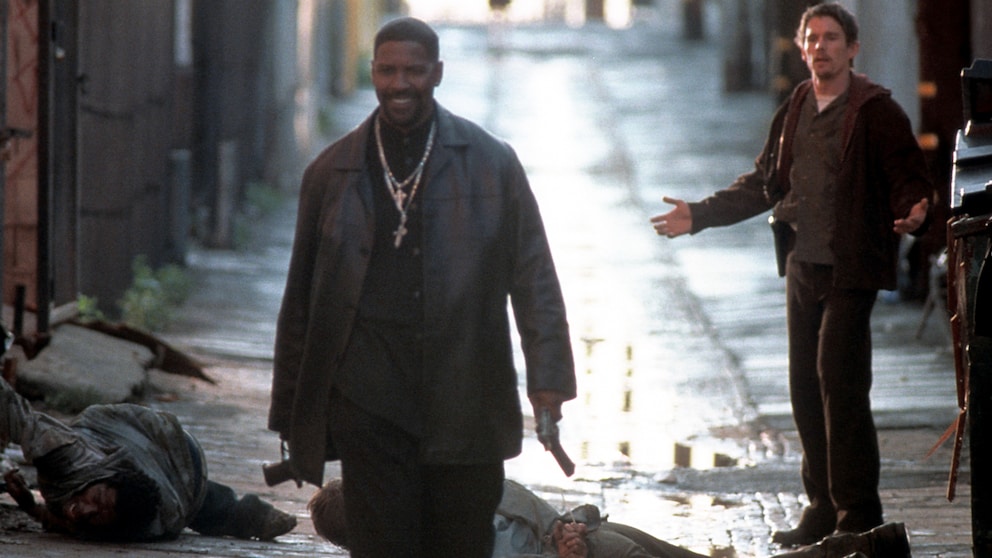
A trial day alongside experienced Detective Alonzo Harris (Denzel Washington) is supposed to show whether young cop Jake Hoyt (Ethan Hawke) is suitable for the LAPD’s narcotics division. Initially, Hoyt is fascinated by the confident, smart Harris, who has an answer for every question and the right reaction for every situation. But soon the rookie has to revise his first impression. Harris turns out to be a downright psychopath who doesn’t stop at murder in his dirty dealings …
Director Antoine Fuqua’s cop thriller is less interested in the inner lives of its protagonists than in the almost magical allure that Denzel Washington brings to his character. Washington’s performance is so captivating that it’s hard to get enough of watching him. At the same time, this makes the police film somewhat of a projection screen for a “give the monkey sugar” performance by the Hollywood star. No question, his performance is outstanding. So good, in fact, that it was rightly rewarded with an Oscar, despite a finale where Washington threatens to fall into overacting.
That “Training Day” doesn’t become a mere one-man show for Washington is thanks in no small part to Hawke. He makes much more of his thankless role as the greenhorn than might have been expected. He plays Hoyt’s fear, as he falls into the clutches of a Latino gang, in a literally palpable and impressive way–earning him a well-deserved Oscar nomination for Best Supporting Actor a year later.
Narc
Investigator Nick Tellis (Jason Patric) works as a “Narc,” an undercover detective, for the Detroit police. During an operation, he accidentally shoots a pregnant woman, causing her to lose her unborn child. Tellis suffers trauma and is suspended. Eighteen months later, when a cop from his former unit is killed, they hope for Tellis’ insider knowledge and assign him to the case. Soon he encounters Henry Oak (Ray Liotta), the deceased officer’s former partner …
Dark, dirty, shabby, and corrupt–that’s the world of “Narc” and thus Detroit in 2002. “Narc” portrays the once-thriving center of the American automotive industry as a place of increasing social decline. Lack of prospects and a rapidly rising crime rate prompted many people to leave the city at that time. Detroit lost a third of its population since 2000.
Director Joe Carnahan convincingly captures this milieu in this police film. Hopelessness and darkness are the norm here, not the exception. And disillusionment prevails not only on every street corner but also within the institution that is supposed to protect the city and its people. What ultimately makes “Narc” a small, albeit little-known masterpiece is the duel between Patric and Liotta. They brilliantly portray two men who want to do the right thing, but whose actions inevitably lead to destruction and death.
Read also: 10 series with quirky detectives
Dark Blue
L.A., April 1992: The (later scandalous) verdict in the Rodney King trial is imminent, and tensions are high in the African American community. Meanwhile, Detective Sergeant Eldon Perry (Kurt Russell) tries to prepare his young partner, Bobby Keough (Scott Speedman), for the harshness of the job with rough methods. Perry, a man always on the verge of eruption, bends the law without hesitation if it serves the cause. Chief of Police Jack Van Meter (Brendan Gleeson), himself a brutal, ruthless racist, initially covers for him. But then Perry must realize that his boss seems to be a gangster himself, worse than some of those Perry deals with on the street …
Setting the story against the backdrop of the racial unrest (Ellroy’s novel told of the racial unrest in L.A. in 1962) that took place the same year as the filming proved to be a clever move. A move that gives the film an almost documentary character at certain moments. Director Ron Shelton succeeds in translating the nerve-wracking atmosphere just before the outbreak of violence into compelling images.
That “Dark Blue” (the title refers to the color of the LAPD’s uniform) is thematically reminiscent of “Training Day” is not surprising. The writer David Ayer, who wrote the screenplay for “Training Day,” also worked on “Dark Blue,” this time adapting James Ellroy’s literary source. And the result is impressive. While Kurt Russell is not Denzel Washington, he convincingly portrays a disillusioned, internally torn cop in this police film.
36 – Tödliche Rivalen
In Paris, a special unit led by high-ranking officers Léo Vrinks (Daniel Auteuil) and Denis Klein (Gerard Depardieu) investigates a series of brutal robberies on cash transports. The pressure to deliver results weighs heavily on them, especially since both aspire to the position of chief of the Paris police. When Klein learns that Vrinks is covering for the gangster Silien to get to the criminals, he betrays him. Vrinks is sentenced to several years in prison, and Klein is promoted to police chief of Paris. But then he causes the death of Vrinks’ wife during an operation against Silien …
The only French genre entry on this list, which is not due to a lack of quality. On the contrary: Almost all of director Olivier Marchal’s contributions tackle the subject with an almost impertinent, dark grimness, devoid of even the slightest hint of the gloss that sometimes plagues U.S. productions. This relentless authenticity is not surprising, given that Marchal, who occasionally appears as an actor–for example, in the series adaptation of “The Crimson Rivers”–was a cop in a previous life. He knows the abysses on whose edge his former colleagues repeatedly stand–and sometimes even fall.
However, it must also be said that the aforementioned grimness sometimes leads to infernal eruptions of violence that do not always seem dramaturgically necessary. Nevertheless, “36 – Tödliche Rivalen” is not only one of the best European police films of the past two decades but one of the best overall. That the acting gods Auteuil and Depardieu have their share in this is almost self-evident. By the way: For those wondering about the cryptic, yet meaningless German title, the original, “36 Quai des Orfèvres,” refers to the address where the Paris Criminal Police Directorate was located until 2017.
Departed – Unter Feinden
In much of Boston, the Irish Mafia, led by the brutal Frank Costello (Jack Nicholson), holds sway. Years ago, he managed to plant one of his followers, Colin Sullivan (Matt Damon), within the police force. Young police cadet Billy Costigan (Leonardo DiCaprio) is now tasked with infiltrating Costello’s organization due to his family background–Costigan’s uncle was a member of the Irish Mafia. He is dishonorably discharged and imprisoned as a ruse. After his release, he successfully infiltrates Costello’s gang. But soon the rookie is at risk of being exposed, and it becomes clear that things are much more complicated than initially assumed …
Unlike Martin Scorsese’s other great gangster epics like “Casino” and especially “Goodfellas,” “Departed – Unter Feinden” doesn’t exclusively adopt the perspective of the mobsters but also equally that of the cops. So far, so good. The special twist, however, lies in the fact that here the cop acts as a criminal and simultaneously the criminal as a cop. It is from this play of illusions that “Departed – Unter Feinden” derives its unique appeal.
Anyone who has seen both films will recognize that Scorsese’s work is significantly influenced by the Hong Kong cop thriller “Infernal Affairs” (2002)–no wonder, as it is its U.S. remake. And like the original, the remake was also a success. Not only did the police film win four Oscars, including for Best Director, but it is also, to this day, Scorsese’s second most successful film with a box office gross of $290 million.
11 Police Series That Changed the Genre Forever

10 Sci-Fi and Fantasy Series We Love
Helden der Nacht – We Own The Night
Robert Grusinsky, aka Bobby Green (Joaquin Phoenix), runs a nightclub suspected of being a drug hub for the Russian Mafia. This repeatedly brings him into conflict with his father Burt (Robert Duvall) and his brother Joseph (Mark Wahlberg). Burt is Deputy Chief, and Joseph is a cop with the NYPD. After a raid at the club leads to a brawl between the two brothers, Joseph is shot on the open street …
The police are the family–and vice versa. At least that’s how Deputy Chief and his son Joseph see and wish it. But Robert is the black sheep of the Grusinskys. He even took his mother’s last name to hide his relationship with the police as much as possible. Thus, “Helden der Nacht – We Own The Night” is more of a melancholic family and milieu drama in the guise of a cop thriller than vice versa–which only benefits the film. Director James Gray had already delivered two convincing milieu studies with “Little Odessa” (1994) and “The Yards” (2000), which also showed how organized crime infiltrates, undermines, and ultimately destroys the institution of family.
For context: The original title “We Own The Night,” translated as “We Own the Night,” was the motto of the New York police in the late 1980s, when the film is set. “Law and Order,” the hardline enforcement of the law, was supposed to clean up the streets of the “Big Apple” under President Ronald Reagan and U.S. Attorney Rudy Giuliani.
Gesetz der Straße – Brooklyn’s Finest
Officer Eddie Dugan (Richard Gere), who is about to retire, is assigned a new partner, the young hothead Melvin Panton (Logan Marshall-Green). Meanwhile, Detective Salvatore “Sal” Procida (Ethan Hawke) tries to get money to leave the mold-infested house with his sick wife Angela (Lili Taylor). And Detective Clarence “Tango” Butler (Don Cheadle), who hoped to return to regular duty after three years undercover, is asked to take on one last job …
Once again, Antoine Fuqua and once again Richard Gere. One might have expected “Gesetz der Straße – Brooklyn’s Finest” to be a variation, a lukewarm rehash of “Training Day,” with “Internal Affairs” Gere in the Denzel Washington role. But fortunately, that’s not the case. This film has no more to do with “Training Day” than that it also deals with cops in the borderland between good and evil.
Three cop fates and thus three men who must make decisions in their jobs. Decisions that threaten to be taken from them by the power of events. Fuqua convincingly shows these men in the conflict between what the job demands of them and what would be best for their families and themselves. This brings “Gesetz der Straße – Brooklyn’s Finest” much closer to a milieu study like “Helden der Nacht – We Own The Night” than to “Training Day,” especially since this is not a one-man show but a moving ensemble drama.