

October 7, 2026, 9:18 am | Read time: 2 minutes
A new quantum computer from IBM solved a complex computational task in just 19 seconds. According to researchers’ calculations, a classical supercomputer would take about 110 years to complete the same task.
Superprocessor Relies on Qubits
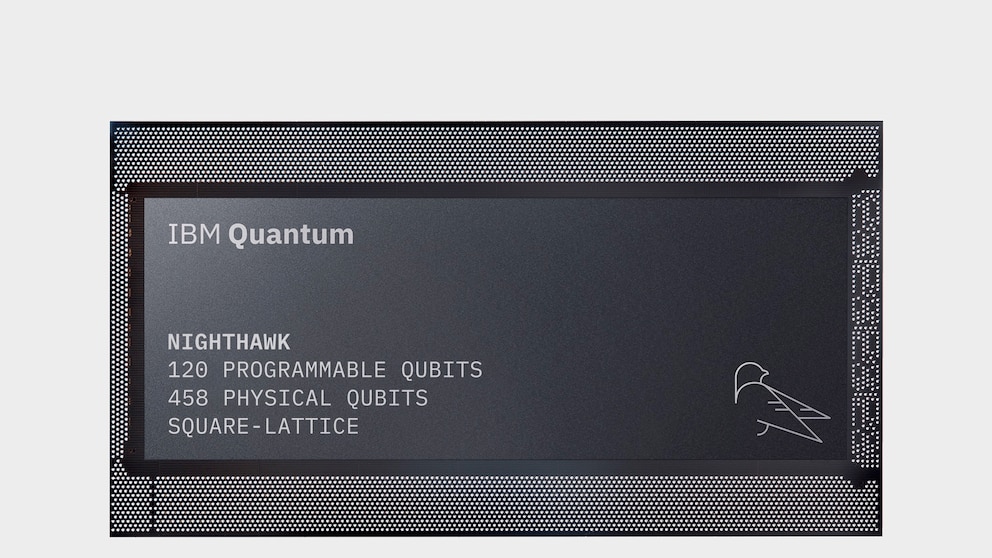
IBM’s new quantum processor is named “Nighthawk r2” and operates fundamentally differently from conventional computers. Classical computers work with bits, which can only be in one of two states: 0 or 1. Billions of these switches process data, programs, images, or videos.
Quantum computers, on the other hand, use so-called qubits. These can be compared to a spinning coin. While a coin lying flat shows only heads or tails, a spinning coin can, in a sense, represent both states simultaneously. This allows quantum computers to handle certain computational tasks in parallel, without having to check each possibility sequentially. This is considered a significant advantage, especially in complex simulations, optimization problems, or the development of new medications.

Researchers Develop Super Battery

Jobs at Risk Due to Artificial Intelligence
Nighthawk r2 Demonstrates IBM’s Capabilities
As reported by the science portal Science Alert, IBM provided researchers with a “Nighthawk r2” via the cloud for an experiment. The processor has 120 qubits, 61 of which were used for the test. These were connected in a series of increasingly complex and randomly generated computational steps.
The system then repeated the measurements very frequently, generating a million results. After a total of 36 computational rounds, the quantum computer achieved its goal: The task was completed in just 19 seconds. The result demonstrates the potential that modern quantum processors now have for certain specialized tasks.
Also interesting: German researcher builds the internet of tomorrow
Supercomputers Remain Relevant Nonetheless
The researchers then calculated the effort a classical computer would need for the same task. According to their estimate, about 1.2 × 10²⁷ computational operations would be required. Even “Frontier,” one of the most powerful supercomputers in the world, would take about 110 years to complete it.
However, this does not mean that quantum computers have already displaced classical high-performance computers. The calculation is based on a specific method for estimating the effort. If a more efficient algorithm for classical systems is found, the required computation time could be significantly reduced. Nevertheless, the experiment provides further evidence of the significant lead that quantum computers can now have in selected tasks.