

September 4, 2025, 8:14 am | Read time: 4 minutes
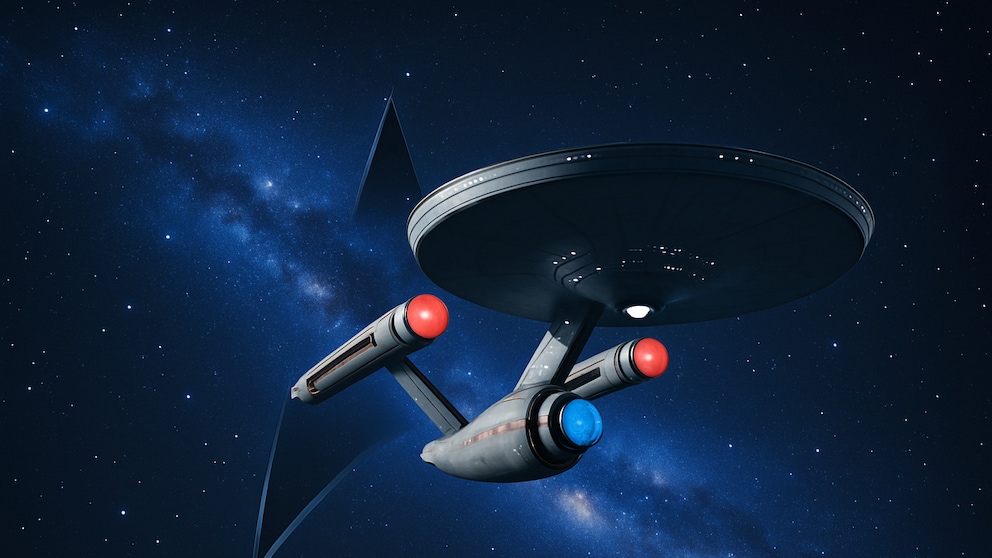
The TV series “Star Trek,” known in German as “Raumschiff Enterprise,” has created an entire universe. That’s why “Trekkies”–as the fans of the series call themselves–still adore Captain Kirk and Mister Spock. Through these science fiction heroes, humanity also learns about warp drive, or traveling faster than light. While such a drive was long considered a fantasy, researchers have now shown that warp drive is more than that. TECHBOOK ventured into the infinite expanses to learn more about it.
Tim Dietrich is a professor of theoretical astrophysics at the University of Potsdam. He is also a big Star Trek fan. Together with two British scientists, he created a coherent simulation of the collapse of a warp bubble as part of a study. The explanation of why this is important for the theoretical development of a warp drive follows shortly.
First, a little physics refresher. A warp drive has long been a purely hypothetical propulsion system for spacecraft. Normally, the speed of light is considered the absolute limit for these.
What is a Warp Drive?
The warp drive suggests that if you distort the space around the spacecraft without moving it faster itself, the spaceship can travel faster than light within a so-called warp bubble. The warp bubble is created by compressing the space in front of the spacecraft while stretching it behind. This creates a suction effect that would be faster than light–the warp drive.
In 1994, Mexican physicist Miguel Alcubierre developed a mathematical description of this principle within the framework of general relativity.
Warp drive, general relativity, and “Star Trek”–how did the idea to combine these and research them come about? “First of all, all three of us are huge ‘Star Trek’ fans,” Tim Dietrich explains in an interview with TECHBOOK. “Although this study is a side project alongside our actual research, our result is mathematically based on solid ground,” the physicist emphasizes.
Read also: The world’s first real lightsaber could come straight from a Star Wars movie

Sex with Robots Could Soon Be Part of Everyday Life

Yoona Founder: “It’s Still Not Normal for Women to Start a Business”
Despite Science Fiction, Very Realistic
For their research work, Tim Dietrich and his two colleagues delved deeply into the Star Trek world. They also examined how realistically the series’ writers worked. “The screenwriters put a lot of effort into depicting the laws of physics. They succeeded, considering that the first episodes aired in the U.S. in 1966,” Tim Dietrich emphasizes.

After publishing their study results, the researchers also had the opportunity to speak with the series’ scientific advisor, Dr. Erin MacDonald. She carefully ensures that the physics in the many spin-offs and films of the “Star Trek” series is accurately portrayed.
Warp Bubble: Theoretically Measurable
With their study, the three researchers were able to show what happens when a warp bubble collapses. Gravitational waves would be generated, which could be measured in the form of electromagnetic signals. However, the result does not yet explain the warp drive itself but only shows that if it existed, the warp bubble could be detected with detectors–at least theoretically.
Today’s gravitational wave detectors are not yet capable of this. However, the development of such technology is at least conceivable in the foreseeable future. Much more challenging remains the distortion of space around the warp bubble.
“The amounts of energy and the forms of energy required for this seem simply too large or beyond human imagination,” Tim Dietrich gives a sober assessment of the warp drive. Not even the energy of all power plants, all stars, and all suns combined would be enough to distort the space in front of and behind the warp bubble.
At least in the TV series “Star Trek,” it is a certain Dr. Zefram Cochrane who undertakes the first space flight with warp drive in 2063. There’s still some time until then. Can this be solved physically by then? “As I said, I’m very skeptical,” Tim Dietrich says, adding with a wink, “However, my two co-authors of the study are much more optimistic.”
Perhaps by then, at least teleportation will work.