

July 4, 2024, 6:02 am | Read time: 5 minutes
Starting in July 2024, Brandenburg-Berlin Airport will offer a new, smart service. TECHBOOK provides an overview of how BER Biometrics works and the status at other airports.
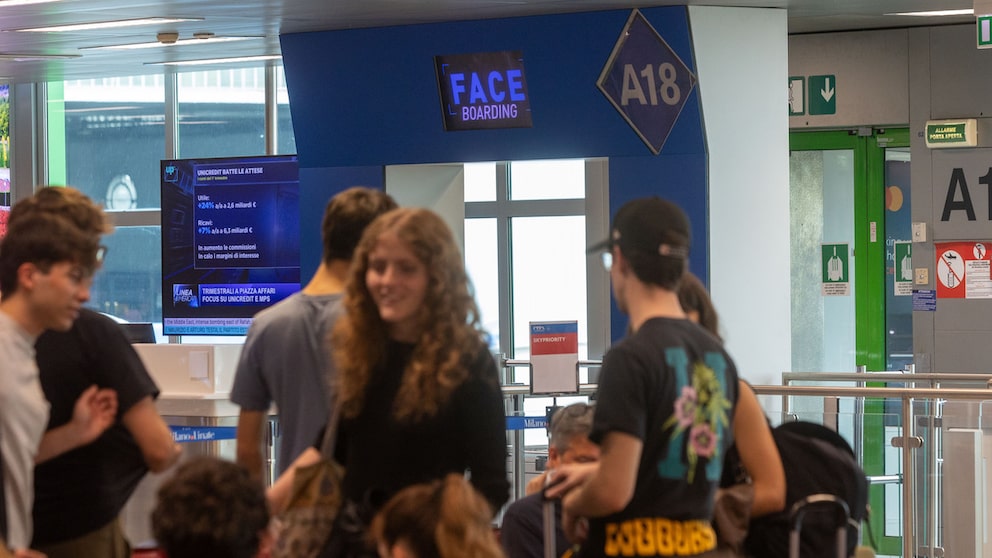
The vacation season is approaching, and for many people in Germany, that means checking in, boarding, and taking off. Those who wish can minimize contact with airport staff to almost just the mandatory security check: Online check-in or self check-in and fast bag drop at kiosks make it possible. Now, BER Airport is taking another step toward a smart airport: Biometric facial recognition is set to make manual boarding pass scanning obsolete. The concept promises more comfort for travelers and faster processing in less time.
“Face Boarding” instead of traditional boarding pass
The use of biometric facial recognition at airports has long been standard for passport control. For several years, airports, airlines, and companies like Airsphere and Star Alliance Biometrics have been testing facial recognition for the boarding process. The first terminal with biometric boarding in the U.S. was opened by Delta Airline at Hartsfield-Jackson Airport in Atlanta in 2018. In Europe, airports in Vienna, Frankfurt am Main, Milan, and Munich offer this service. Just in time for the summer holidays, the German capital airport is following suit.
Starting Monday, July 1, 2024, travelers aged 16 and over can voluntarily use the alternative face-boarding service at Berlin-Brandenburg Airport in Terminal 1. To do so, one must first install the SmartDepart app on an iOS or Android smartphone.
In the app, users register with their name and email address and must upload a selfie. This is matched with a live image at designated stations at the airport. If the biometric facial recognition is successful, the gate door opens, for example. Showing the boarding pass is no longer necessary. However, it is important to still carry the usual documents–passport and boarding pass.
Once registered in the app, the service can be booked for free up to seven days before departure, and the ticket can be linked with the app. Even after doing so, travelers can still print their boarding pass at the counter and present it at subsequent stations if they wish. According to the app operator Airsphere, BER Airport deletes all data after the flight. Only the encrypted data in the app, which users can manage themselves, is stored by Airsphere.
Read also: Why you no longer need to turn on airplane mode

Digital Passport for Smartphones Planned

New Google Feature Helps With Lost Luggage
Other airports lead the way
The major advantage of biometric facial recognition for customers is said to be increased comfort and smoother operations. Above all, long waits in line should be reduced. The U.S. airline Delta claims that travelers can be processed twice as fast in their biometric-controlled terminal compared to areas with conventional methods.
After the global air traffic halved in the pandemic year 2020, the number of flights is steadily increasing again. However, as of 2023, the numbers in Germany have not yet returned to pre-pandemic levels. The reasons are varied: increased environmental awareness, fewer private long-distance trips due to economic burdens and inflation, and a decline in business travel due to a more digital corporate culture. Nevertheless, significant time savings would make the airport experience more relaxing.
However, there are still some teething problems with the new system: The lack of standardization could prove inconvenient for customers. On one hand, only selected airlines currently offer the boarding service based on biometric facial recognition. Airlines supporting the service include Lufthansa, Swiss, and Austrian Airlines. On the other hand, different airports work with different providers.
For example, if you want to start your vacation from Berlin-Brandenburg, you need the SmartDepart app from Airsphere. If you fly from Munich, Hamburg, Frankfurt, or Vienna, you need the app from Star Alliance. For frequent flyers who use airports and airlines offering such a service, registration can be worthwhile. However, the time and comfort gain for vacationers who fly only once a year or less frequently still seems limited at the moment.
You still need the boarding pass
While the service in Berlin is just starting after only a two-week trial phase of the app, Vienna has had experience with biometric facial recognition since November 2021, and Munich even since 2020. In the FAQs, the Austrian capital airport emphasizes that the use of the technology is voluntary for customers and is only used in clearly marked areas. The images of scanned individuals are not stored, regardless of whether identification is successful or not. A mask does not interfere with the process.
Star Alliance Biometrics states that it stores photos, identification features, frequent flyer numbers, passport expiration dates, as well as the PIN and security questions from the app in the Microsoft Azure Cloud in the EU. Airports and airlines do not have access to the data. Passenger names are not stored.
Overall, the service is being implemented at more major German airports. However, its use is still limited to selected airlines. It is expected that its spread will increase in the coming years. Ultimately, though, biometric facial recognition is intended to replace the boarding pass in the boarding process but will not replace it as a proof document.