

July 20, 2024, 7:27 am | Read time: 8 minutes
For those looking to capture spectacular sports footage, the GoPro is the go-to choice. However, despite once shaping an entire industry, the camera manufacturer has been struggling economically for several years. What’s behind this?
GoPro is not just a brand name anymore; it’s synonymous with action cams of all kinds. Yet, although the startup founded in 2002 in San Mateo, California, created an entire industry sector, its history is marked by highs and rapid declines. The founding legend begins–quite fittingly for the brand–with a five-month surfing trip in Australia and Indonesia.
Overview
A Surfer Discovers a Market Gap
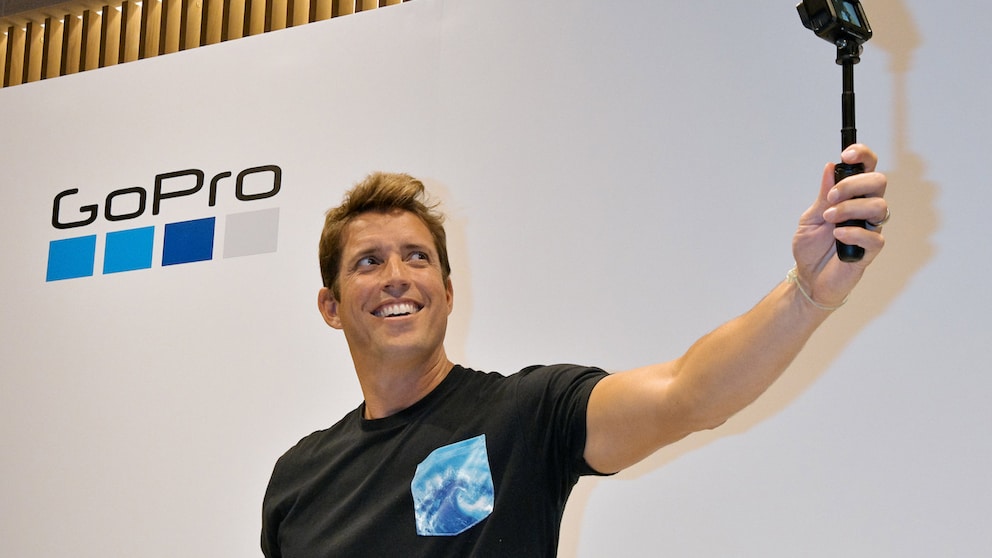
The founder and current CEO of GoPro is Nick Woodman, born in 1975 in the U.S. At one point, he was considered the highest-paid CEO in the U.S., but after a stock market dip, he fell off the billionaire list. Today, Forbes estimates his wealth at $1.1 billion. Nick Woodman often recounts the founding of his company as a success story based primarily on passion and creativity. As a passionate surfer, Woodman chose the University of California San Diego as his alma mater. According to Woodman, the proximity to the beach and his training as a visual artist were the two cornerstones of his later success.
“If you take this academic experience and combine it with the parallel experience of surfing and how enormously creative and inspiring that experience is, then UC San Diego was like a catalyst for GoPro,” he said at an alumni event. The fact that his father was a co-founder of the investment bank Robertson Stephens and could provide him with $200,000 in startup capital certainly helped as well.
The spark of an idea came to Woodman only after graduation during that very surfing trip with friends. They wanted to prove themselves as capable surfers with self-shot videos and make the leap to professionalism–“go pro,” as it’s said in English. But for that, you need a high-resolution camera that is both robust and compact. With that, Woodman discovered a niche.
Read also: The 6 Best Gimbals for Cameras and Smartphones
Eight Years as a Niche Product
In 2002, he founded his startup with the fitting name GoPro. Two years later, the first product appeared: the Hero 35mm, a small, waterproof plastic camera with a 35mm film and wrist strap. But the leap to digital cameras wasn’t far off. Facilitated by falling prices and advancing miniaturization, the first GoPro digital camera appeared in 2006. In 2007, the next innovation followed: the Digital Hero 3 now also featured sound recording.
Until 2010, GoPro remained a niche product despite its innovative value. This was partly due to the still moderate recording quality. On the other hand, the target audience was significantly smaller than today. Videos were hardly widespread on social media platforms. Instagram and Snapchat only introduced story and video functions in 2013. The classic YouTube video blog also only experienced its heyday after 2010. Although the company grew steadily since 2002 and continued to develop its products, it remained manageable and familial in line with the market situation. However, that changed from 2010 onwards.
Athletic Rise of a Lifestyle Product
With the HD Hero, GoPro brought the first truly high-resolution action cam to the market. The 1080p recordings combined with software for high-quality compression resulted in a significant quality leap for the camera. At the same time, the social media landscape began to change, allowing GoPro to grow into a billion-dollar company in the following years. Besides its own social media presence, every privately shot film was excellent advertising for GoPro.
Woodman wanted to maintain the familial atmosphere of his company, but the departmental structure had to be made more economical. Growth also resulted from a newly tapped target audience. The HD Hero models were no longer used only in the amateur sports sector. Professional TV productions also relied on the action-tested cameras.
GoPro also pursued a successful marketing strategy. The company didn’t just sell action cams and accessories but a lifestyle. Action, life, adventure–that’s what the footage promised. And as known from Red Bull, the camera manufacturer sponsors (extreme) sports events like the Ironman Triathlon in Hawaii or the Freeride World Tour.

GoPro Changed the Video World
I bought my first GoPro–the Hero 5–in 2016 to film my progress in the trending sport of parkour. Back then, HTC was still a known brand, but smartphone video recordings were only good for family gatherings. GoPro’s big advantage: the ultra-wide-angle lens, which not only shows everything the filmer sees from the POV perspective but also allows for relatively smooth footage. For many sports, including parkour, there was simply no alternative but to strap on the GoPro (or hold it between your teeth) and start filming.
But the small cameras soon became indispensable for travel as well. The compact design allows filming practically anywhere and from any perspective. So I bought a new GoPro generation after generation: Hero 6, Hero 7, Hero 8. Each was a huge step forward: better image quality, more frames per second, and above all, incredibly good stabilization. But for me, the Hero 8 was the point where I couldn’t justify a new model anymore. The footage was practically shake-free, and with 4K and 60 frames per second, it was absolutely sufficient for my needs.
Even today, I film my parkour sessions with the camera and have no desire for an upgrade. Perhaps that’s also one of the reasons why GoPro has stumbled. If a device is already so good, why should buyers put money on the table for a new model every year?
Read also: GoPro vs. DJI: Which Action Cam is Better?
GoPro vs. DJI: Which Action Cam Is Better?

New GoPro Features 8K Resolution and Interchangeable Lenses
Rapid Decline
In 2014, GoPro finally went public and experienced its economic peak. Ten years after the first Hero hit the market, GoPro had expanded a niche into a relevant industry sector. “One morning you wake up, and the company you founded with your college friends is the fastest-growing digital photography company in the world,” said Woodman.
But with success came increased competition, especially from Chinese manufacturers like DJI and Insta 360. As the demand and use of action cams rose, GoPro faced a target audience problem again. A primary customer group in the amateur sector was young adults and teenagers who wanted to film their skills with skateboards, BMX, and more. However, they didn’t need 4K resolutions or sophisticated mounting accessories, but above all, affordable action cams. The competition from Asia benefited from the path GoPro had paved for the industry and now pushed prices down. The increasing camera quality of smartphones also made external cameras obsolete in some situations, putting additional pressure on GoPro.
The consequences are directly reflected in GoPro’s stock price. At its peak in 2014, it was about 64 euros, today it’s under 2 euros. The value dropped between July 2015 and February 2016 and has remained stable in the low range since then. GoPro’s attempt to mitigate the damage with an even lighter, more compact product–the Hero Session–did not succeed. Unlike the competition, the manufacturer could not or would not lower the price.
A New Business Branch?
At one point, however, there seemed to be a light at the end of the tunnel when GoPro entered the drone business. Since the manufacturer was already targeting an outdoor-oriented audience, the move seemed logical. The hype surrounding drones since 2015 likely justified the investment of almost $100 million. But the innovation business was preceded by significant losses on the stock market and mass layoffs. Although the drone “Karma” had a hopeful name, it couldn’t meet expectations. Quite the opposite.
Fundamentally, “Karma” was a good idea. The drone seamlessly integrated into the GoPro ecosystem, and the mini camera Hero 5 already met the requirements of a drone camera. But the drone, priced at about $800, proved to be technically immature. Users faced issues with malfunctions and crashes. GoPro was forced to recall all 2,500 sold drones just a few months after the launch in the first quarter of 2017. In January 2018, GoPro officially withdrew from the drone business. The reputation as an innovation company was severely damaged.
How GoPro will develop in the future is uncertain. The action cams are still high-quality cameras with very good image stabilization and software solutions. But beyond that, there seems to be little room for technical innovations. Instead, GoPro has introduced a subscription model with a cloud and even more extensive software offerings. Apparently, expansion is primarily being pushed in this area. Direct sales allowed GoPro to achieve a larger net profit in 2021, but it did not prove sustainable. The latest business figures also suggest that GoPro does not have enough money for major development projects. The “next big thing” does not seem to be in sight.