


May 15, 2023, 2:52 pm | Read time: 6 minutes
With the iPad Pro and its MacBooks, Apple has long been operating on two fronts. But the platforms are increasingly converging–Macs support iPad apps and iPads have keyboards and trackpads. According to TECHBOOK editor Adrian Mühlroth, the iPad Pro will eventually prevail and make laptops obsolete.
In terms of performance, the iPad Pro has long surpassed most laptops. Currently equipped with the M2 chip, the tablet is even faster than the entry-level version of the new MacBook Air–and for significantly less money. The Air comes with an 8-core CPU and 8-core GPU for 1,499 euros, while the 11-inch iPad Pro has two additional GPU cores and costs 1,049 euros. Add the Magic Keyboard for 369 euros, and you have a mini-laptop for 1,418 euros that is cheaper and more powerful than the MacBook Air. However, software has always held back the iPad Pro in the past.
Overview
Read also: The Story Behind the PDF
Is Apple Playing 3D Chess or Is It Aimless?
Even with the 2018 relaunch of the iPad Pro, Apple was far ahead of the competition. A 120-hertz screen, thin display edges, and extremely high performance for a tablet. The Apple A12X Bionic chip was already faster than most laptop processors. Quite impressive–but completely oversized for iOS 12 at the time. No app could take advantage of it, and professional applications were still reserved for macOS.
When Apple introduced the Magic Keyboard for the iPad Pro in 2020, I was impressed by the elegant design but still wondered what the expensive accessory was good for. At the time, the iPad Pro practically had no apps that could take advantage of the laptop-like operation with a keyboard and trackpad. An accessory that costs almost as much as a completely new iPad should offer significant added value, right? Instead, there was only a new operation with a cursor, which was quite inconsistent at launch.
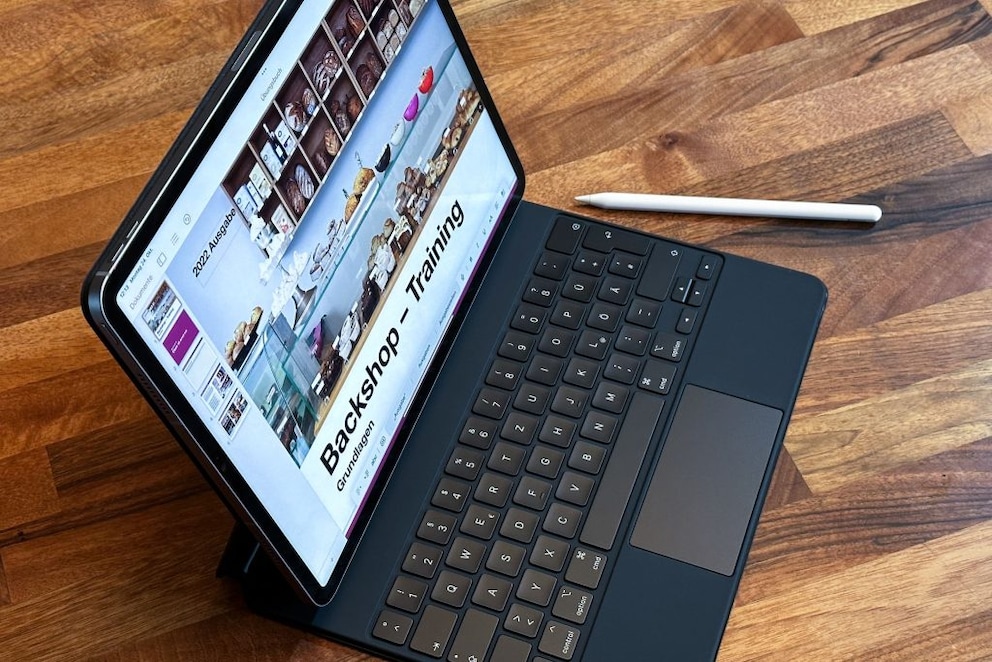
It has now become clear that Apple was pursuing a long-term strategy. The Magic Keyboard simply came very early–before performance and app offerings could catch up. With the iPad Pro with M1 and currently M2, the company has demonstrated how powerful tablet hardware can be. When Apple introduced the first iPad Pro with M1 in April 2021, I considered this innovation superfluous. At the time, iPadOS still had too many limitations, and there was no sign of Adobe Premiere Pro and Apple’s Final Cut Pro. The only apps where the higher performance could actually make a difference in rendering time. Only now is the software side catching up to the promise of a compact, flexible, and work-suitable iPad.
Read also: New iPad Pro Could Be More Expensive Than Ever
Apple Presents New iPad Air with More Powerful Chip

“I’m initially skeptical about the new MacBook!”
The iPad Pro Finally Has What It Takes to Replace a Laptop
Over the years, the iPad Pro has increasingly acquired laptop-like features–including multitasking, resizable windows, and even the Stage Manager known from the Mac. But all these features are useless without a solid app base behind them. That is now changing. At the end of 2022, the video editor Davinci Resolve was released for the iPad Pro. This already provides one of the most powerful tools for video color correction, which is highly popular in the film industry. Octane X for cinema 3D rendering and Affinity Publisher for page layouts also arrived on the iPad Pro at the same time. While this was an important step, the editing program that is the standard for many professional content creators for video editing was still missing: Final Cut Pro. The long wait is finally over. On May 23, a version specifically developed for the iPad Pro of the Apple program will be released.
Almost as if Apple wants to make up for lost time, Final Cut Pro for the iPad Pro comes with a completely new interface. You can scroll through the timeline using a jog wheel and draw or write directly over video content with the Apple Pencil. Additionally, the tablet version of the editor can directly access the camera and record videos in ProRes format. It’s a bit unfortunate that at least an iPad Pro with an M1 chip is required for this. The problem isn’t the performance–even the A12 Bionic chips in older iPad Pros have enough resources. The older models simply have too little RAM. Final Cut Pro requires at least 8 gigabytes, which is only standard starting with M1.
At least owners of older iPad Pros can look forward to the second software innovation from Apple: Logic Pro. The well-known digital audio workstation with sequencer allows the creation and editing of music samples. Here, too, the studio microphones of the iPad Pros can be used for quick recording of voices and instruments.
Who Still Needs a MacBook?
The software naturally comes at a price: Both apps cost 4.99 euros monthly or 49 euros per year. However, those who use the programs professionally will hardly be bothered by this. More importantly, Final Cut Pro and Logic Pro demonstrate desktop-level functionality, showing that Apple finally takes the iPad Pro seriously as a laptop replacement. This is encouraging, as the high-end tablets have long been able to match the hardware in MacBook Pros–and far exceed that in the MacBook Air.
In the future, it will be difficult for Apple to justify the MacBook Air as an entry-level laptop. Only those who still use older desktop apps that are only available for macOS should opt for a Mac. Even here, there’s no reason the iPad shouldn’t eventually be able to run traditional Mac programs–it’s more than capable. By offering apps for professional use, Apple has already taken an important step that could mean the end for MacBooks. While this would be a major shift, it would be consistent. For most, the iPad Pro is already the better “laptop.” MacBook Pros might only play a role in the future for truly demanding tasks that require even more power.
As for me, I’ve been using my 11-inch iPad Pro from 2018 daily for three years and will probably never return to a traditional laptop. Since I got the iPad Pro, my expensive Dell XPS 15 has been gathering dust in the corner. Together with the Magic Keyboard–which I decided to get during the COVID-19 pandemic–the tablet has become a full-fledged laptop replacement for me. Although I can’t install Final Cut Pro on it, I still edit my videos faster than on my laptop.