



November 12, 2020, 11:55 am | Read time: 11 minutes
Apple introduced three new Macs at the November event. The highlight: They feature a brand-new chip developed by the company itself.
Apple had announced it at the Worldwide Developers Conference (WWDC), and now it’s a reality. The company is moving away from its previous chip supplier, Intel, and starting to equip its Macs with its own chips.
Table of Contents
If you want to watch Adrian’s argument in the video, here is the conversation between colleague Rita Deutschbein and him:
Otherwise, continue here with the news….
Apple Introduces Its First Proprietary Laptop Chip
On November 10, Apple unveiled three new Macs: MacBook Air, MacBook Pro 13″, and Mac Mini. All devices feature the new M1–a chip entirely developed by Apple.
Unlike Intel processors previously used in Macs, the M1 is based on ARM architecture. The manufacturer ARM licenses its architecture to other companies, allowing them to create their own chip designs. Apple has been doing this for ten years now. In 2010, the company introduced the ARM-based A4 in the first-generation iPad–its first self-developed chip.
Intel has been in a challenging phase for some time, making slow progress. For about four years, Intel has struggled to transition to a more modern manufacturing process. As a result, the manufacturer’s processors suffer from poor energy efficiency and limited battery life. Apple, as one of the main buyers of these processors, is particularly affected by these limitations. The company aims to end this dependency with its own chips.
The Apple M1 in Detail
The M1 is the first system-on-a-chip (SoC) in a Mac. Previously, various components were distributed across the mainboard. Intel processor, memory controller, and memory itself were separate chips. The M1 integrates all these components into one chip with shared resources. Apple calls this the “Unified Memory Architecture.” This means all components communicate directly and access the same memory resources, allowing the M1 to operate much more energy-efficiently.
The deeper chip integration also means that RAM can no longer be upgraded later. If you buy 8 GB, you’re stuck with 8 GB–even if you do a lot of internet browsing, you should consider whether that’s enough. Especially for the Mac Mini, the lack of memory upgradeability is disappointing. However, the entry-level Mac is now 100 euros cheaper.
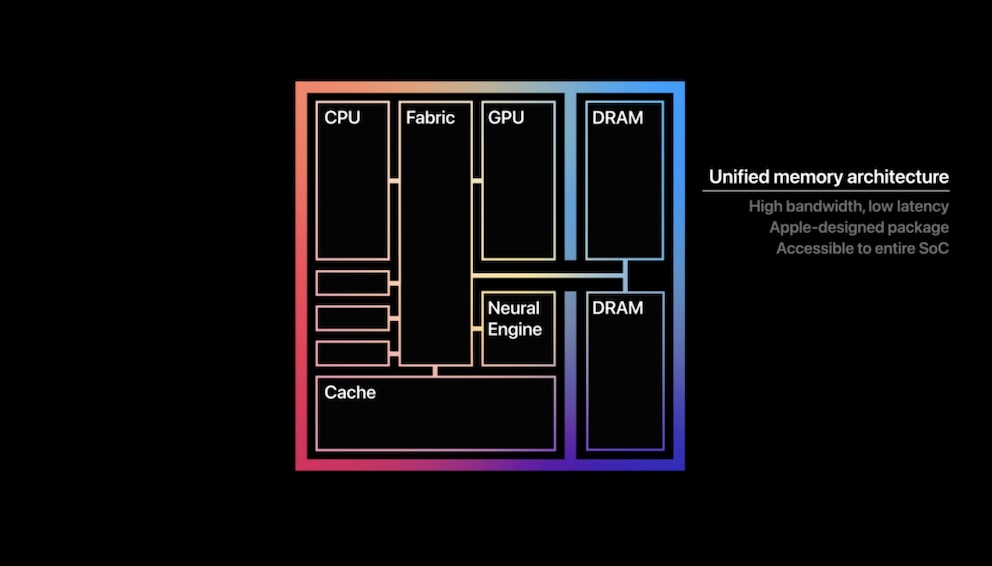
The M1’s CPU consists of eight cores, four optimized for performance and four for energy efficiency. We already know a similar arrangement from the A12Z Bionic in the 2020 iPad Pro. The GPU also has 8 cores.
More Performance and Less Power Consumption?
However, such a significant shift presents a major challenge for the company. It must prove that its “Silicon” (Apple calls its new product “Apple Silicon”) can match or even surpass the previous Intel processors.
What Apple ultimately delivered at the November event was neither here nor there. The company threw around numbers about how much better and more efficient the M1 is. “3x” more, “6x” more, “faster than 98 percent of all PC laptops”–but what’s behind these numbers?
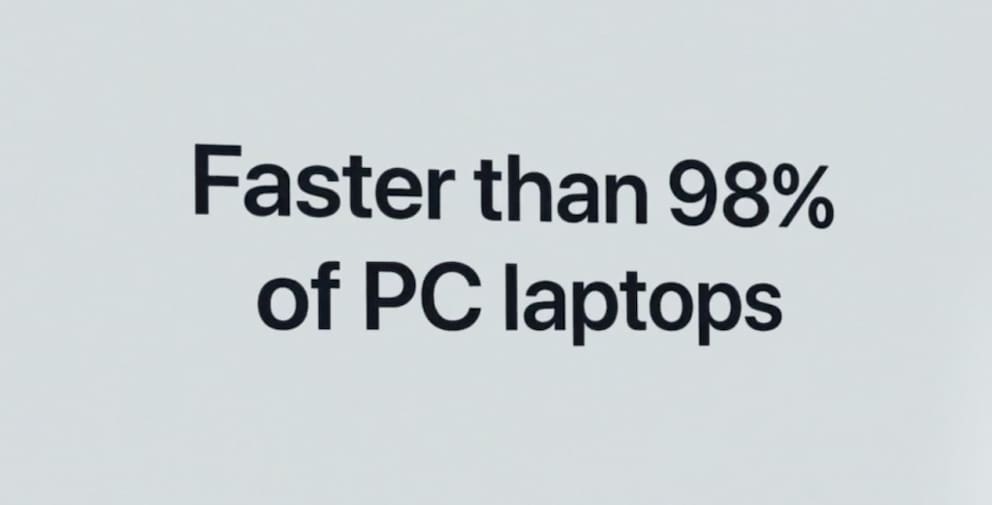
What Apple shows in its presentations is mostly based on solid ground. But the company is very secretive about how the numbers are composed. So far, we only have claims that Apple made at the event.
The MacBook Air is supposed to deliver 3.5 times more processor performance and 5 times more graphics performance than its predecessor, which is only six months older. But which MacBook Air does Apple use as the basis for its claims? 3.5 times more performance than the base model with an Intel i3 dual-core processor? Or the significantly stronger model with an i5 quad-core?
For the MacBook Pro, Apple talks about 2.8 times more CPU performance and also 5 times more graphics performance. Even with the Pro model, it’s unclear whether the i5 quad-core or the i7 quad-core is used for comparison. When it says the new MacBook Pro is “three times faster than the best-selling Windows laptop in its class,” what class is that? Measured by price, performance, or perhaps form factor?
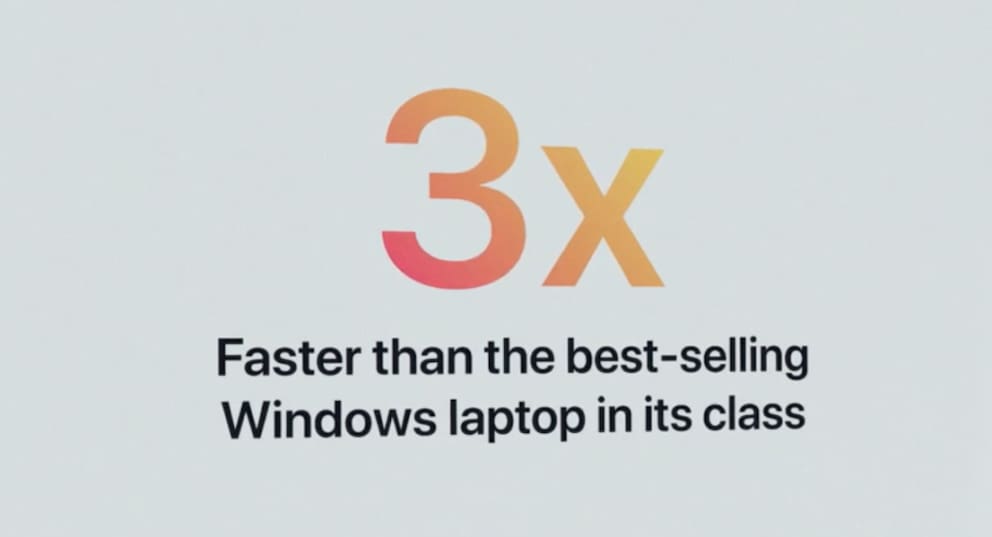
The best-selling laptops are hardly the ones with the best performance. From what we know, the Windows laptop in the same class could be a 400-euro budget laptop. Hardly a comparison for a 1,400-euro MacBook–or a 1,400-euro Windows device.
Apple provides no answers to all these questions, which is extremely misleading for the buyer. As long as there are no independent performance tests, the claims remain unverified and floating in the air.
No Basis for Apple’s Claims
With Macs using Intel processors, it was easier to measure performance jumps from generation to generation. This is because we already know almost all the details about the chips and can assess their performance. Apple Silicon chips are entirely new to us, and we have no reference point for what they can deliver in a laptop form factor.
The vagueness of the statements is particularly evident in the claim that the M1 is “the fastest CPU core in the world.” Where are the comparisons with high-end desktop processors like the AMD Ryzen 9 5950X and Intel’s i9-10900K? Anything to substantiate this claim?

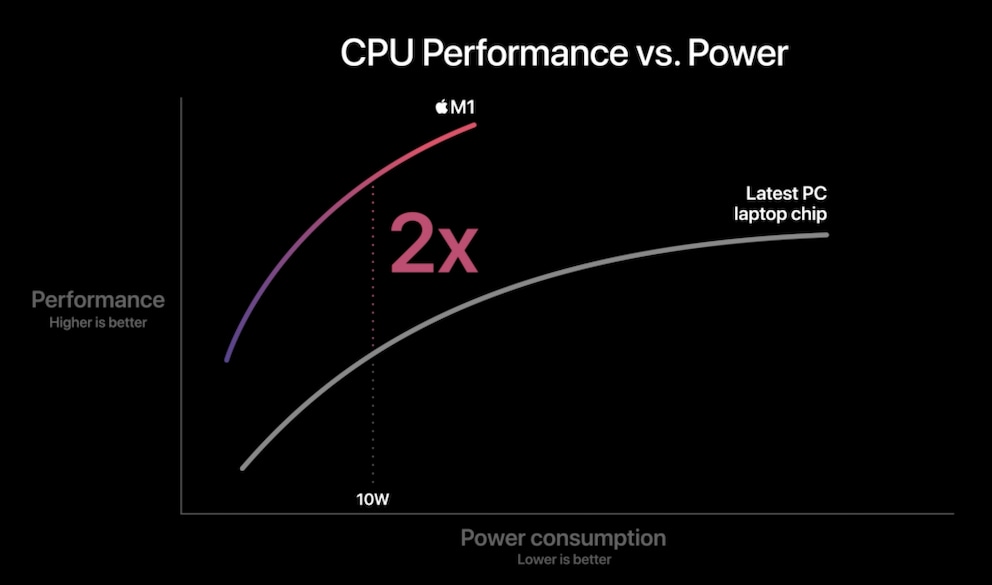
Apple shows graphs–if you can call them that–intended to demonstrate the M1’s performance. However, I find them hardly meaningful. The placement of the curves seems completely arbitrary, with no scales on the axes. As a comparison point, Apple uses the “latest PC laptop chip.” What is this? A mystery. Does Apple mean Intel’s Tiger Lake processors, which range from 2 cores to 8 cores with 16 threads? Or perhaps the Tremont SoCs, which Intel manufactures for affordable entry-level laptops? I have no clue how to assess the claim “twice the performance at a quarter of the power consumption.” All the curves tell me is: Apple’s M1 is better than something. Who is supposed to be convinced of the new chip’s capabilities?
Power Consumption Seems Promising
Apple has always struggled with heat development in Intel chips. MacBooks are known for running too hot and having issues cooling down the hardware. Here, the M1 could really make a difference. The fact that Apple can completely do without an active fan in the MacBook Air is proof that the M1 runs more efficiently and cooler. However, whether Apple has also managed to control the high surface temperatures on the casing, which are common with Intel MacBooks, remains to be seen.
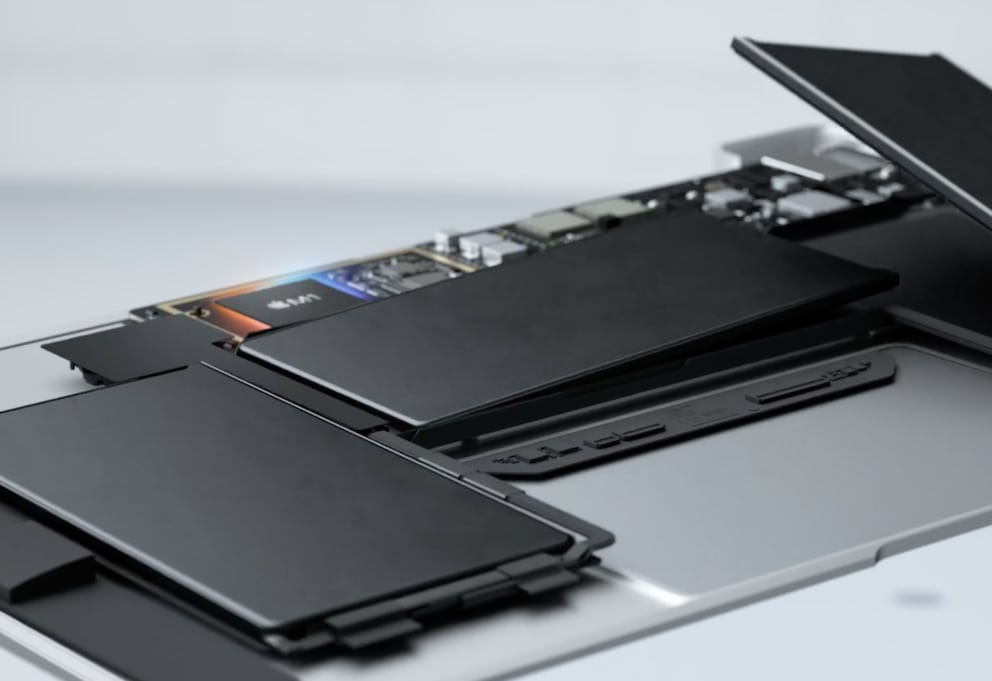
Where I do trust Apple’s claim is the battery life. Here, the integrated design of the M1 can really flex its muscles. The MacBook Air achieves 18 hours of video playback–that’s 6 hours more, or 50 percent, than its predecessor. The MacBook Pro even reaches 20 hours, twice as much as the predecessor.
No Changes to the Design of the Macs
What particularly surprised me about the presentation is the fact that all the Macs introduced have exactly the same exterior as their predecessors. Unfortunately, this means that the MacBook Air and MacBook Pro still have large bezels around the display.
Apple has been using this design for four years now. I would have hoped that the company would present a more modern look for such a significant shift as the M1 is supposed to mark. It has proven it can do so with the MacBook Pro 16″ in early 2020.

Apart from the internals, there are very few changes–not even new webcams. Although the image signal processor (ISP) of the M1 is supposed to deliver better images, the quality remains limited by the 720p resolution.

Installing Alternative Operating Systems on a Mac

Apple Unveils New MacBooks with M5!
Intel Not Completely Replaced Yet
That Apple itself is apparently not entirely sure about the performance gains of the M1 can be easily seen in its sales strategy. The new MacBook Pro with M1 chip is sold in two variants. However, the old MacBook Pro with Intel processors, which according to the presentation was surpassed in all respects by the new one, is still offered. But not as a cheaper alternative, no. The old MacBook Pro is available in two more expensive variants than the new one. If the M1 chip is really that much better, why does Apple still offer the old devices?
The new models also come with a maximum of 16 GB of RAM, while the old ones can have up to 32 GB. Additionally, the MacBook Pro with M1 has only two Thunderbolt/USB ports, while the Intel counterpart has four. This suggests that Apple cannot yet completely replace the old design with its new chip. How the M1 fares against its Intel rivals in real life will be revealed next week when the new laptops are delivered.
It’s also interesting that the MacBook Air now has the same M1 chip as the MacBook Pro. So what is the reason to buy a MacBook Pro? I suspect that Apple artificially limits the M1 in the Air by capping the clock speed. This would also explain why the Pro needs an active cooler while the Air does not.
Also read: “The iPhone 12 disappointed me, so I’m now opting for the …”
Apple Focuses Mainly on App Optimization
I assume that we will initially see the major performance leaps only in apps that come from Apple itself. It is mainly an optimization for the new chip that provides advantages.
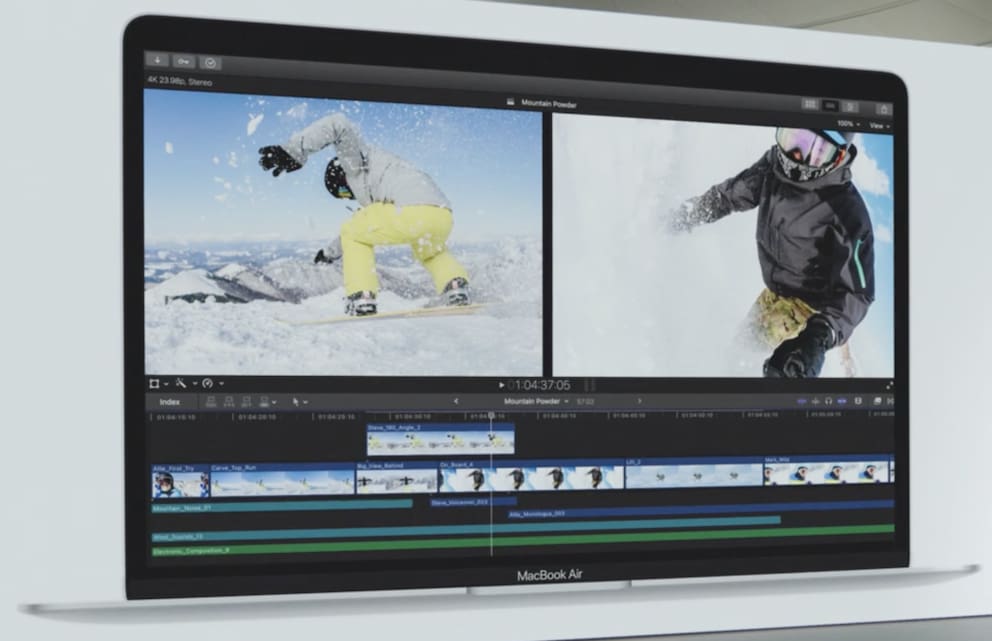
What is possible with this is shown by editing 4K ProRes videos in Final Cut. Working with multiple timelines is a challenge even for high-performance laptops. Now this is supposed to be possible with a fanless MacBook Air. However, the question arises whether the performance is equally high with other codecs. After all, ProRes comes from Apple itself and is therefore well optimized. Film cameras, however, record in H.264 or H.265; is the performance just as good here?
New macOS Required
MacBooks with the M1 start directly with the new macOS version Big Sur. This is necessary because only Big Sur was developed from the ground up for the new chip architecture. At least all old programs and apps written for Intel’s X86 processors and not yet optimized for the new system run automatically on the new M1 Macs. This is at least what Rosetta 2 promises, Apple’s software that translates X86 code into ARM code in real time–while the app is running. Although there are no figures yet, it is very likely that unoptimized apps will run significantly slower due to the translation process than on previous Intel Macs.
Users who need their Mac for work could be severely limited by this. If work software suddenly doesn’t perform as usual and developers need time to adapt, it can quickly lead to outages.
macOS and iOS Grow Closer
A benefit of the ARM-based M1 is that iOS and iPadOS apps can now also run on the Mac. This is because Apple’s A-series processors, which are in iPhones and iPads, are also based on ARM architecture.
Apple Still Has a Lot to Do
It will take a while for developers to adapt their apps to the new architecture. A new version of Photoshop is expected to come out in early 2021. Only then can users truly benefit from the M1’s higher performance.
At least Apple itself admits that not all apps can immediately benefit from the performance. In an unusually self-reflective moment towards the end of the presentation, the company acknowledges that it still has a lot of work to do to fully exploit the potential of its own chips.