


June 7, 2023, 12:03 pm | Read time: 7 minutes
Women remain significantly underrepresented in the tech world, especially in leadership roles. TECHBOOK spoke with founder Güncem Campagna about the reasons and how more women could be brought into the industry.
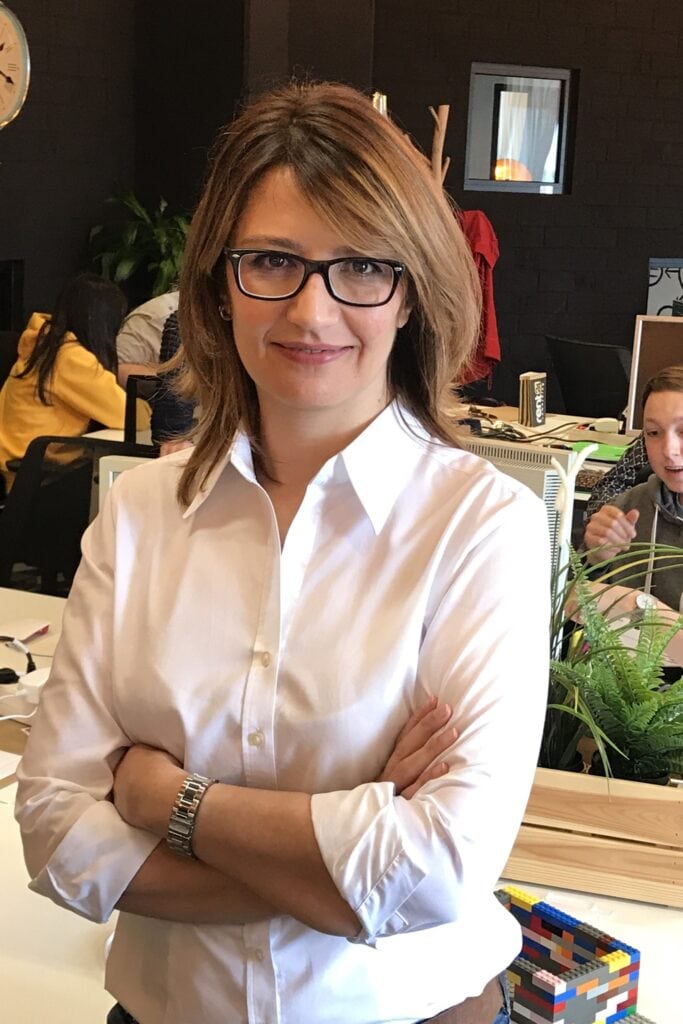
Güncem Campagna is the founder and CEO of the nonprofit “tech and teach gGmbH” in Düsseldorf and the first chairwoman of “Women in Tech e.V.” With her work, Campagna aims to significantly improve opportunities for women to pursue tech careers. In an interview with TECHBOOK, the 49-year-old reflects on her own career path, discusses the challenges women still face today, and explains why things are better in other European countries than in Germany.
Interview with “tech and teach” Founder Güncem Campagna
TECHBOOK: Ms. Campagna, you are the founder and CEO of the nonprofit “tech and teach gGmbH.” What does this organization stand for?
Güncem Campagna: “tech and teach” offers a wide range of educational programs on technological topics for children, teenagers, teachers, and adults looking to further their education or change careers. At the same time, I am the first chairwoman of “Women in Tech e.V.,” which aims to connect women in tech professions in the German-speaking region and advise potential newcomers on career opportunities.
Today, a certain level of understanding of new technologies is indispensable. How did “Tech” influence your career planning?
Initially, not at all; my career path was planned quite differently. I studied economics to understand how the economy as a whole works. However, my heart has always belonged to marketing, which eventually led me to a large corporation in international automotive marketing. Unfortunately, I soon realized that I kept hitting limits because many structures in corporations are very static. By nature, I am a doer, so I left the corporate world in 2014. I was unemployed for a whole year and had to realize that I was suddenly left behind as the world moved increasingly toward digitalization.
Was there an aha moment?
Yes. Whenever I looked at job ads, they contained so many terms from the digital world that I didn’t understand, which was quite a shock for me. But I quickly did everything I could to acquire digital skills on my own, attending many events on digital topics. Suddenly, I realized how well I could bridge the gap between the world of traditional business and marketing on one side and the digital world on the other.
Did you have specific role models?
No, at least not a specific person. For me, the fields of economics and marketing were the areas I was drawn to. In that sense, you could perhaps say that economics and advertising were my role models.
Also interesting: Interview with eSports player Dilana: “How often I’ve heard: ‘You’re really good for a woman'”
Career Path in the Tech Industry
What happened next?
Eventually, I found myself as a consultant for startups, and I noticed for the first time that there were very few women in this startup world and in the corresponding tech professions. That really bothered me at the time. Digitalization has increasingly influenced our lives, health, communication, etc., but women have not participated. That’s why I started offering workshops on digital topics exclusively for women and developing corresponding business models. Unfortunately, these workshops were not very well attended, which, in my experience, was mainly because someone who lost interest in such topics as a girl was unlikely to be enthusiastic about them later as a woman.
Was this realization the foundation for “tech and teach”?
In a way, yes. In 2016, I offered the first programming workshop for girls, and from there, things took off. “tech and teach” was founded as an initiative in 2020 and was rebranded as “tech and teach gGmbH” in 2021.
Has anything changed on a broad basis since then? Are there more women in technical degree programs and professions?
I really wish I could say “Yes.” But the current situation doesn’t reflect that. What has actually changed is that there are significantly more initiatives, both publicly and privately or civil society organized, for women. However, the numbers that provide insight into women in tech professions or women founding startups are still barely moving.
What gives me hope is that it is now at least recognized that the journey into the tech world must begin very early, in school. However, this is a major problem in Germany. There is a dramatic shortage of teachers, especially in computer science, which is not a mandatory subject. While steps are being taken for the future, we will probably only know in ten or more years whether anything will have really changed by then.

IDnow Executives in Interview: “Female Role Models in IT Are Important”

The Woman Behind Germany’s Amazon Alexa on AI and Bias
“In Certain Situations, I Felt This Bias”
How was it for you personally? Were you taken seriously when you ventured into tech on your own?
I believe I was initially laughed at. No one said to my face, “You can’t do it, I don’t trust you.” But in certain situations, I felt this bias. For example, when standing in a larger group, the men would have lively conversations and show interest in the projects being discussed. But when I talked about my plans, they would at best say, “Okay, Güncem, nice, interesting.” But that was it.
I simply wasn’t taken seriously, and the business potential of the whole thing wasn’t recognized. The social aspect was seen, as they said, “Women stand for social professions.” Often, I was the only woman in such a group, which made it even more disappointing.
Does it still feel like missionary work today?
At least in the tech sector, I am still almost an exception. When women start a startup, it’s usually in areas like food, lifestyle, or social sectors. But when it comes to artificial intelligence, blockchain, etc., women are still very rare.
With “tech and teach,” you want to change that; what numbers are we talking about?
Let me first mention that our numbers have almost doubled every year so far. One reason for this is that we are now partners with the Vodafone Foundation, which has given us a significant boost. As for the numbers, last year we had around 10,000 people who took advantage of our educational offerings. This year, we expect 13,000 to 14,000 participants. Despite all the joy about this, it should not be overlooked that while we provide impulses and inspiration, we do not accompany people to their final career choice.
Situation in Germany
In Germany, there is currently a significant shortage of skilled workers, especially in technical professions. Do you believe women can be a resource here?
Absolutely! There is a strategy paper from the federal government on the topic of which resources need to be tapped to counteract the shortage of skilled workers. Women are one of the most important factors. However, many women in Germany still work part-time, more than in almost any other European country. Because these women cannot find childcare, potential working hours are lost, and this resource is not utilized. Here, in terms of childcare or even care options, politics must find solutions.
Why is it so much better in many other European countries?
Especially in the former Eastern Bloc countries or the Baltic states, the rates are much higher than ours. There, tech jobs are just like any other job–also for women. This is partly because the barriers to a technical degree, such as engineering, are not as high as they are here.
Finally, what advice would you give young women today who might be interested in a tech career but don’t know how to approach it?
The biggest mistake is not questioning something and thinking my path is predetermined. And under no circumstances should I rely solely on traditional career information services. They often still present careers that won’t exist in a few years. These advisory services simply haven’t kept up with the speed of digitalization.
Instead, I really need to listen to myself and identify my interests. If a tech career is still an option, I would try to do a series of internships first. Then I can see if the corresponding job might appeal to me in practice. I should take my fate into my own hands and dare to take the first step.