

February 26, 2026, 2:14 pm | Read time: 5 minutes
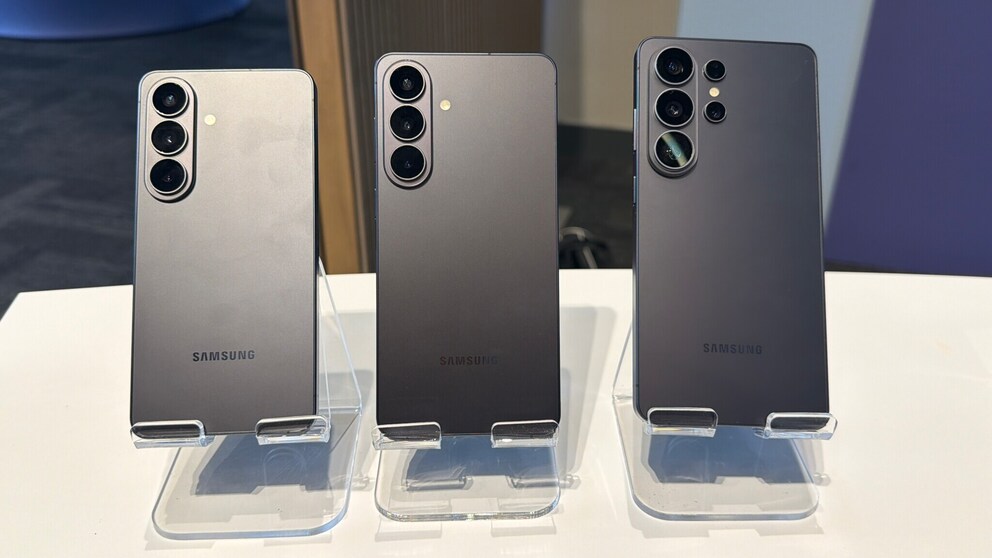
One of the most important events of the year for Samsung has taken place: the unveiling of the new premium smartphones. The Galaxy S26 series includes a total of three models, which at first glance mainly differ in size and the number of cameras. However, there are significant differences in processor, display technology, charging performance, and features.
At its Unpacked event in San Francisco, the focus was primarily on the Samsung Galaxy S26 Ultra, the top model of the series, which stands out with its technical innovations. However, the other two models–the Galaxy S26 and the Galaxy S26 Plus–also offer some interesting features. TECHBOOK shows how the new smartphones differ in detail in this comparison.
Overview
Design, Display, and Privacy Feature
The Galaxy S26 is the base model and features a 6.3-inch display with Full HD+. The Galaxy S26 Plus is slightly larger with a 6.7-inch display and QHD+ resolution. The S26 Ultra measures 6.9 inches and also offers QHD+. All models use LTPO OLED panels with an adaptive refresh rate from 1 to 120 hertz and reach a brightness of 2600 nits.
The special anti-reflective coating with Gorilla Glass Armor 2 is reserved for the Ultra, while the S26 and S26 Plus use Gorilla Glass Victus 2. Additionally, the Ultra is the only model in the series to include the S Pen, continuing the tradition of previous generations. However, new to the flagship is that Samsung has opted not to use a titanium frame, instead using aluminum for all three devices.
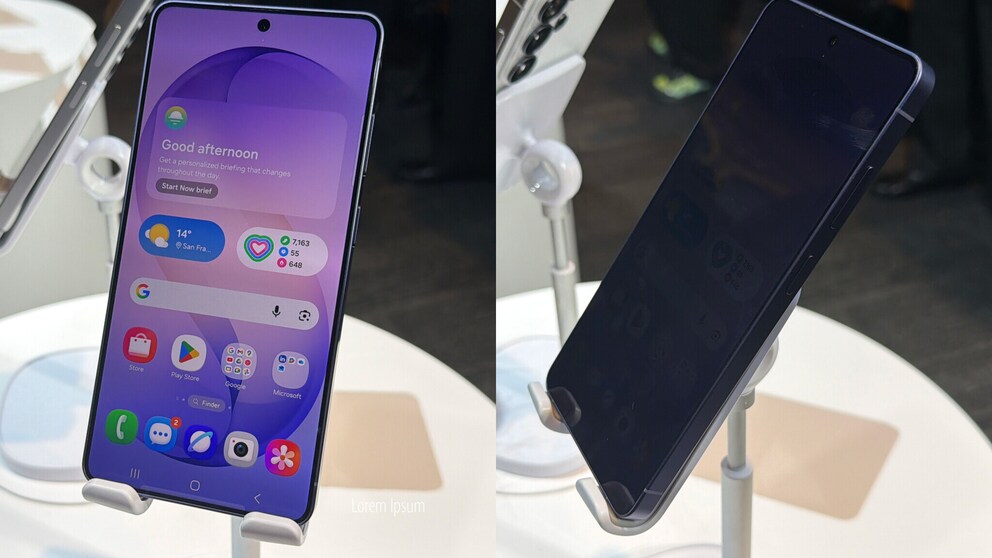
Exclusive to the S26 Ultra is the Privacy Display, which caused a stir even before the official unveiling. The integrated privacy feature controls individual pixels so that content is dimmed when viewed at an angle. In the first test, the flexibly adjustable feature impressed, which can be limited to certain apps or notifications. The Galaxy S26 and S26 Plus do not have the necessary hardware and therefore do not include the Privacy Display.
Processor, Memory, and Battery
In Europe, only the S26 Ultra features the Snapdragon 8 Elite Gen 5 for Galaxy, manufactured using a 3-nanometer process. The S26 and S26 Plus use Samsung’s Exynos 2600 from a 2-nanometer process. Both chips promise significant performance gains, although the Snapdragon is likely to offer advantages in pure CPU performance. The Exynos, on the other hand, potentially operates more efficiently.
All new Samsung smartphones are available with 12 gigabytes of RAM and 256 or 512 gigabytes of storage. Additionally, there is an exclusive 1-terabyte version of the Galaxy S26 with 16 gigabytes of RAM.
In terms of battery capacity, much remains unchanged compared to the S25 series: 5000 milliampere-hours in the Ultra, 4900 in the Plus. The S26 increases from 4000 to 4300 milliampere-hours. There are more significant differences in charging technology. The Ultra supports up to 60 watts wired and 25 watts wireless. The Plus charges at 45 watts wired and also 25 watts inductively, while the base model offers 25 watts via cable and 15 watts wirelessly.
Also interesting: Surprising Battery Downgrade in the Galaxy S26
Detailed Differences in the Camera
The camera equipment shows the most significant differences within the series. The Galaxy S26 and S26 Plus primarily rely on the familiar combination of a 50-megapixel main camera with optical image stabilization and an f/1.8 aperture, a 12-megapixel ultra-wide-angle camera with an f/2.2 aperture, and a 10-megapixel telephoto lens with 3x optical zoom and an f/2.4 aperture. This hardware essentially matches the equipment since the S22 series. Improvements are expected mainly through the stronger signal processing of the new processors, which extract more image quality from the sensors.

The Galaxy S26 Ultra stands out technically. The main camera has a resolution of 200 megapixels and now works with a brighter f/1.4 aperture instead of f/1.7 in the predecessor. The additional telephoto lens with 5x optical zoom offers 50 megapixels and a larger f/2.9 aperture instead of f/3.4. There is also a 50-megapixel ultra-wide-angle with an f/1.9 aperture and the 3x telephoto with 10 megapixels and f/2.4. For zoom levels above 5x and high-resolution shots, the Ultra remains clearly advantageous.
The front camera remains unchanged: All three models use a 12-megapixel camera with autofocus and an f/2.2 aperture. An adaptation to the square sensor format of the iPhone 17 with automatic switching between portrait and landscape mode does not occur in the S26 series.

This Detail Makes the Samsung Galaxy S26 FE a Difficult Purchase

Galaxy S26 Ultra With Privacy Screen Display Hands-On
Technical Data at a Glance
Prices and Availability
Samsung offers the Galaxy S26 in storage variants of 128, 256, and 512 gigabytes, the S26 Plus with 256 or 512 gigabytes. The S26 Ultra is available with 256 or 512 gigabytes and with 1 terabyte, with the largest version equipped with 16 gigabytes of RAM. The suggested retail prices are 999 euros for the Galaxy S26, 1249 euros for the S26 Plus, and 1449 euros for the S26 Ultra.
All models are offered in the colors violet, blue, black, and white. With the unveiling at the Unpacked event, the new S26 series has officially launched.