


March 17, 2026, 1:48 pm | Read time: 2 minutes
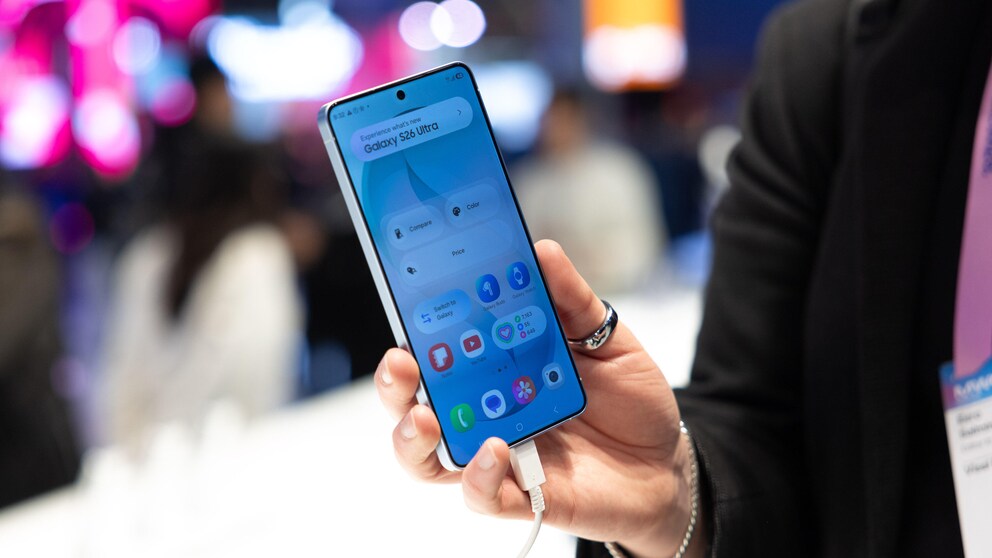
Samsung promotes the Privacy Display as the biggest innovation in the flagship Galaxy S26 Ultra. The technology is designed to better protect content from prying eyes in public environments. However, initial users report limitations in everyday use.
Update (March 17): Samsung responds to criticism
Samsung has now confirmed to “Techradar” that under certain conditions, “deviations” can occur in the display representation. The company refers to viewing from an angled perspective, where the image no longer appears as clear as “during normal use.”
This inconsistency supposedly only occurs at maximum brightness and is said to be negligible during everyday use and normal handling.
Technology behind the Privacy Display
For privacy protection, Samsung uses two different types of pixels. In addition to conventional “wide” pixels, “narrow” pixels are used to direct light specifically forward.
When the Privacy Display is activated, the wide pixels turn off, halving the resolution. This also dramatically reduces peak brightness. The affected areas, such as only notifications or entire banking apps, then reach a maximum of 1156 nits instead of 2471 nits.
Samsung Galaxy S26, Plus and Ultra–Which Is Right for You?
YouTuber Buys Galaxy S26 Before Official Launch
Users report display issues
On Reddit, several users describe anomalies during normal operation. Some suspect that the division into two pixel types remains visible even without activated privacy protection.
One user writes: “As soon as I slightly tilt my smartphone (for example, when watching a YouTube video with my fiancée), it feels like my eyes are ‘switching viewing modes’.” He describes the effect as “strange.”
In another post, it states: “At a certain angled view, when transitioning to direct view, you are somewhat ‘hit’ directly by the narrow pixels.” Text and blue links are particularly affected.
The general text display is also criticized in a post: “The text looks particularly odd, and the edges of boxes and boundaries seem to bend in a way that—lacking a better word—appears ‘wavy’ and also pixelated.” In a comment under the post, a user adds: “After prolonged use, this display is actually borderline painful to look at.”
Results from the test lab
In the lab test, my colleague Christian Just from COMPUTER BILD could not replicate the described effects when viewed head-on. Anomalies did not occur during direct viewing.
However, measurements show that the color gamut is slightly worse than that of its predecessor and the other S26 variants. Additionally, the display reflects more than the Galaxy S25 Ultra, which still offers a more anti-reflective surface.