


September 8, 2026, 10:45 am | Read time: 7 minutes
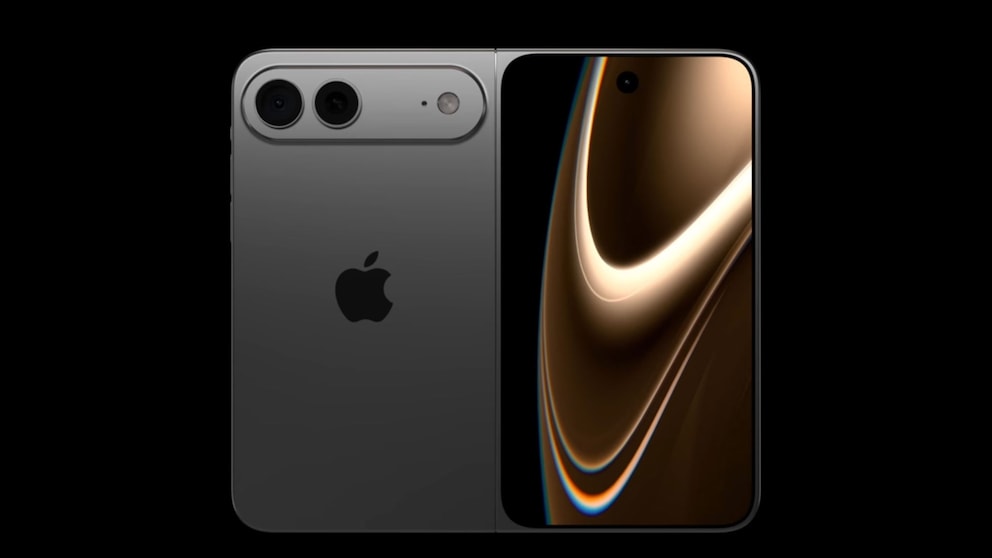
For years, there have been reports about a foldable iPhone. Initially, Apple experimented with different designs, but now everything points to a model in a passport format. The device will come in an iPhone mini format and, when unfolded, almost becomes an iPad mini. It is still unclear what name the new flagship will carry–internally, however, it is referred to as the “iPhone Ultra.”
This evening, the tech world turns its attention to Cupertino: Apple will unveil the new iPhone 18 Pro generation at its September event. While the iPhone 18 Pro and iPhone 18 Pro Max are expected to be presented, many fans are hoping for another surprise. Rumors about a foldable iPhone have been circulating for years, and its unveiling has never seemed as close as it does now. We reveal what is known so far about Apple’s first foldable and why it could be the most exciting iPhone in years.
By the way, TECHBOOK is live at the event in Cupertino and will report this evening on the innovations Apple presents. You will find the first impressions of the new devices here.
But now to what we know so far about the iPhone Fold:
Compact Case in Passport Format
When closed, the foldable iPhone is said to resemble a passport and thus be similar to the Samsung Galaxy Z Fold 8. With a display diagonal of about 5.5 inches, the exterior would be roughly in the size class of the iPhone 12 mini and iPhone 13 mini, but rather wide than tall.
Some people have reportedly already tried the device. Despite its unusual design, it is said to feel good in the hand and be easy to store. The hinge is also supposed to give a high-quality and stable impression.
Large Inner Display in iPad Format
When unfolded, a second display appears, which is expected to have a diagonal of about 7.8 inches. This is nominally only 0.9 inches larger than the current iPhone 17 Pro Max. However, due to the different aspect ratio, the actually usable screen area is significantly larger.
TECHBOOK estimates that the known dimensions so far suggest about 30 to 40 percent more display area compared to the iPhone 18 Pro Max. The inner display could have an aspect ratio of 4:3, reminiscent of an iPad. Applications would thus have more space for additional controls, sidebars, or the simultaneous display of multiple contents.
At the same time, the wide screen is better suited for videos than the almost square inner displays of many other foldables. Movies and series in 16:9 format could run with comparatively small black bars.
Thinner Than the iPhone Air
Particularly striking is the device’s thinness. When unfolded, the iPhone Ultra could measure less than 5 millimeters, with some leaks even suggesting only 4.5 millimeters. This would make it thinner in the open state than the iPhone Air and possibly the thinnest device from Apple ever.
However, when folded, the case thickness nearly doubles. The foldable iPhone would therefore be significantly thicker when closed than a regular iPhone.
Display Crease–Yes or No?
A known issue with foldable smartphones is the visible and tangible crease in the middle of the inner display. Manufacturers have now found ways to minimize the crease. Apple is also said to be making great efforts with a complex folding mechanism that distributes the stress from folding as evenly as possible. Early testers have positively rated both the workmanship and the hinge.
Dual Camera Without Telephoto Lens
Users will have to make compromises with the cameras. Apparently, a dual camera with a main sensor of 48 megapixels and an ultra-wide-angle camera is planned. However, a dedicated telephoto lens is said to be missing. For enlarged shots, only a digital zoom or a crop from the main sensor would be available. A true optical zoom is therefore not possible.
The omission is likely due to the limited space in the thin case. Telephoto cameras, especially systems with folded periscope optics, take up comparatively much space. Despite a starting price of well over 2,000 euros, the reduced camera equipment could still draw criticism.
Touch ID to Return to the iPhone
Apple might take an unusual approach to biometric unlocking as well. Instead of Face ID, the foldable iPhone is expected to have a Touch ID sensor. This is likely to be located in the side power button, similar to certain iPad models.
The fingerprint sensor requires less space than the components needed for Face ID. This could allow Apple to reduce the display bezels and especially the thickness of the case.
The foldable iPhone would thus be the first new Apple flagship model in years to rely on Touch ID again. Whether users see this as a step backward or a welcome return of Touch ID will likely depend on personal preferences.
Performance at Pro Level
In terms of memory, Apple is expected to remain at the level of its Pro models. The iPhone Fold is reportedly equipped with 12 GB of RAM. For internal storage, three options are likely to be available:
- 256 GB
- 512 GB
- 1 TB
Like the iPhone 18 Pro and 18 Pro Max, the iPhone Ultra is expected to feature the new high-end A20 Pro chip. It is Apple’s first smartphone chip based on TSMC’s 2-nanometer architecture. This chip not only delivers more performance but is also significantly more energy-efficient.
Apps Adapt Dynamically
Apple has been preparing developers for more flexible display sizes and aspect ratios for some time. Applications should no longer be designed exclusively for fixed device classes and rigid orientations. Instead, their interfaces must adapt to different dimensions.
This is particularly important for a foldable iPhone. An app must switch from the small outer display to the large inner screen as seamlessly as possible when unfolded. Content should not just be enlarged but should make meaningful use of the additional space.
Early testers describe the arrangement of apps on the inner display as iPad-like. Apple is likely not just stretching existing iPhone interfaces but providing its own layouts for the larger screen.
Production Apparently Facing Issues
Foxconn reportedly began a test production of the iPhone Fold in spring 2026. Such a step usually occurs before transitioning to mass production and serves to check manufacturing processes and identify potential errors.
Mass production was initially supposed to start in June but was then postponed to the end of July. Even this date could not be fully met. Difficulties with the hinge and flexible display, component shortages, and high production costs are said to have affected the schedule.
Currently, “Nikkei Asia” reports that only a few hundred units are produced each day.
Also interesting: What new devices does Apple have in the pipeline?

How the First Foldable iPhone Performs in Early Tests

Images Show iPhone Fold and iPhone 18 Pro Size Comparison
Unveiling in September
The unveiling of the first foldable iPhone is expected on September 9, 2026. Apple could present the device alongside the iPhone 18 Pro and iPhone 18 Pro Max. However, the iPhone Ultra might not go on sale until later and initially be available only in the U.S.
Such an approach would not be unprecedented. The iPhone X was unveiled in September 2017 but was not released until early November due to its more complex technology. Vision Pro was also initially available only in the U.S. and came to Germany several months later.
Most Expensive iPhone Ever
The foldable iPhone is expected to be the most expensive smartphone Apple has ever offered. Earlier estimates ranged from 2,000 to 2,500 U.S. dollars.
A later leak provides specific prices for the Chinese market. After adjusting to Apple’s usual pricing structure, the following U.S. prices could result:
- 256 GB: 1,999 U.S. dollars
- 512 GB: 2,199 U.S. dollars
- 1 TB: 2,399 U.S. dollars
For Germany, we have calculated the following amounts based on previous pricing:
- 256 GB: 2,449 euros
- 512 GB: 2,649 euros
- 1 TB: 2,899 euros
Other forecasts already set the base model at 2,300 to 2,500 U.S. dollars. The actual starting price could therefore be even higher. All price information is currently unconfirmed.