

July 22, 2026, 3:47 pm | Read time: 6 minutes
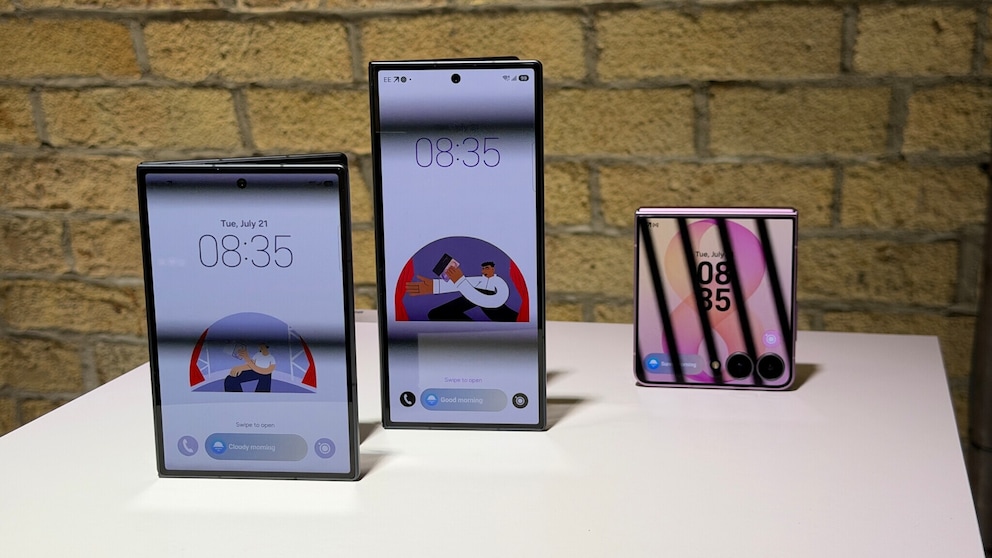
With the Galaxy Z Fold 8, Samsung is moving away from an idea that has defined the Fold series so far. Instead of making a folded device look as much like a classic smartphone as possible, the manufacturer is now opting for a significantly wider format.
Initial hands-on impressions already show how much the new concept differs from previous Fold models. Samsung aims to solve a particular problem: Many users use their foldable phone mostly closed, like a regular smartphone. The Fold 8 is now intended to be better suited for this purpose.
Wider Format Puts Outer Display in the Spotlight
Previous Fold models focused on combining a narrow smartphone with a large inner display. The Galaxy Z Fold 8 now takes a different approach. When folded, the device resembles a small passport or notebook. The outer display measures 5.5 inches, while the inner display is 7.6 inches. In parallel, Samsung has also introduced the Galaxy Z Fold 8 Ultra. This model sticks to the previous design, offering a 6.5-inch outer display and an 8-inch inner display.
According to Samsung, this difference already makes the device a different tool. The greater width provides more surface area, making content easier to read and creating more space for productive tasks. If additional space is needed, the device can still be unfolded. However, the Fold 8 is only partially optimized for widescreen videos.
The inner display still has an aspect ratio of about 4:3, which means that many movies or trailers will have black bars above and below the image. The Fold 8 Ultra, on the other hand, is more geared toward users who want as much display area as possible when unfolded and therefore prefer the previous format.
New Display Technology Aims to Improve Stability
In addition to the new format, Samsung is also addressing a known weakness of many foldables. Many users are bothered by the visible and tangible crease along the fold line. A new foldable display technology with titanium protection is intended to remedy this. Samsung calls it the Titanium Flexible Display.
To achieve this, the manufacturer integrates a titanium alloy film and an additional titanium plate into the display’s construction. According to Samsung, the film is “20 times stiffer than a polymer film.” It is processed until it reaches approximately one-third the thickness of a human hair. This is intended to make the display thinner. The underlying titanium plate is supposed to provide additional stability. Samsung claims that the new construction could also improve energy efficiency, which could positively impact battery life or display brightness.
Samsung is also focusing on particularly low values for the casing. According to the manufacturer, the Fold 8 is 4.5 millimeters thick, while the Fold 8 Ultra is only 4.1 millimeters. However, an on-site inspection showed that the thickness at the edge of the casing is about 0.3 to 0.5 millimeters higher. The official values are achieved directly on the slightly recessed display surface. Regardless, both models are among the thinnest devices in their class.
More Battery, Current Processor, and Camera Differences
Technically, Samsung is also advancing the Fold series. The Galaxy Z Fold 8 receives a 4800 mAh battery, while the Fold 8 Ultra comes with 5000 mAh. For the first time, the manufacturer is using a silicon-carbon anode, which is supposed to offer higher energy density. The charging power is expected to rise to up to 45 watts.
The processor used is the Snapdragon 8 Elite Gen 5 for Galaxy, which is also found in the Galaxy S26 Ultra. The variants with 256 GB and 512 GB of storage have 12 GB of RAM. The exclusive models with 1 TB of storage, which Samsung sells in its own online store, offer 15 GB of RAM. This continues Samsung’s known division of storage variants, reserving the most extensive equipment for the largest storage option.
The cameras also show significant differences between the two Fold models. The Galaxy Z Fold 8 Ultra still features three cameras on the back. The equipment includes a main camera with 200 megapixels, a telephoto lens with 10 megapixels and three times optical zoom, and a new ultra-wide-angle sensor with 50 megapixels. The Galaxy Z Fold 8 is much simpler in this regard. Samsung forgoes a telephoto lens and relies only on a main camera and an ultra-wide-angle camera, both with 50 megapixels. Those who place particular value on camera equipment will still find the more extensive equipment in the Ultra model.

Samsung Galaxy Z Fold 7 Hands-On – New Hinge, Better Smartphone?
Leak Reveals New Samsung Z Fold 8 Wide in Full Width
Android 17 Preinstalled and Significantly Higher Prices
Galaxy Z Fold 8, Galaxy Z Fold 8 Ultra, and Galaxy Z Flip 8 will be delivered with Android 17 preinstalled. Samsung also promises seven years of Android updates and security patches. Support is expected to last until 2033, covering both new Android versions and minor security updates.
Samsung is noticeably raising prices. The Galaxy Z Fold 8 costs 1,999 euros with 256 GB of storage. The 512 GB version is priced at 2,199 euros, while buyers will have to pay 2,599 euros for the model with 1 TB of storage. The Galaxy Z Fold 8 Ultra starts at 2,199 euros. The 512 GB version costs 2,399 euros, while the 1 TB version is priced at 2,799 euros. The previously common free storage doubling for pre-orders is also no longer available.
Also interesting: Samsung plans smartphone with extendable display
Pre-orders for the Galaxy Z Fold 8 and Galaxy Z Fold 8 Ultra were possible immediately after the Unpacked event on July 22. Delivery and the official sales launch are scheduled for August 7.
First Impression: Outer Display Becomes the Key Feature
During the initial trial, the new aspect ratio is particularly noticeable. The device feels smaller in hand than the technical data might suggest. At the same time, the outer display offers more usable space than previous Fold models. This is intended to make reading texts more pleasant and using content more comfortable.
It was also positively noted that widescreen videos can almost fill the entire screen area on the outer display when the smartphone is rotated 90 degrees. This is the most distinctive feature of the new model. The focus is not on the foldable inner display but on the significantly larger outer display. Those who need more space can still unfold the device and use the large inner display. Those who want to use a foldable as a tablet replacement as often as possible are more likely to opt for the Galaxy Z Fold 8 Ultra. Samsung is thus catering to two different approaches within the Fold series: a wider everyday device focused on the outer display and a model more geared toward maximum display area.