


June 30, 2023, 8:52 am | Read time: 12 minutes
Pedelecs, e-bikes, etc., are becoming increasingly popular. Many people are interested in them and want to get one themselves. TECHBOOK has looked for affordable alternatives and found a pedelec or e-bike conversion kit online for just under 500 euros. But are such conversion kits worth it? Below, you’ll learn how the conversion of the trekking bike to a pedelec went.
First, the theory before the practice. We want to explain the difference between an e-bike and a pedelec. Additionally, we’ll discuss why we converted an old trekking bike into a pedelec and what the current trend has to do with it. We’ll introduce the individual components of the e-bike conversion kit and have the converted bike examined more closely by an expert.
Quick note: We refer to an e-bike conversion kit below because the set’s contents are designed for it. However, you can build the electric bike with a trick so that it is classified as a pedelec.
Overview
- Why a Pedelec or E-Bike Conversion Kit?
- These Are the Conversion Parts from the Set
- How the Pedelec Conversion Went
- The First Test Ride with the Converted DIY Pedelec
- Expert Takes a Closer Look at the Bike
- The Bicycle Mechanic’s Verdict
- Where Do the Conversion Kits from the Internet Come From?
- Our Conclusion on the Entire Pedelec Conversion Project
The Legal Requirements for an Electrically Powered Bicycle
E-bikes and pedelecs are often equated, but there is a significant difference. The definition of a pedelec can be found in the Road Traffic Act under Paragraph 1, Section 3. It states:
“Land vehicles that are propelled by muscle power and equipped with an electric auxiliary motor with a nominal continuous power of no more than 0.25 kW, whose assistance progressively decreases with increasing vehicle speed, are not motor vehicles within the meaning of this law, and
- 1. are interrupted when reaching a speed of 25 km/h or earlier,
- 2. when the rider stops pedaling,
are interrupted.”
Additionally, according to Road Traffic Licensing Regulations (StVZO) Paragraph 63a, a start and push aid without pedaling can be used up to a maximum of six kilometers per hour. Furthermore, the motor may only have a maximum of 250 watts. Thus, despite the electronic assistance, pedelecs are still considered regular bicycles. For this reason, no explicit operating permit is required for such types of bicycles.
An e-bike, on the other hand, is considered a motor vehicle because it does not fall under the above law. The electric assistance is independent of the pedaling motion. Simply put, you don’t have to pedal for the bike to move. Using a knob or lever on the handlebar, you can start the e-bike. The motor power is always over 250 watts. For this reason, they are classified as mopeds and divided into three categories. According to the ADAC:
- E-bikes up to 20 kilometers per hour: Considered a light moped, requiring a moped test certificate and an insurance license plate. The minimum age to ride is 15 years.
- E-bikes up to 25 kilometers per hour: Considered a moped, requiring a test certificate and an insurance license plate. You must be 15 years old to ride, and a helmet is mandatory.
- E-bikes up to 45 kilometers per hour: For these types of bikes, you need a Class AM driver’s license. You must be 16 years old and wear a helmet while riding. An insurance license plate is also necessary.
Why a Pedelec or E-Bike Conversion Kit?
The mentioned legal regulations were crucial for us to choose a pedelec conversion instead of an e-bike conversion. The reasons for the conversion are due to personal interest and the current trend, which has been growing for years and could continue to rise in the future. E-mobility is one of the defining topics of our time. More and more people are buying a pedelec or an e-bike. This is shown by a study by the Bicycle Industry Association. In 2011, 330,000 e-bikes were sold, and in 2021, sales rose to two million. Private ownership has also steadily increased in recent years. This is evidenced by the figures from the Federal Statistical Office. In 2014, 1.6 million people owned an electric bicycle, and by 2021, the number had risen to 7.1 million. It should be noted that in the statistics, “e-bike” refers to all electric bicycles, including pedelecs.
Price also plays an important role in manufacturer models. Anyone who wants to get a pedelec must dig deep into their pockets. Prices for most models are in the four-digit range. A conversion kit for around 500 euros is therefore a much more cost-effective alternative.
These Are the Conversion Parts from the Set
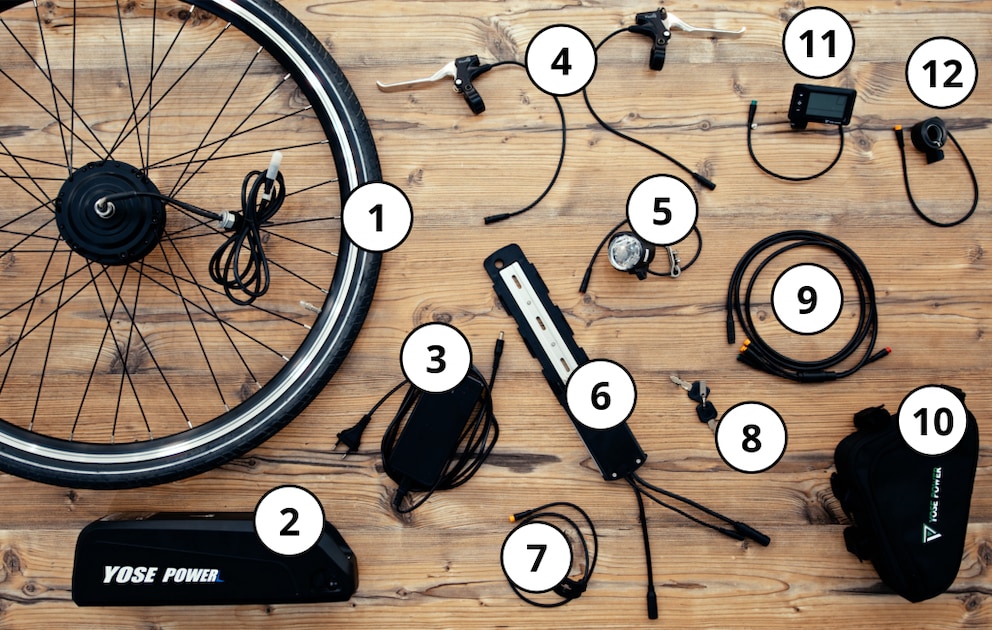
For the e-bike conversion kit, we ordered a set from the internet. It was a complete set from Yose Power. According to the manufacturer, the entire e-bike conversion kit has CE and RoHS certification. The package included the following components:
- Front wheel with an integrated 250-watt motor
- 36-volt battery with 15.6 ampere-hours capacity
- Charger for the battery
- Brake set
- Front light
- Battery holder with integrated controller
- PAS sensor
- Key to lock the battery in the holder
- 5-in-1 cable
- Cable bag
- LC display
- Thumb throttle
How the Pedelec Conversion Went
Before the conversion, we first removed the old brakes from the trekking bike and also took off the tire and tube from the old wheel. Then, the new front wheel with the motor was fitted with the tube and tire.
After mounting the wheel, the next step was to attach the front light and the components to the handlebar. This included the LC display and the brake set. Then, the left crank was removed using a crank puller, the PAS sensor (Pedal Assist Sensor) was attached to the bottom bracket, and the crank was reattached. This step requires some force, as the crank bolt is often very difficult to loosen, especially if it is old or even rusty. A pipe wrench or ratchet can definitely help here. It is also important to turn the crank puller completely or straight to the stop in the bottom bracket after the bolt is removed, as this is the only way to remove the crank.
The next step involved the centerpiece: the battery with the holder. Since the battery holder had three holes, we had to drill an extra hole in the bike frame, as there were only two holes for a bottle holder. After attaching the battery holder, we inserted the battery and locked it with the supplied key in the holder with the controller. Finally, we connected the cables of the conversion components, secured them with cable ties at various points on the bike frame, and hid or stored the excess in the bag attached to the frame.
We deliberately left out the thumb throttle during the conversion, as it would allow a start assist of over six kilometers per hour. The converted bike would thus no longer be considered a pedelec but would fall into the e-bike category.
Read also: The Best E-Bikes for Everyday Cyclists
The First Test Ride with the Converted DIY Pedelec
After the conversion, it was time for the fun part: the first test ride. It should be noted upfront that the ride was very pleasant. The brakes worked perfectly, the PAS sensor’s measurement was very accurate, and the pedal assist was always there. However, as soon as you braked or stopped pedaling, the motor turned off–just as it should. You didn’t notice the additional weight of the components, especially the battery and motor, during the ride. However, you did feel the extra six kilograms of the conversion parts when carrying it up the stairs.
Now a few words about the functions of the components. The brakes ensure that the motor receives a signal when it needs to turn off. When you brake, you automatically stop pedaling, and the motor stops providing pedal assist. The Pedal Assist Sensor (PAS) sends impulses synchronously with the pedaling motion to the control unit. Simply put, the riding speed is transmitted, which you can see on the LC display.
The pedal assist can be individually adjusted on the LC display. There are levels 0 to 5, increasing with motor assistance. The speed display during the test ride was flawless. Whether on flat or bumpy paths, the riding experience was always satisfactory. Despite our overall good impression, one important aspect of the pedelec conversion was still missing: the final inspection by a bicycle expert.
https://oembed/techbook/affiliate/e54583b188e07af03e05af5e4259ef0746fd4cd2e591a5f682b67df2e690c1e4/b6e44ea0-940f-43c7-93ea-971f6546c765/embed
Expert Takes a Closer Look at the Bike
In advance, we contacted several places to conduct an inspection of the converted pedelec. These included the ADAC, the ADFC, TÜV Rheinland, and Dekra. However, there were various reasons why an examination by the experts did not take place. The ADAC, ADFC, and Dekra generally advised against a DIY conversion and did not want to conduct a check due to safety concerns. Since the pedelec is a new device after the conversion, several uncertainties automatically arise, making a general statement about safety and functionality only partially possible. We could not proceed with an inspection by TÜV Rheinland due to time and cost reasons.
Therefore, we sought out a bicycle workshop and agreed on an appointment with the bike shop Little John Bikes. After the test ride, we brought the converted bike to the workshop and had it examined more closely by the mechanic or bicycle mechanic André Gudlat. To give you a heads-up: his verdict on the e-bike conversion kit was more than clear.
Read also: TECHBOOK Author: “Rode an E-Bike for a Month and I’m Surprised!”
The Bicycle Mechanic’s Verdict
The bicycle expert took a close look at the converted bike and initially criticized the wiring and the battery holder attached to the frame. According to André Gudlat, the trekking bike is not designed to carry the extra weight of an e-bike conversion kit. Therefore, this additional weight could become a problem while riding. Additionally, he believed the existing brake was by no means sufficient. He therefore recommended disc or hydraulic brakes.
According to Gudlat, things get even more complicated with insurance and standardization issues. A bicycle must meet certain standards. For bicycles, e-bikes, or rather pedelecs, two standards apply: ISO 4210 and EN 15194. This ISO standard outlines the safety requirements for a bicycle. The EN standard, on the other hand, relates to electrically powered bikes and regulates the minimum requirements. This means that the converted pedelec must first undergo an official inspection to ensure it meets the standards.
Liability is also an issue. Since we converted the old trekking bike into a pedelec, we have essentially become the manufacturer. We have essentially created a new product. For this reason, we would have to bear the costs for the standard inspections ourselves or take care of them ourselves. If these steps are not followed, you would be liable in the event of accidents or similar incidents. Gudlat also emphasizes that a converted pedelec bike must comply with the Machinery Directive. This involves the Machinery Directive 2006/42/EC. This regulates that the conversion kits are safe to use and that the corresponding EU regulations are complied with.
André Gudlat concludes by emphasizing that he and many of his colleagues advise against conversion kits. Also, for liability reasons, conversion kits operate in a gray area, as the converter becomes the manufacturer after the conversion, as already described. For compliance with the requirements, i.e., all standards and guidelines, you can have an inspection carried out by TÜV Rheinland and ideally obtain an official test mark or certification. However, this is associated with additional costs.

Affordable E-Bike at Aldi–Who Should Consider This Offer?

The Best E-Scooters at a Glance
Where Do the Conversion Kits from the Internet Come From?
When looking for relatively inexpensive e-bike conversion kits online, it quickly becomes clear that many providers are from China. Our set from Yose Power is also a Chinese product. There are also other providers from the Far East, such as Bafang, Season, and Tongsheng.
Looking at the German market, the situation is also clear. There are companies that manufacture e-bike or pedelec components, but they do not offer them as complete sets. An example here is Bosch. Due to the aforementioned requirements, many companies in this country often refrain from offering complete conversion kits. Instead, they only offer individual parts for already finished e-bikes or pedelecs.
Our Conclusion on the Entire Pedelec Conversion Project
As mentioned earlier, the conversion was done quickly. In about an hour, we managed to convert an old trekking bike into a pedelec using an e-bike conversion kit. With the right tools, the conversion was also quickly done as a layperson. The subsequent test ride was surprisingly good. The pedal assist never exceeded 25 kilometers per hour. Only when we pedaled harder or rode downhill did the speed exceed this limit. However, this had nothing to do with the motor, as it no longer assisted above 25 kilometers per hour. The riding experience was always good, and the other components worked flawlessly.
Nevertheless, we must say that in the future–also because most official bodies advise against it–we would not build such a DIY pedelec again. Since many safety aspects and standards must be met, independent conversion is not advisable. Instead, you should first seek the advice of an expert and have the bike checked, as “classic” bikes, due to their weight alone, are not designed for conversion kits.
In short: We will leave our pedelec built with an e-bike conversion kit for now and seek an official inspection. Until then, we prefer to ride a non-converted bicycle.