

December 9, 2025, 10:00 am | Read time: 4 minutes
When you’re on the go and your battery dies, making you unreachable, it can be quite inconvenient depending on the situation. To prevent this, many smartphone users always carry a power bank. Just charge it and plug it in when needed–using these mobile backup batteries is fairly simple. However, there are some mistakes you can make.
While trains or public facilities increasingly offer the option to plug in with a carried charging cable and recharge your battery, such places are still often unavailable. To be safe, it’s better to have a power bank with you. These devices are reliable–provided they are handled with the necessary care.
Overview
How Powerbanks Work
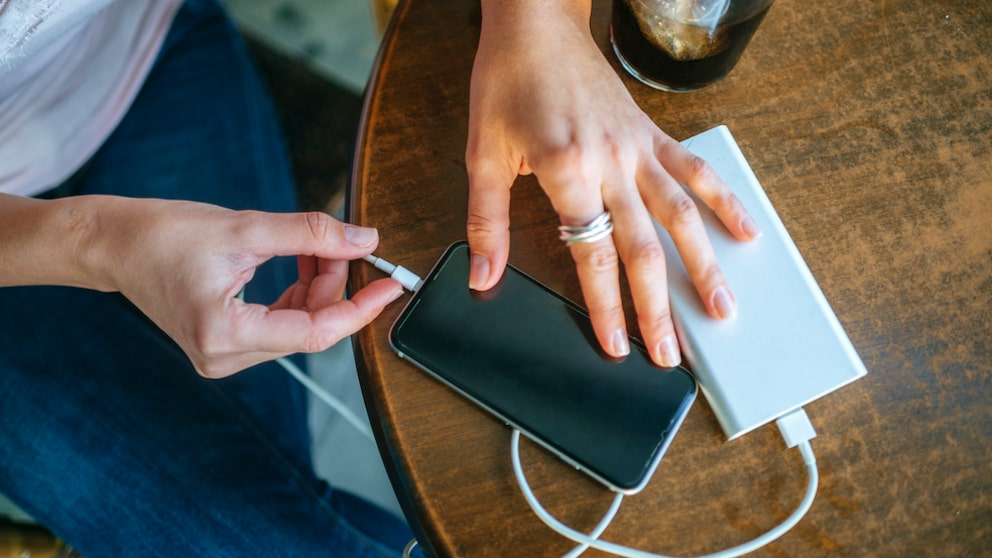
Powerbanks are small mobile power sources that allow you to charge the batteries of electronic devices via cable. Increasingly, this can also be done through wireless charging. It’s quite simple: You connect the power bank to a power source to charge it. Later, when you connect it to an iPhone, tablet, or similar device, it discharges the power.
However, there are several things to consider when using power banks. For instance, in air travel, passengers are allowed to carry only a maximum of two power banks–and they must be in carry-on luggage. This is because the lithium-ion battery could cause a fire in the event of a short circuit. The TÜV Association (VdTÜV) provides detailed information on other handling errors that can lead to problems. Certain safety precautions are also important for the longevity of the device itself.
Charging Process Poses Risks for Powerbanks
During the charging process, owners should not leave their power bank completely unattended. This applies both to charging the power bank itself and when transferring power to other devices. It’s advisable to regularly check the temperature.
If the power bank becomes so hot that you can no longer hold it comfortably, you should immediately disconnect it from the power source or the smartphone, etc. You should also avoid charging it for too long, such as overnight. This also generally applies to electronic devices, as it can shorten the lifespan of a battery.
Inspect Damage Carefully and Avoid Overheating
After a fall or with general external damage, you should be cautious with a power bank. Is the casing swollen or deformed? Are there contact points on metal parts or melt marks on the casing? In such cases, it’s better to dispose of the devices properly. Again, check the temperature.
If the power bank gets hot without being connected, it’s a warning sign. The device should no longer be used. Also, if the battery discharges much faster than usual, this is an indication of a defect.
As with smartphones, the optimal operating temperature for most power banks is between 32 and 95 degrees Fahrenheit, according to the VdTÜV. If the devices overheat, for example, due to a short circuit or external heat, an internal thermal reaction can be triggered. In extreme cases, this can even lead to an explosion. Power sources should not be left in the open in a car or on the dashboard in summer.

Which Tech Myths Will Still Persist in 2026–and Why They’re Wrong

Why Your Phone Battery Drains Faster in the Cold
Tips for Buying a Powerbank
Due to the fire and explosion risk of lithium-ion batteries briefly described above, you should always look for a CE mark when buying a power bank, advises the VdTÜV. Additional guidance is provided by the voluntary “GS mark.” Those who are mainly active outdoors should also look for an IP67 certification. This indicates that the power bank is dustproof and protected against water. It must withstand temporary submersion up to one meter for up to 30 minutes.
Inferior power sources can also damage the device being charged. Especially with self-imported devices, such as those purchased online, incorrect or misleading CE marks cannot be ruled out. You should examine this carefully and ensure that the abbreviation stands for “Conformité Européenne”–and not “China Export,” as the TÜV Association has found with some Chinese products.
Be cautious with so-called no-name products: “If no manufacturer is specified, you should avoid buying the power bank,” advises the association. Skepticism is warranted, especially with extremely cheap offers that promise high performance.
Models with Intelligent Charging Mode
When purchasing a device, ensure that the output voltage matches that of the device to be charged, or damage may occur. Often, there are multiple ports that charge with different amperages. Some models have an intelligent charging mode and can automatically recognize the device to be charged and adjust the charge accordingly. If the device is not used for a long time, do not let it fully discharge; instead, partially charge it from time to time. This can extend its lifespan.
Sources
- with material from dpa
- TÜV