

July 11, 2024, 6:15 am | Read time: 4 minutes
This Sunday, the European Championship final will take place at Berlin’s Olympic Stadium. TECHBOOK reveals what you need to watch the game on a big screen at home. From very expensive to quite affordable, there are many ways to turn your living room into a home theater.
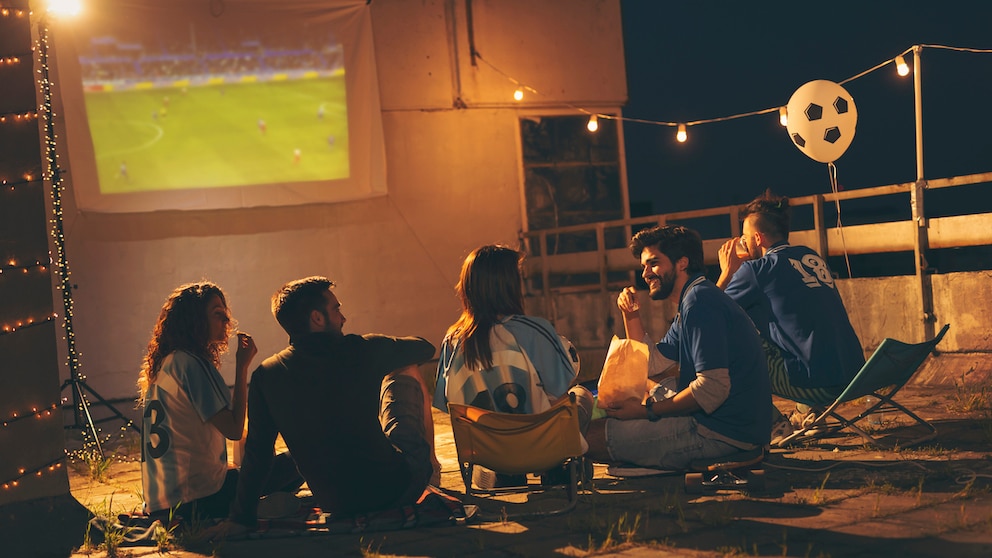
The German national team narrowly missed making it to the semifinals. Still, this year’s UEFA European Championship for men holds some surprises. If you’re not attending a public viewing, you can alternatively transform your living room into a home theater with little effort. Especially if you want to watch the final with friends or family, big screens are a lot of fun. TECHBOOK shows you how to turn your living room—or even your garden or rooftop terrace—into a stadium. All you need is a projector, optionally a screen, good lighting conditions, and a convincing sound system.
A Good Projector–The Heart of the Home Theater
A projector creates an atmosphere much more reminiscent of public viewing than a small TV. Additionally, a projector offers larger images at a significantly lower price compared to a TV. If you’re looking to get a projector quickly before the final or for future movie nights and sports events, there are a few criteria to consider. Starting with the type of projection: DLP projectors have high brightness and contrast, making them ideal for daytime use. However, they can quickly produce unwanted color gradients at the edges. This rainbow effect can be avoided with LED and LCD projectors, although they are weaker in terms of contrast.
Brightness is also crucial for a projector. For darkened rooms, 100 to 150 lumens are sufficient, while lightly darkened rooms require 250 to 500 lumens. If you want to use the projector in bright rooms or outdoors, you need at least 500 lumens. As for resolution: projectors in the mid-price range display images in HD quality (1280 x 720 pixels), while more expensive models can display Full HD (1920 x 1080 pixels) or 4K content.
Finally, the aspect ratio is not entirely irrelevant. The 4:3 format was long the standard for TVs and broadcasts. However, movies are filmed in 16:9 or even 21:9, so the image played in 4:3 format would be smaller. For a large image, it’s advisable to use a projector that supports cinema formats. Lastly, consider whether a mini projector or a regular projector is better suited for your home theater. The choice between a fixed or portable device should also be well thought out.
Micro-LED, Rotatable, Wireless, Transparent – The Coolest TVs at IFA

What Is HDR and How Does It Work?
Light and Screen
If you regularly use the projector, you should also invest in a suitable screen. Depending on the size of the projector image, there are screens for quick setup and takedown or for permanent installation on the wall or ceiling. In this variant, the screens can be discreetly rolled up. If you use the projector only occasionally or are interested in a particularly cost-effective setup, a plain white wall will suffice.
Whether wall or screen, the bright surface reflects the light. For this reason, the projector’s performance alone is not enough to guarantee a high-contrast image. To ensure that ambient light doesn’t disrupt the home theater effect, the room should be as dark as possible—especially if the projector delivers relatively few lumens. However, the audience doesn’t have to sit in complete darkness. Well-dosed light sources that provide indirect lighting and are only weakly reflected by the screen can create an extra cozy atmosphere. Especially with videos with bright images—such as a sports broadcast—a little room light doesn’t disturb. For literally dark Netflix series, however, the lighting should be dimmed more.
The Perfect Sound in the Home Theater
Finally, good sound determines whether the atmosphere from the soccer stadium really reaches your living room. Some projectors have built-in speakers. However, if you want to achieve a certain quality, three-dimensionality, and volume in your home theater, you should opt for external speakers. In the past, this meant investing in a full surround system with multiple speakers. Even in the simplest configuration, a 2.1 system, you still need two stereo speakers and a subwoofer for the bass to create a somewhat spatial sound.
Alternatively, you can use a soundbar, which replaces the multi-part stereo system, albeit with slight compromises in the 3D sound experience. Even simpler—and cheaper—is using a regular speaker or even a Bluetooth box. While you won’t achieve three-dimensional sound with this, it might be enough for a sports broadcast like the European Championship final, where you just want to cheer along.