

September 4, 2023, 1:39 pm | Read time: 5 minutes
Every year at the IFA, visitors have a lot to see, including new and innovative TV devices. TECHBOOK presents the highlights.
From September 1 to 5, the IFA (short for “Internationale Funkausstellung”) is once again taking place in Berlin this year. Companies from around the world showcase their latest innovations in home entertainment and household electronics. A particular focus at the IFA 2023 was once again on televisions. TECHBOOK has listed the most remarkable TV devices from this year’s fair.
Overview
TV Highlights at IFA 2023
LG OLED TV M3
The manufacturer LG was once again one of the big names at IFA 2023 when it came to televisions. Among other things, visitors could check out the OLED TV M3. The special feature of this model: It is virtually wireless. This is made possible by the so-called Zero Connect Box, which is included. All important interfaces are located on the box, and the device transmits the information wirelessly to the TV itself.
This even allows for transmission in 4K UHD and up to 120 fps. The box can be placed up to ten meters away from the TV, avoiding unsightly cable clutter. The LG OLED TV M3 is available in three different sizes: 77, 83, and a gigantic 97 inches. The smallest model costs 7,300 euros, the 83-inch model is priced at 9,700 euros, and the 97-inch TV costs a whopping 35,000 euros. The market launch is planned for Q4 2023.
However, the LG TV is not entirely new. TECHBOOK already reported on the device from CES earlier this year and was able to take a closer look at it in Las Vegas at the time.
Samsung Mico LED
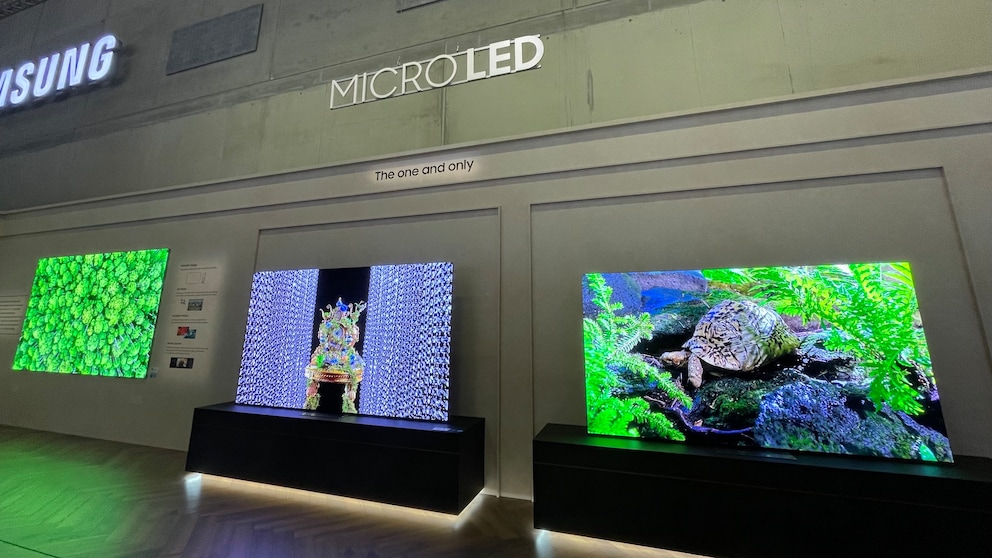
Another big name at the IFA this year was Samsung. The South Korean manufacturer had booked the City Cube on the Berlin exhibition grounds and presented all its devices there in one go. Smartphones next to smartwatches next to vacuum cleaners–next to televisions. In the latter category, Samsung’s motto this time is: Bigger is better. Particularly impressive was the Micro LED TV.
The name says it all. Thanks to LED lights only 50 micrometers in size, individual pixels can be controlled separately. Similar to OLED, the picture is very high in contrast, as pixels can dim or turn off completely on dark and completely black surfaces. Micro LED also eliminates one of the biggest weaknesses of OLED panels: brightness. The pixel LEDs can shine much brighter than the organic diodes. However, the major drawback of this technology is the price. Although Samsung has already made significant progress in production, the large model with its 140 inches is likely to reach the six-figure range.
LG StanbyME Go
A frequently seen TV concept at IFA 2023 was that of the flexibly usable, rotatable TV. A prime example of this is the LG StanbyME Go, which comes in a suitcase. This brings two major advantages: On the one hand, it is completely wireless–the suitcase contains a corresponding battery. On the other hand, the device is incredibly flexible.
LG itself refers to the StanbyME Go more as a portable smart touchscreen. With a 27-inch screen diagonal, you get 1080p resolution and 60 Hz. The suitcase also has 4-channel speakers and the aforementioned battery, which reportedly lasts up to three hours. Thanks to the portable concept, the screen can also be rotated and then used flat, for example, as a game board. Currently, the LG TV costs 1,349 euros.

Hisense – Laser TV and Retro Flair
Hisense’s presence at the fair could not be more contrasting. On one side, the company showcases its ultra-short-throw projectors, marketed as “Laser TV.” On the other side are real TV panels that practically have the character of artworks and even evoke a bit of retro flair.
The Laser TV projectors come with their own screen, which is mounted on the wall like a TV. The projectors themselves can be placed so close to the wall that they could be mistaken for a soundbar. A single Laser TV can produce an image in 4K resolution with up to 120 inches diagonal. The party trick: two devices can be combined to enlarge the area to up to 200 inches of cinema screen–something no regular TV can do.
With the R7K, Hisense has another highlight in its lineup. It is a mini-LED panel with a fabric-covered frame and wooden legs, which could almost come from a GDR living room.
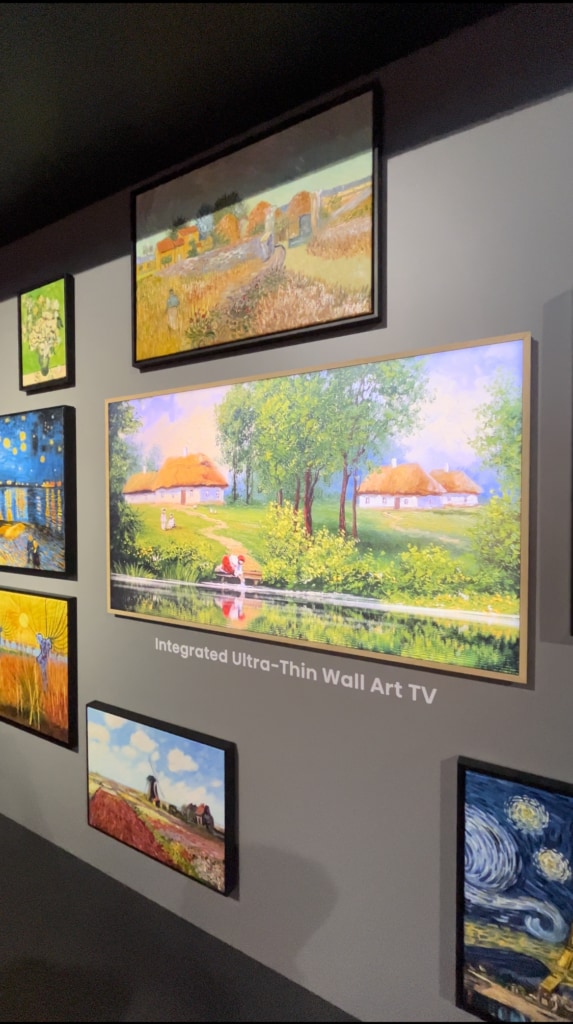
Hisense also directly showcases an “Integrated Ultra-Thin Wall Art TV,” which was hidden among several paintings on a wall. At first glance, it is not even noticeable that it is a TV. This is made possible by a matte surface that, unlike conventional TV sets, does not reflect light. The thin wooden frame contributes to the effect.
Samsung Projector
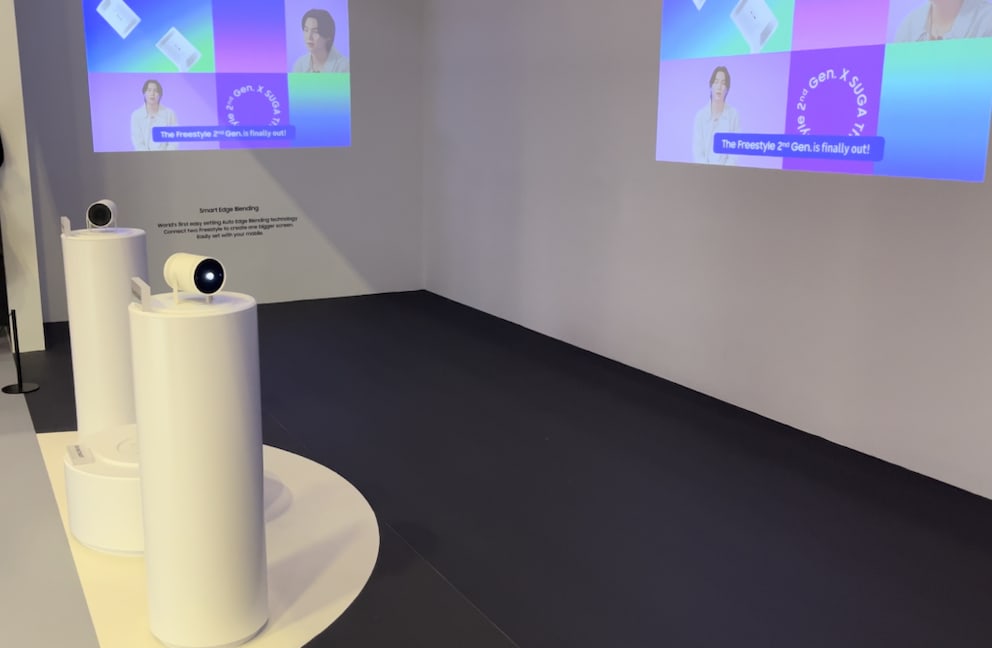
In addition to its huge 8K 140-inch TVs, Samsung also showcased the second generation of its “The Freestyle” projectors. The big innovation here is that–similar to the Laser TV–two devices can be combined. While the image can be up to 100 inches in single use, two projectors create an area of up to 160 inches–fully automatically. Users only need to bring the two image areas together, and the devices handle the rest, including angle correction.
Metz Invision
Not new, but still impressive is the transparent TV available at Metz–or not visible, depending on how you look at it. The device uses OLED technology, which does not require backlighting to be transparent when turned off. The German company introduced the panel back in 2019, but a market launch is still not in sight.
So far, the technology is still in its infancy, with only companies like Xiaomi and LG offering options either exclusively for corporations or limited markets.