

November 15, 2023, 9:34 am | Read time: 12 minutes
Simulate a sunrise in the morning, work under bright daylight, and relax on the couch in the evening: Smart home lamps offer the right lighting mood for every situation. Whether it’s Philips Hue, Innr, or Ledvance, TECHBOOK compares the common lighting systems and reveals what’s important.
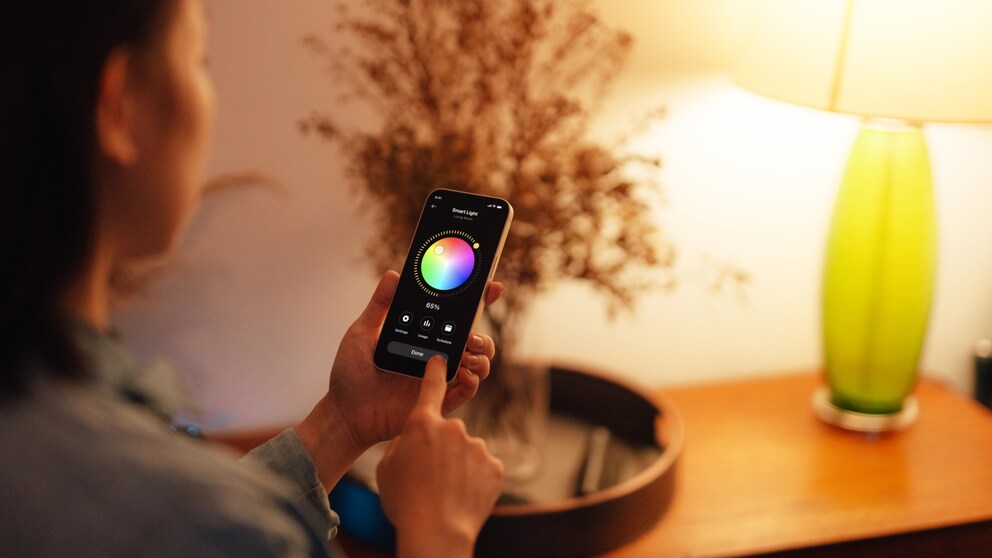
For many, smart lighting is the entry point into the world of smart homes. The wireless lamps can be conveniently controlled via an app, even from afar. You can set schedules, routines, or automations, as well as adjust the brightness and color of the light. The days of having to drag yourself out of bed to turn off the light at night are definitely over. What is important before buying–and how do the different lighting systems differ from each other?
Overview
Smart Home Lamps: What Are They and How Do They Work?
Traditional lamps can be turned on and off with a switch or remote control, sometimes even dimmed. Smart home lamps, however, can do much more:
- Control via smartphone or voice assistant
- Activation from afar
- Individual adjustment of color and brightness
- Timers and routines
- Automations in conjunction with other smart home devices
This works because a wireless module is built into the base of the LED bulbs. This module either works directly with the smartphone (WLAN, Bluetooth) or is controlled by a so-called bridge that connects all the lights (ZigBee, Z-Wave). This also makes it possible to link the lamps with other smart devices like smoke detectors or blinds.
Buying Smart LED Lamps with Color Change: What’s Important
If you’re considering outfitting your home with smart lamps with color change, you should think about a few aspects in advance. What type of lamps should it be? With which wireless standard should the new smart lighting work? Should they be controllable by voice?
Smart lamps with color change are available for both indoor and outdoor use. This means you can equip not only every room with smart LED bulbs, but also the terrace or balcony can benefit from the perfect lighting ambiance at any time. Nowadays, the common sockets are available as smart lamps: E14, E27, and GU10. LED strips are particularly good on furniture or walls to immerse the entire room in a cozy atmosphere.
Most smart lamps can also be activated by voice command when paired with a speaker. However, caution is advised: Not every light works with every assistant. Amazon Echo and Google Home offer broad compatibility, while Apple’s HomeKit or Microsoft’s Cortana have a narrower product range.
WLAN, ZigBee and Co.: Wireless Systems Compared
When it comes to the wireless standard that the module in the base operates with, there are four common systems to choose from: WLAN, Bluetooth, ZigBee, or Z-Wave. WLAN and Bluetooth are particularly suitable for beginners:
- Direct connection to the smartphone
- No bridge needed
- Ideal for a few lamps or individual rooms
- May not be compatible with smart switches or sockets
The range of a Bluetooth connection is quite short, so control may not be possible if the distance between the base and smartphone is too long. Controlling from afar or even from another room is often difficult. The WLAN connection offers a greater range. However, it should be noted that multiple lamps can quickly overload the network–the connection of other devices like smartphones, laptops, or TVs may suffer as a result. The optimal functionality of the smart lights is also only given with a stable network.
ZigBee and Z-Wave are particularly good for equipping the entire house, including the balcony or garden, with smart lighting:
- Connection via a bridge or hub
- Ideal for complete systems
- Strong wireless signal with high range
- Does not burden other networks
- Usually compatible with smart switches and sockets
Many manufacturers and brands rely on one of these wireless systems to ensure high range and not additionally burden other networks like WLAN. It’s best to decide on a wireless system from the start and align the entire smart home accordingly. This ensures that the individual devices can communicate with each other without problems and can be connected via a hub.
Philips Hue
The leader among smart lights is manufacturer Philips. Under the name Hue, Philips offers many different bulbs. The entire house, including the garden, can be equipped with the system. The portfolio of Hue lamps is particularly diverse: They are available as E14, E27, and GU10. Each socket is available as a white light version and as a colorful LED light with color change. The different product names are easy to confuse:
- Philips Hue White: warm white light
- Philips Hue White Ambiance: white light spectrum with over 50,000 shades
- Philips Hue White Filament: LEDs in retro bulb design, white light spectrum
- Philips Hue White & Color Ambiance: white and colored light, over 16 million colors
The advantage of the Hue system: the large integration possibilities. Many other smart home device manufacturers make their products compatible with Philips lamps. A single LED, for example, the Philips Hue White Ambiance for dimmable white light, can be paired with the smartphone via Bluetooth. If you use multiple lamps, you need a separate bridge for control. Therefore, the Hue starter set, which includes three smart LEDs (E27, 75 watts, 806 lumens) and a Philips Hue Bridge, is recommended for beginners. This can equip one or two rooms. You can then expand the set with other lamps as desired. Once the Hue app is installed on the smartphone and the bridge is connected to the WLAN router, the light spectacle can begin: Depending on the lamp, over 16 million colors and scenarios are available.
Also interesting: The best smart sockets for your home
Innr
Similar to Philips lamps, Innr bulbs are also available in various versions. The standard lamps offer dimmable, warm white light, while the Comfort and Color series each cover the white light and colorful light spectrum. The latter offers over 16 million colors. The filament lamps come in a bulb design and give any room a cozy, warm white vintage flair.
Most Innr lights operate via ZigBee and must therefore be connected via a bridge. However, the color change version and the filament lamps are also available in the E27 variant as a WiFi model. They can only be connected and controlled via WLAN and do not work with the Innr bridge. This is optimal for individual lamps but complicates the setup or expansion of the smart home lighting system. Therefore, special attention should be paid to the “WiFi” addition in the product name when purchasing.
Hombli
Unlike Philips and Innr, manufacturer Hombli focuses on the essentials in smart lighting: Various bulbs with RGB or white spectrum as well as amber and smokey variants are available. For the outdoor area, there is a wall and a path light.
With a power consumption of five to nine watts, the various bulbs are quite energy-efficient. These models also work with a WLAN module and can be individually controlled from the phone. In the associated app, you can configure the lamps according to your wishes. Triggers for different light scenarios can be, for example, the time, sunrise or sunset, the weather, or the temperature. For quick operation, the smart lamps also respond to voice commands to Siri, Alexa, or Google Assistant.
Hama
Manufacturer Hama also offers a wide range of smart lighting. In addition to the bulbs available in the three common sockets, wall lights and ceiling lamps are also available. The bulbs have a luminous intensity of about 800 lumens and can be adjusted in brightness between 2700 and 6500 Kelvin–this corresponds to a spectrum from yellowish warm white to bright daylight white. Depending on the model, an RGB color spectrum with 16 million colors is added.
However, all Hama bulbs are WLAN models. They are therefore perfect for entering the smart home world because they do not require a gateway for control. However, integration into an existing system, such as Philips Hue, is not possible.
Trådfri
Ikea has also jumped on the smart home systems bandwagon. Under the Trådfri brand, the furniture giant’s portfolio also includes smart LEDs and accessories. Trådfri translates to wireless–which perfectly captures the concept of the bulbs. All products are plug-and-play devices. They are ready to use as soon as they are screwed into the socket or connected to power. Operation is via remote control, a dimmer, the smartphone app, or voice control.
The Ikea lights are not only compatible with the in-house Home smart system but can also be integrated into other connected units. Ikea also scores with relatively low prices: Compared to other manufacturers, Trådfri bulbs and sets are easy on the wallet. However, the selection of different lamps is not as extensive as with other systems; for example, there are no lights for outdoor use.
Xiaomi
The Chinese manufacturer Xiaomi offers a wide range of different smart home products. In addition to smartphones, technical products, and household appliances, WLAN LEDs are also included. However, the selection is small: There is a warm white and a colored E27 bulb. In various tests, these impressed with intense colors and a relatively low price. Light scenarios can be adjusted and routines created via the Mi Home app. The lamps communicate via WLAN directly with the smartphone and can be connected with other compatible smart home devices.
Tint
A real price tip among smart lamps with color change are the models from Tint. They come in various white and color light variants and can be controlled via remote control and voice assistant or smart home app. Ceiling lamps and outdoor lighting are also part of the product portfolio. The downside: They are mainly designed to expand already existing systems. Therefore, the brand does not offer its own hub. Instead, the LED bulbs can be integrated into many ZigBee systems, such as Philips Hue or Magenta SmartHome. Without a compatible unit, the functionality of the lamps is reduced to color settings via remote control.
Ledvance
Ledvance offers bulbs with various connections. The Smart+ lamps are available as WiFi, Bluetooth, and ZigBee versions, each in dimmable white, with a white spectrum, or with a color spectrum. The Bluetooth and WLAN models are connected to the smartphone or tablet for control, while the ZigBee variants can be integrated into existing units. Alternatively, the Smart+ Switch can be mounted and used as a regular light switch on the wall.
Smart Lamps with Color Change: Which Ambiance for Which Room?
Once the smart lamps are installed, the next question arises: Which color suits which room? In general, because the colors can be changed at any time with the push of a button, you can experiment to see which light scenarios best suit which room. However, different tones have been shown to have different effects on overall well-being and mood. The following combinations are recommended:
- In the living room or bedroom, red and yellow light is recommended because it feels cozy and warm. Green light can also promote relaxation here.
- Orange tones work well in the kitchen because they suggest sunlight and thus stimulate the appetite.
- At the desk and in the study, daylight white is the best solution, meaning light with a brightness of at least 10,000 lux or from 5300 Kelvin. This light strongly inhibits the production of the sleep hormone melatonin and instead stimulates serotonin production. The release of the happiness hormone can boost motivation and concentration.
- Blue as a color appears quite cool, but also fresh and invigorating–ideal for the bathroom.
Did you know? The light color (also called color temperature) of a white light source is given in Kelvin and indicates how warm or cool the light generally appears. The rule is: The higher the light color of the lamp, the cooler the light.
- Warm white is below a color temperature of 3,300 Kelvin.
- Between 3,300 and 5,300 Kelvin is considered neutral white light.
- From a light color of 5,300 Kelvin, it is cold white light, which corresponds to daylight at noon–hence it is also called daylight white.

Smart Homes Existed 100 Years Ago! This Technology Proves It
Which Smart Plug Is Right for Me?
Wireless Sockets: How to Make Regular Lamps Smart
Don’t want a smart lamp? Then you can upgrade regular lamps with a suitable adapter. These adapters are placed between the socket and the cable. The adapter then receives the signal, and no additional wireless module is needed in the base of the LED lamp. This way, standard light sources can also be controlled remotely via smartphone. However, this only works if the lamp is activated directly by power contact. If an additional switch is needed, a smart socket adapter is only partially worthwhile. Such adapters are available from Philips Hue, Innr, or Trådfri, for example.
Conclusion
If you don’t mind the cost, go for the most successful lamp concept from Philips. Philips Hue offers a very large product range and high compatibility. This makes the manufacturer a market leader. Cheaper WLAN lighting systems are available from Hama, Hombli, or Xiaomi. For expanding an existing ZigBee network, the corresponding lamps from Tint, Innr, or Ledvance are suitable. The selection of smart lights is large–those who are clear about budget and use before buying will definitely find the right product.