

June 15, 2018, 2:44 pm | Read time: 5 minutes
Apple is now offering its smart speaker, the Homepod, in Germany. How does it fare against the already established and cheaper competitors, Amazon Echo and Google Home? TECHBOOK’s comprehensive test reveals the answer.
Smart speakers are already considered part of the living room inventory by many. Google, Amazon, and now Apple are vying for market share. But which device can actually do what–and which is right for my needs?
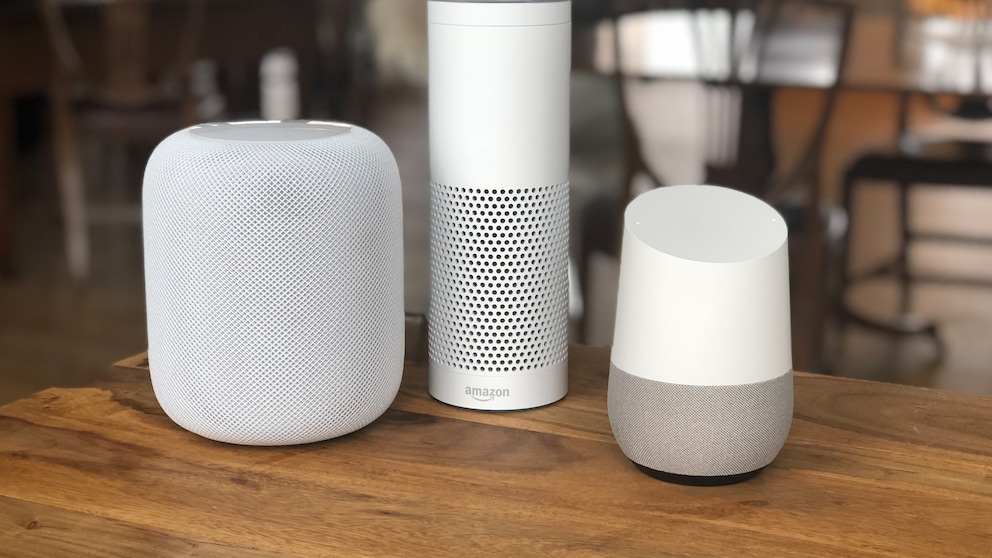
TECHBOOK put the two most established voice assistants against Apple’s newcomer:
- Google Home with Google Assistant (manufacturer price 149 euros, available for about 110 euros)
- Amazon Echo Plus with Alexa (manufacturer price 149.99 euros, available for about 140 euros)
- Apple Homepod with Siri (manufacturer price 349.99 euros, available for about 340 euros)
Microsoft Cortana is missing from the comparison, as there is currently no smart speaker with this assistant.
In the test, the devices faced four criteria: setup, intelligent voice recognition and command execution, sound quality during music playback, and integration with other devices.
All excel in setup
The three test devices were easy to set up. Users simply need to put them in pairing mode with a button press and then connect them to the home Wi-Fi network via a free smartphone app–done! This worked flawlessly with all models, with no clear winner emerging here.
Be cautious with the Homepod: Apple’s voice assistant can only be set up with an iPhone or iPad, not with an Android smartphone, such as those from Samsung. Without an iPhone, the Homepod is merely expensive living room decor. The other two devices can be set up independently of the smartphone’s operating system.
Voice recognition and intelligence
All speakers faced a detailed questionnaire in the TECHBOOK test. Basic functions like current weather and navigation to a specific location, as well as encyclopedia knowledge such as Bill Gates’ birthplace or the name of Niki Lauda’s mother, were queried. The voice assistants were asked a total of ten questions in the test.
This highlighted the weaknesses of Siri in the Apple Homepod. Siri neither knew Bill Gates’ birthplace nor could convert two pounds into grams. The Homepod also failed to play radio stations. A poor performance!
Google Home and Amazon Echo, on the other hand, knew the answer to almost every test question. Only in route guidance and questions about celebrities did Google Assistant outperform Alexa. Especially since Google Home automatically sends the requested Maps route to the smartphone. Thus, Google Assistant is the winner in this category.
Apple dominates in sound
If not in voice recognition, Apple should at least impress with sound quality. After all, the tech giant from Cupertino repeatedly emphasizes what a “music expert” the Homepod is. And here Apple delivers: The great and unfortunately only strength of the heaviest device in the test lies in its good sound quality.
Great bass, clean highs, room-filling sound–despite its compact size, the Homepod is suitable for larger parties at home. Music is available via iPhone through the streaming service Apple Music (10 euros per month), services like Spotify or Amazon Music are not directly supported. A small trick: You can start them on the iPhone and “beam” them to the Homepod using Apple’s wireless transmission standard Airplay.
Amazon Echo Plus comes in second place. Depending on the music genre, it definitely satisfies the everyday listener. Bass enthusiasts will only scoff at the Echo. However, Amazon’s Echo is much more open to other music apps and supports Spotify, among others, alongside Amazon Music. Otherwise, any music–including Apple Music–can be transmitted via Wi-Fi.
Google Home, on the other hand, performs weakly as a sound box; the device simply lacks power at higher volumes. It is quite suitable as a radio replacement, but not as a true replacement for a Bluetooth speaker. Google is also more open than Apple regarding music services, and almost anything can be played via Wi-Fi.

Apple HomePod in TECHBOOK Review

Amazon Echo Studio (2025) Review–New Look, Better Sound
Integration with other devices
All devices like to call themselves “smart home hubs,” capable of controlling window contacts, blinds, thermostats, or alarm systems–but they only partially live up to the name. The Homepod, in particular, only plays within the “Homekit” cosmos, Apple’s proprietary smart home platform. If your devices aren’t compatible, tough luck! Apple currently lists only about 50 compatible products from a few manufacturers in its store–too few!
It’s different with the competition: Google Home alone supports more than 170 services and products with its voice control, such as Netgear Arlo, Philips Hue, and the smart home solutions from Telekom and Innogy. Amazon Alexa can control even more devices on request, including Medion’s smart lamps and Nuki’s smart door lock.
Convenient for Android users: Google Assistant is deeply integrated into the smartphone. Often, a tap is enough to send music to the speaker or stop playback. With Amazon Echo, however, you always need to use the Alexa app for changes and settings.
All devices can be used as a multiroom sound system. This means music can be played simultaneously on several Amazon Echos in different rooms. Two Homepods can even function as a stereo pair–a feature the other devices lack. However, Echo and Home boast plenty of accessories: Fire TV, Chromecast, Echo Buttons, and many other devices complete the Amazon and Google households.
Voice Assistants in Test – Editorial Conclusion
In the end, it’s quite clear: Apple’s new Homepod simply offers too little to justify the high price. The unique Apple ecosystem also provides few opportunities for third-party manufacturers to make their products compatible.
Amazon’s Echo is somewhat weaker in terms of sound, and Google Home is even more so, but both devices master the basics: They reliably recognize speech and help in everyday life thanks to numerous compatible devices. Google Assistant ultimately does this a bit better than Amazon’s Alexa. Thus, Google Home is not only the cheapest but also the best smart speaker in our test.