

May 30, 2026, 2:25 pm | Read time: 4 minutes
In 2001, a three-way battle emerged in the gaming console market. Until then, Sony had led the rankings unchallenged with the PlayStation. Now, two competitors were trying to dethrone Sony. One was a complete newcomer, Microsoft, entering the stage with the Xbox. The other was a veteran, Nintendo, attempting a different approach with the Gamecube. TECHBOOK explores why this ultimately wasn’t enough.
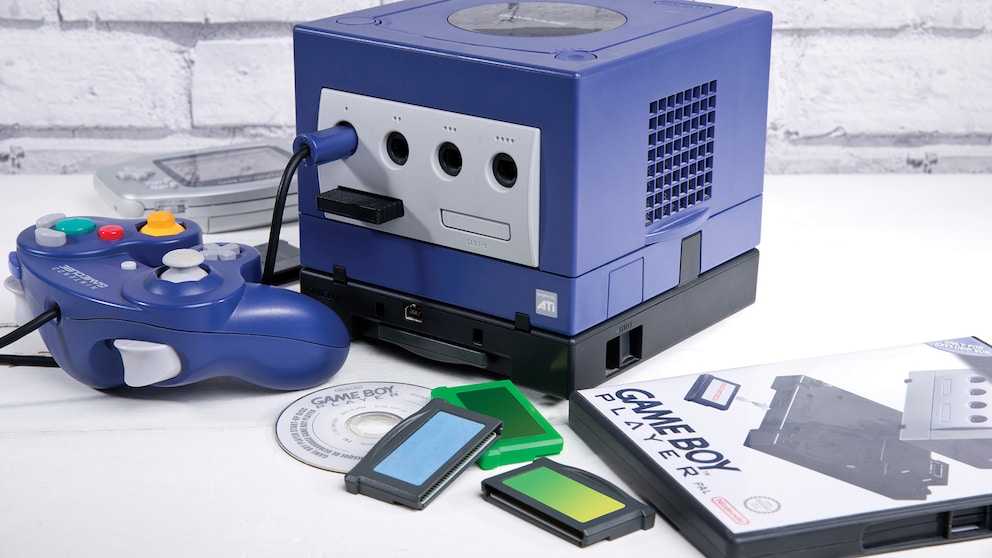
Externally, Nintendo’s Gamecube stands out immediately. While the PlayStation and Xbox are more flat, resembling a VCR or DVD player, Nintendo opted for a cube design.
Nintendo chose this form not only to differentiate in design but also for financial reasons. To compete with the other console manufacturers, Nintendo made many “cheap” compromises in its features.
Nintendo Opted for “Cheap”
This starts with the drive and the game media. The drive didn’t have a motorized front loader but was a top loader that opened with a button press.
“Additionally, the Gamecube didn’t use standard DVDs or CDs as media but relied on so-called mini-DVDs,” adds Matthias Oborski, exhibition director at the Computerspielemuseum in Berlin. “These were hard to copy and had faster load times but also significantly less storage than the standard DVDs used by the PlayStation 2 and Xbox.”
Since the PlayStation and Xbox were not just pure gaming consoles but also played DVDs and CDs for movies and music, the Gamecube was not a multimedia machine.
Portability Instead of Multimedia
Nintendo tried to downplay this with marketing phrases. Shigeru Miyamoto, the iconic developer and software genius of the Japanese gaming console manufacturer, said at the time that with the Gamecube, Nintendo aimed for “the image of a portable and easy-to-use gaming machine.”
“A handle attached to the console suggested easy portability, especially compared to the heavy Xbox,” confirms Matthias Oborski of Nintendo’s efforts. But a console that’s easy to transport in the emerging multimedia internet age was hardly enough as a selling point. The success-driven Japanese were aware of this. “That’s why Nintendo focused much more on first-party games, titles developed internally by Nintendo, than Sony and Microsoft did with the Gamecube,” adds the exhibition director of the Berlin Computerspielemuseum.

New PlayStation Console Leaked
Users Should Urgently Switch Nintendo Console Back on Now
Game Hits Despite Cost-Effective Hardware
These exclusive games included Eternal Darkness, Wind Waker from the popular Legend of Zelda series, Mario Party, and F-Zero GX. With four controller inputs, the cult cube was ideal for hours of multiplayer sessions.
In terms of hardware, Nintendo avoided expensive in-house developments. Instead, they relied on supplies from renowned specialists. The so-called Gekko CPU was the powerful heart of the Gamecube and came from IBM. ATI provided the room-filling sound with a chip named “Flipper.” The mini-DVDs used as game media were developed by the Japanese specialist Matsushita for the Gamecube.
The significance of Nintendo’s Gamecube in the console world is therefore difficult to assess. By the official end of production in 2007, nearly 22 million units had been sold, not a bad number. “But the very diverse and superhit-filled game offering of the PlayStation 2 was far greater than that of the Gamecube,” concludes Matthias Oborski from the Computerspielemuseum in Berlin.
Also interesting: What ever happened to the video game manufacturer Sega?
Gamecube Remains Nintendo’s Console Before the Wii
The other competitor ventured in a new direction. “The Xbox offered successful online gaming with Xbox Live,” emphasizes Oborski, categorizing the Gamecube overall as more of a failure. Still, Nintendo showed with some big game hits that commercial game success doesn’t solely depend on the hardware used.
But the console manufacturer learned quickly. “Nintendo radically changed its strategy after the failure and developed the Wii, one of the most successful consoles of all time,” says the exhibition director of the Berlin Computerspielemuseum, offering a glimpse of what was to come.