

July 23, 2025, 9:33 am | Read time: 9 minutes
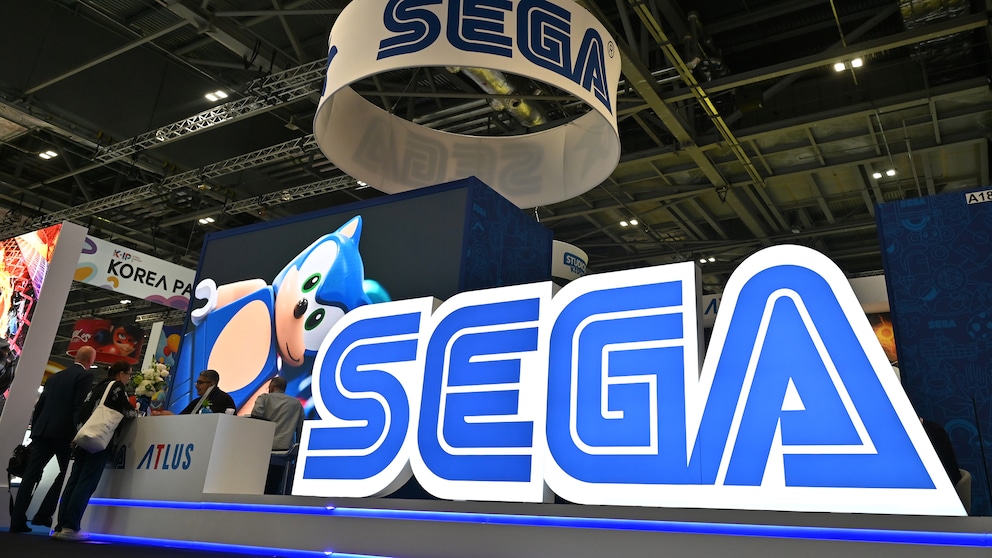
K.K. Sega (Japanese: Kabushiki Sega), better known in Europe and the U.S. as Sega Corporation, was alongside Nintendo and Sony one of the three major providers of video games and consoles from the late 1970s to the late 1990s. However, the history of the now Japanese company actually began decades earlier, not in Japan, but in the U.S. Today, Sega is focusing on its own rich tradition, which is now being made future-proof.
When Shuji Utsumi announced a renaissance of Sega at the 2024 Game Awards in Los Angeles, the joy among the brand’s legions of fans was boundless. “Gamers loved Sega because we showed them a new style, a new attitude, and a new lifestyle,” said the CEO of Sega America and Sega Europe. They have some great pillars, including “Sonic,” “Yakuza,” and “Persona.” “At the same time, we also have other titles that perfectly reflected Sega’s style, attitude, and context. And I think players will love it if we do it right. It will be a challenge–expectations are high–but if we master this, we can become Sega again,” Utsumi promised.
In fact, Sega’s history goes back much further than “just” to “Sonic,” “Yakuza,” “Persona” (1990s), or even older iconic video games like “Space Fury,” “Monaco GP,” or “Subroc.” A history that was extremely eventful, so much so that it is sometimes even described as “confusing.” To do justice to each of these twists would probably require a book or at least a doctoral thesis. Therefore, this text condenses the events, but all the crucial facts are, of course, considered.
Sega’s Cradle Stands in Hawaii
Sega, as we know it today, has its origins in a company founded in 1940. But not, as one might expect, in Japan by Japanese people, but by three Americans: Martin Bromley, Irving Bromberg, and James Humpert. The trio laid the foundation for what would later become Sega in Honolulu, Hawaii, then still under the name Standard Games.
The name already suggests that they saw a flourishing business field in leisure entertainment, which they wanted to serve with coin-operated machines. Initially, they had the U.S. soldiers stationed in Hawaii in mind. Eleven years later, in 1951, the company relocated to Tokyo, as the U.S. Congress had meanwhile banned the installation of slot machines on military bases. This decision is known in U.S. economic history as the “Gambling Devices Transportation Act.”
Entertainment for U.S. Soldiers Overseas
At this time, the U.S. was at war with Korea, so the contingents of U.S. bases in the Pacific had been significantly increased. This also applied to Japan, which had been under U.S. occupation since the end of World War II. By the end of 1945, the U.S. had stationed more than 350,000 soldiers there, representing another promising clientele for the three entrepreneurs. The GIs, far from home in a country whose language was completely foreign to them, were looking for entertainment. And Bromley and Co. wanted to offer their compatriots this with imported coin-operated machines.
Additionally, Japan, which was traditionally very conservative, was gradually opening up to the American way of life. Many renowned U.S. companies from all economic sectors were vying for this new market. The Japanese economy itself had also recognized the opportunities here, and many domestic companies were seeking foreign partners, primarily from the U.S.
Thus, the vending machine operator Nihon Goraku Bussan, founded in 1951, entered into a partnership with Bromley just a year later, whose company had been renamed Service Games of Japan since moving to Japan. In 1960, they founded the subsidiary Japan Entertainment Trading Company, which soon became one of the largest providers of jukeboxes, slot machines, and vending machines.
A Fourth American Lays the Foundation for Sega
And another American came into play. David Rosen was a U.S. soldier stationed in Japan who decided to stay there after his service. Rosen had developed an appreciation for Japanese culture and, like Bromley, recognized the market opportunities.
So, in 1954, he founded Rosen Enterprises, which initially sold photo booths but soon also imported used slot machines from the U.S. While the Japanese company, by status, received a license for U.S. military bases, the intended expansion to the entire Japanese market initially seemed hardly possible.
Japan, which was in the process of rebuilding, had a 6.5-day workweek. And the Japanese Ministry of Trade considered distraction through slot machines counterproductive and denied Rosen the necessary license to install the machines. It wasn’t until 1957 that he managed to convince the authorities that entertainment and economic growth were not mutually exclusive. Rosen believed that workers who could relax through entertainment in their limited free time would actually fuel the economic upswing.
His argument was so convincing that he was eventually granted the license. And Rosen was proven right. The slot machine market was now booming, and Rosen Enterprises also benefited from this boom, soon dominating the Japanese market. Both Rosen and Bromley recognized that a merger of the market leaders–Rosen Enterprises in slot machines, Nihon Goraku Bussan in jukeboxes–would benefit both companies.
Read also: Most valuable video game sold for 2 million U.S. dollars
The Modern Sega Emerges
Initially, the plan was to operate under the name Rosen Enterprise. After all, it was Rosen who held the necessary license. However, the former GI had enough sense and heart to realize that this would have offended the Japanese spirit, already deeply wounded by the devastating consequences of World War II. Therefore, they decided on the name Sega Enterprises Ltd., based on the initials of Service Games. Thus began the actual history of Sega in July 1965.
Now that the company also had production facilities, they began developing their own machines. The first hit the market in 1966, called “Periscope,” and was based on the idea behind the game known to us as “Battleship.” “Periscope” became an international success, which in turn attracted the attention of the U.S. company Gulf and Western. For three years, the Americans courted Sega, and in 1969, the acquisition finally took place. Sega was now a 100% Gulf and Western subsidiary but was able to retain both its name and logo, as well as Rosen as the chairman of the board.
In 1983, Sega Also Entered the Console Market
In the following years, Sega continued to grow steadily–including through the acquisition of the U.S. competitor Gremlin–and regularly released more arcade games. These included titles like “Space Attack,” “Monaco GP,” “Eliminator,” “Pulsar,” and “Frogger.”
All these games were well thought out and executed, giving Sega a reputation as a provider of high-quality games. According to “Historycorner,” “Space Fury” was “the first arcade game to offer colored vector graphics and voice synthesis. The player controlled a spaceship and had to fend off attacks from enemy ships. The spoken announcements, such as ‘Prepare for battle!’ had an almost hypnotic appeal. And the 1982 follow-up “Subroc” gave Sega a unique selling point, as it was the first commercial video game in stereoscopic 3D format.
Around the same time, Sega responded to a new trend that had begun in the early 1980s and was growing. Companies like Atari had already celebrated initial successes with game consoles. Sega now picked up on this trend and developed versions of its most successful arcade games for the most common game consoles. And it wasn’t long before Sega itself appeared on the market with a console.
SG-1000, Sega’s First Own Game Console
On July 15, 1983, Sega introduced its first own game console, the SG-1000. However, it had to compete on the very same day with the “Nintendo Entertainment System” released by Nintendo–better known as NES. The SG-1000 was not destined for great success, partly due to the strong competition and partly due to the high price Sega demanded in markets outside Japan.
Additionally, 1983 saw the preliminary collapse of the video game industry, known as the “Video Game Crash.” As a result, numerous companies, including the former market leader Atari, Inc., went bankrupt. This development was only halted in 1985 when Nintendo’s NES console and the now legendary game “Super Mario Bros.” also appeared on the American market and became major sales hits there.
Read also: Why the “Power Glove” for the NES flopped 35 years ago
What Ever Happened to the Sega Genesis?

35 Years of NES: How Nintendo’s Iconic Console Shaped Our Childhood
Back to the Roots
Such successes were only partially granted to the consoles that followed the SG-1000. Successors like the “Sega Mega Drive” or later “Sega Saturn” sold excellently, so much so that Sega dominated the North American and thus the world’s most important gaming market in early 1994. But the “Mega Drive” was already six years old at that point and had long reached its expiration date.
Sega’s attempts to modernize the console were not well received by fans. As a result, the company lost more than 30% market share within twelve months. This was not least due to the successor, the “Sega Saturn.” Although it initially sold brilliantly, it had to account for its enormous technical complexity. Sega simply had too few games available that were compatible with the console.
However, this was far from the peak of the disaster. In the 1999/2000 fiscal year, Sega had to report a loss of 400 million U.S. dollars. This was only partially due to the “Sega Saturn” successor introduced at the end of 1998, the Dreamcast console. Rather, it was the imbalance between revenue and the excessively high development and production costs that had brought Sega to the brink of collapse. They simply failed to offer anything competitive against the likes of Sony (“PlayStation”) and Nintendo (“GameCube”).
Mega Drive is Today Sega’s Best-Known Console
Thus, in the top 20 best-selling game consoles to date, only one Sega model, the “Sega Mega Drive,” is found, ranking just 19th. No wonder, then, that they exited the console market as early as 2004. In the same year, they merged with Sammy Corporation, the then-leading manufacturer of “Pachinko” machines, to form Sega Sammy Holdings. A “Pachinko” is a gambling machine similar to a “pinball” machine, but unlike the latter, it offers an automatic payout like a slot machine.
Sega now focused exclusively on developing and producing games for the various platforms of the competition. Thanks to the aforementioned merger, the company was able to report a 31% increase in profit to 577 million U.S. dollars by 2006.
Consequently, this focus has hardly changed to this day and will not change in the future. There will definitely be no more Sega consoles, Utsumi confirmed. Instead, they will invest in their own classics like “Golden Axe,” “Virtua Fighter,” or “Jet Set Radio.” “We will introduce these games to a new audience rather than just treating them as museum pieces,” said the CEO of Sega America and Sega Europe. Sega’s iconic legacy is to be made future-proof. So, we can look forward to it.