

June 23, 2024, 7:50 am | Read time: 4 minutes
In the early 1970s, the era of video games began. Atari’s game “Pong” is widely considered the first video game ever. However, that’s not entirely true. In 1972, Magnavox released the Odyssey console in the U.S. a few weeks before Atari conquered arcades with “Pong.” Odyssey, on the other hand, could be played at home on the TV. Without a microprocessor on board, the first game console eventually sold more than 350,000 units.
In the U.S., Ralph Baer, an engineer with German roots, had been working since the mid-1960s on a device that could be used to play interactively on a TV. He and his team demonstrated the so-called Brown Box to several companies starting in 1969, including Magnavox, the U.S. subsidiary of Philips.
The Brown Box is—as the name suggests—a simple, brown box. Inside are capacitors, resistors, and transistors—electronic components also found in analog TV sets.
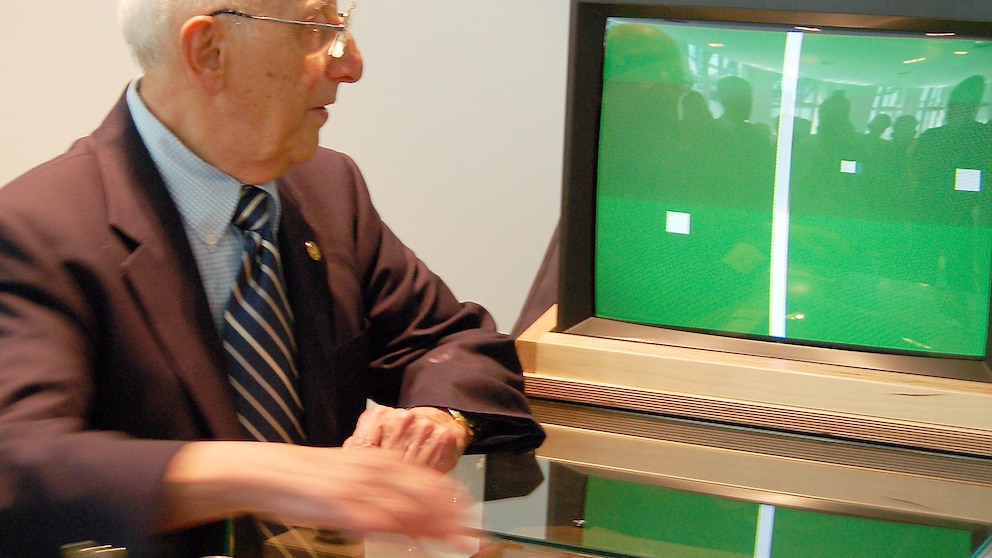
The prototype by Ralph Baer and his development team had only one game variant: table tennis. This strongly resembled the later-released “Pong.” Two controllable square dots served as paddles, a smaller square was the ball, and a solid white line in the middle of the screen was the net.
Odyssey–Not a Classic Game Console
Magnavox eventually secured the contract and all necessary licenses. Starting in 1971, the company began producing a console for home use. Nearly a year later, in spring 1972, Magnavox introduced Odyssey, the world’s first game console—initially only in the U.S. Tech enthusiasts still debate the term “console” due to the lack of microprocessors, as the device relied entirely on electronic components.
Nevertheless, Odyssey featured a “programming” interface. The device had a slot where different cards could be inserted, allowing for the simulation of various game scenarios.
However, the first video games required gamers to use a lot of imagination. Essentially, only square light dots appeared on the screen, behaving differently depending on the game variant.

No Color, No Sound
Tennis, table tennis, American football, board, or educational games could be played on the TV using different cards. The image was black and white, and there was no sound.
However, Odyssey came with thin, colorful screen overlays. These had to be placed on the screen before playing. Thanks to electrostatic attraction, the overlay stuck to the screen, adding some color to the game and making the experience seem more realistic.
The square light dots were controlled with two boxes that seem bulky by today’s standards. There were rotary knobs on the sides, allowing the light dots to move up and down or left and right.
Two additional features provided some variety in the game. A dial on the back of the console could increase the “ball’s” speed. Additionally, both controllers had another smaller rotary knob, allowing each player to give the “ball” a spin, making it harder for the opponent to hit the light dot.
Nearly 100,000 Odyssey units were sold in the first year in the U.S. The price was $99.95, which would be about 650 euros today, adjusted for inflation.

The history of the gaming controller
This video game console served as a model for Atari nearly 50 years ago.
Odyssey Comes to Germany
Although the target sales mark of 140,000 units was missed, Magnavox began marketing its game console in other countries. The company initially focused on the European market, especially Germany.
In 1973, Odyssey appeared at the International Radio Exhibition in Berlin. In Germany, ITT Schaub-Lorenz, a leading brand in TV, radio, and electronics at the time, took over the distribution of the game console. The retail price for the Odyssey game console was 400 Deutsche Marks, which would be approximately 710 euros today.
Meanwhile, Atari had released its video game “Pong.” This indirectly benefited the sales of the Odyssey console, as the device offered similar gaming fun. However, there was no need to visit an arcade; a home TV was sufficient.
The boom didn’t last long, though. The development of video games, as they were later called, progressed too quickly. Although Magnavox later released a light gun for shooting light dots on the screen, the era of the Odyssey ended in May 1975, and production was discontinued.
Successful Pioneering Work
Late, but not too late, the management of Magnavox realized the potential they held with the video game patent. After a tough court settlement, the company at least received money from Atari for licensing. For Atari, it was money well spent. Starting in 1977, a new era in video games began with the Atari 2600 console.
Even though the Odyssey console was not comparable to Atari’s home console, Magnavox paved the way for the video game industry.