

September 14, 2025, 2:06 pm | Read time: 4 minutes
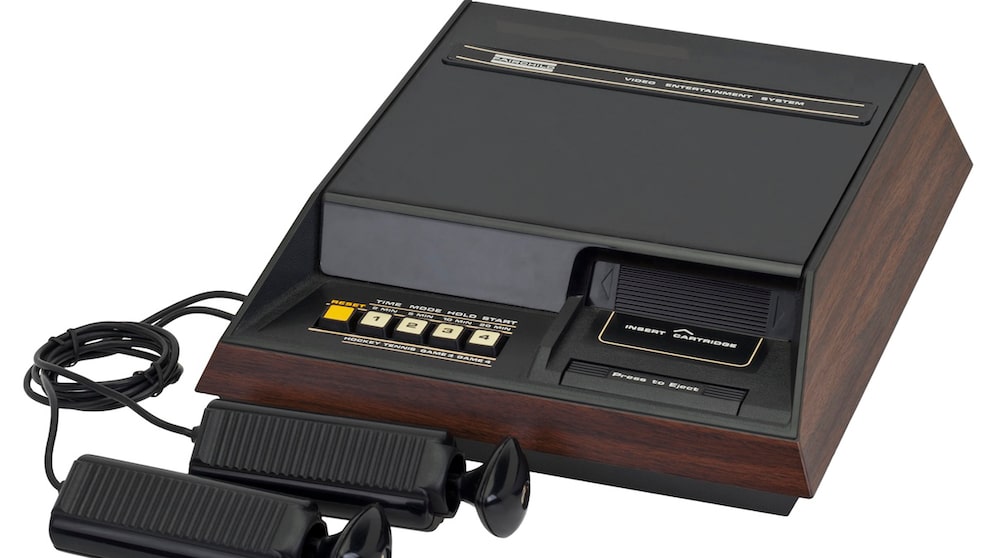
Today, video games are available on all devices in our digitally connected world. Over 50 years ago, in the early days of gaming, special equipment was needed to play. The Atari video game console was likely the first encounter many had with digital games. However, the story would have been quite different if the company Fairchild hadn’t launched its own console, Channel F, as a mere byproduct. TECHBOOK tells the story of a major misunderstanding in this article.
Founded in 1957, Fairchild Semiconductor remains a pioneer in integrated circuits and semiconductors. The U.S. company laid the groundwork for today’s computers and smartphones as early as the 1960s. Fairchild was also one of the first companies in Sunnyvale, California, now known as “Silicon Valley.”
Fairchild’s development team included Robert Noyce and Gordon Moore, who later founded another well-known company called “Intel.” Gordon Moore is also the father of Moore’s Law, which states that the performance of computer chips doubles approximately every 18 months. Although this rule no longer holds in its pure form, Moore’s Law was long valid in the early days of computerization.
Game Console as a Byproduct
So how did the chip manufacturer Fairchild come to develop a video game console? Initially, not at all. All preliminary work was done by the company Alpex. The first prototype of a video game console with an integrated processor was completed in 1974. However, Alpex lacked the financial means to market its own console.
In search of financially strong companies, a request was also sent to Fairchild. The company showed great interest but wanted to equip the console with its own developed processors. At Fairchild, no one considered the potential of video game consoles. The executives were only interested in demonstrating the performance of their processors.
In the summer of 1976, Fairchild presented its Channel F console at the Consumer Electronics Show in Chicago. However, it was merely a display piece without any functionality. Yet, interested media representatives immediately recognized the potential of the new console. For Fairchild, the console remained a mere byproduct to advance its chip development.
Read also: Odyssey – the story of the world’s first game console
Atari launches new console for retro romantics

The history of the gaming controller
Media Show Enthusiasm
Even the enthusiastic media coverage didn’t change that. After all, it was the first console with a processor and memory, allowing games to be started directly via the console or played using interchangeable cartridges. This was also a pioneering achievement.
Channel F came with tennis and hockey as built-in games. Later, over 20 additional games were added as cartridges. The control was via two built-in joysticks. However, the handling was complicated. Game characters could be moved right, left, up, and down. Additionally, the joystick could be rotated, pressed, and pulled. There was no fire button.
For the first time, thanks to the memory chip, game scores could be saved. Also new: Channel F not only offered the option to compete against a human opponent but also allowed a duel against the computer.
The device found its way to Germany in various versions. Saba called its console Videoplay, Nordmende named it Teleplay, and ITT dubbed its device Telematch Processor. All three consoles were based on the original Channel F from Fairchild.
Channel F Comparable to the Moon Landing
However, since Fairchild continued to show little interest in promoting the console, much more business-savvy competitors quickly emerged. One of them was Atari in 1977, just a year later.
With its Video Computer System–VCS for short–Atari launched a significantly more powerful console and thus began the era of video games. Fairchild quietly disappeared from the console manufacturer scene, as if there had never been a Channel F console–F for “Forgotten.”
The company itself likely didn’t mind. After all, becoming a successful console manufacturer was never Fairchild’s goal. As a chip manufacturer, the company made a name for itself. In 2016, a competitor, ON Semiconductor, acquired the company for over $2 billion.
This marked the end of Fairchild’s story after more than 60 years. Even though the Fairchild Channel F was only a tiny episode in the company’s history, it is comparable to the first moon landing in the field of console development.