


July 7, 2021, 2:00 pm | Read time: 5 minutes
After many rumors and a long wait, Nintendo has finally unveiled a new Switch console. However, it is not the Pro version that many gamers had hoped for. Instead, the new Nintendo Switch OLED offers much of the same and only a few improvements.
It could have been so much better. Much was expected from the new Switch. In addition to a 4K display, for example, a new graphics chip, a new CPU, and longer battery life were anticipated. All these things would have been needed to make the gaming experience smoother. Instead, the Nintendo Switch OLED brings only a few new features–and they mostly concern the casing and the ports. TECHBOOK summarizes what we like about the new Switch and what we don’t.
Overview
Nintendo Switch OLED with Useful LAN Port
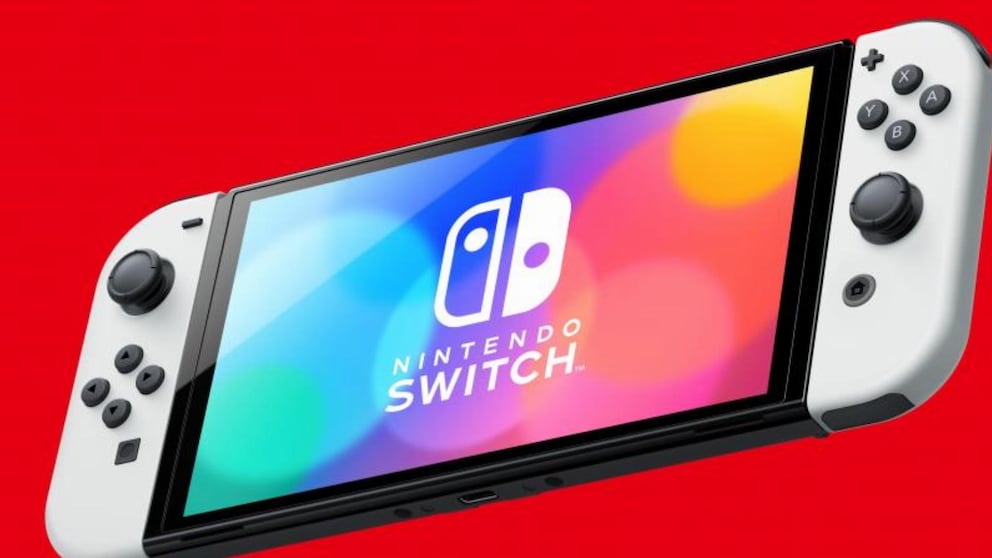
Visually, the Nintendo Switch OLED (model number HEG-001) differs little from the previous Switch. However, there are some small changes. New is the white version, which is offered alongside the neon red and neon blue versions. The design of the Joy-Cons remains the same, as does the adapter. However, Nintendo has modified the dock of the Switch OLED. It is now more rounded at the edges and equipped with a LAN port. The latter is a truly useful addition, allowing players to connect the Switch to the internet via cable.
The new Switch can still be set up on a table thanks to the integrated kickstand. Nintendo has now enlarged the fold-out stand, responding to customer feedback. It spans the entire width of the console and can be adjusted in tilt angle. The stand of the old Switch is relatively narrow, causing the console to tip over easily with small jolts.

Larger Display, but No 4K
The console itself is slightly wider at 102 x 242 x 13.9 millimeters and a bit heavier at 420 grams, including Joy-Cons. Nintendo has increased the display diagonal from the previous 6.2 inches to now 7 inches. Additionally, the manufacturer uses modern OLED technology. The old Switch, on the other hand, has an LCD panel. The switch to OLED technology is likely to result in brighter colors, higher contrasts, and slightly lower energy consumption, as each pixel is individually illuminated. When displaying black, the pixels remain off.
However, the display resolution remains the same despite the increase in size. Thus, the Nintendo Switch OLED also displays 1280 x 720 pixels in handheld mode and Full HD with a maximum of 60 FPS (frames per second) when connected to a TV. Fans of the console had hoped for 4K.
Also read: Nintendo Switch vs. Switch Lite–Which is Right for Me?
The Hardware of the Nintendo Switch OLED–A Letdown
Regarding the hardware of the new Nintendo Switch OLED, we are very disappointed. The manufacturer uses the same processor as before and still relies on 4 GB of RAM. The Nvidia Tegra X1 used is already six and a half years old and thus far from up-to-date. The performance and energy consumption can no longer compete with current CPUs. The decision to use the old processor also seems odd in light of recent reports. They claim that Nvidia will cease production of the Tegra X1 Mariko chip by the end of the year. However, these reports have not yet been confirmed. It is also unclear to what extent Nintendo may have secured a stock of the corresponding CPUs to ensure continued production.
According to the manufacturer, the battery life remains unchanged. Nintendo states a runtime of 4.5 to 9 hours. In the reference game “The Legend of Zelda: Breath of the Wild,” the Nintendo Switch OLED is said to last 5.5 hours–the same as the previous Switch. The identical battery life is not surprising, as Nintendo uses the same processor in both consoles. The higher power consumption of the larger display in the new version is offset by the more energy-efficient OLED technology.
It is clear that gamers cannot expect better graphics or a smoother gaming experience with the Nintendo Switch OLED. This is more than disappointing for a console upgrade. A small silver lining is the storage of the new version. Nintendo has increased it from the previous 32 GB to 64 GB. We must also mention the optimized speakers here. They are supposed to provide better sound.
Here you can see the presentation trailer from Nintendo:

Nintendo Switch, Lite or OLED? A Comprehensive Console Comparison

Valve Announces New Steam Deck With Several Improvements
Compatibility with Games and Accessories
As Nintendo confirms, all games released for the Switch so far are also compatible with the OLED version. However, there may be “differences in the gaming experience” with certain titles such as the Labo series. This is due to the–albeit minimal–size differences between the two Switch versions.
It also remains questionable to what extent the lower pixel density due to the larger display affects the representation on the Nintendo Switch OLED. Since it still does not support DLSS, games from third-party providers can continue to appear blurry. DLSS stands for Deep Learning Super Sampling. It is an AI-supported rendering technology that enables better frame rates with a sharper image. This works by outputting the image at a lower resolution and then upscaling it again by AI.
What Does the New Nintendo Switch OLED Cost?
Unfortunately, Nintendo has not yet revealed what the Switch OLED will cost in Europe. However, the manufacturer has named a price of $349.99 for the U.S. In Europe, the previous Switch started with an MSRP of 329 euros. The new version could therefore be somewhat more expensive. It is set to hit the market on October 8.
The TECHBOOK conclusion in the video: