


February 2, 2023, 2:44 pm | Read time: 7 minutes
With the Nintendo Switch, the Japanese company has hit a real home run. The popular gaming console is now available in three versions–the original Switch, a smaller Lite version, and a larger model with an OLED display. But what are the detailed differences between the three models, and which target audience are they each aimed at?
The Nintendo Switch has sold millions of units since its release in March 2017. It was so successful that Nintendo launched a more compact version, the Switch Lite, in September 2019. In summer 2021, the largest model to date, the Switch OLED, followed. The biggest difference between the consoles: While the Nintendo Switch and Switch OLED can be connected to a TV thanks to the included dock, the Switch Lite is primarily designed for mobile use. TECHBOOK has listed the details that differentiate the consoles in a comparison of the Nintendo Switch, Switch OLED, and Switch Lite.
Overview
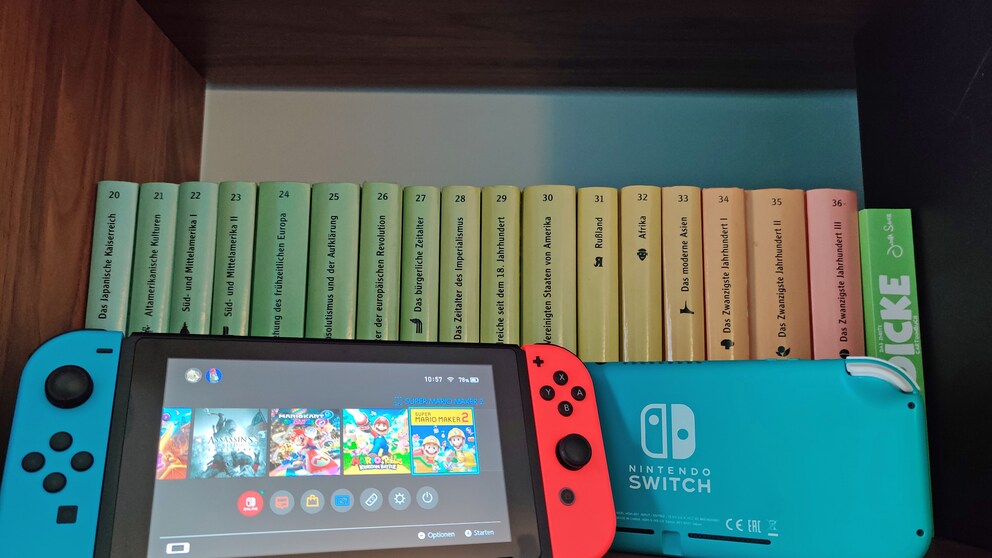
Nintendo Switch and Switch Lite in Visual Comparison
The Nintendo Switch Lite is significantly more compact than the standard version. This is also reflected in the screen size. While the small console has a 5.5-inch LC multi-touch screen, the display of the regular Switch model is 6.2 inches. However, the Switch OLED has a 7-inch display diagonal, offering the most space for gaming. Thanks to OLED technology, the display is also more vibrant and has higher contrast than the regular Switch and Switch Lite. Despite the size differences, all three models have a resolution of 1280 x 720 pixels.
In terms of pure casing size, the two models with docking stations differ little from each other. This is because the Nintendo Switch OLED has significantly narrower display bezels compared to the regular model. However, there are still noticeable differences. For example, the Switch OLED has a wider and adjustable kickstand, making it more stable on a table. The docking station has more rounded edges and includes a LAN port, allowing the console to connect to the internet via cable. Also new with the Switch OLED is the completely white version, offered alongside the neon red and neon blue version.
Differences in Control
The key difference between the Nintendo Switch and Switch OLED compared to the Switch Lite lies in the controls. The Switch (OLED) comes with the well-known Joy-Cons on the sides, which can be detached if needed, while the Switch Lite has different control elements. The button areas are not detachable and are built into the console housing. The typical functions of the Joy-Cons–such as HD rumble or the IR motion camera–are not integrated.
However, there is a modified version of motion control. On the regular Switch and the Switch OLED, you can aim using the gyroscope function by holding the consoles in the desired direction instead of using the controllers. This also works on the Switch Lite. The button layout is otherwise the same on both models, but Nintendo has given the Lite a true D-pad instead of individual arrow buttons. This evokes retro nostalgia, as this design aspect has been familiar since the first Game Boy.
Also interesting: How to Properly Clean a Gaming Console
Since the Joy-Cons on the Switch Lite cannot be detached compared to the Nintendo Switch and Switch OLED, and the smaller console also lacks a kickstand, it cannot be used in tabletop mode without additional accessories. However, players can upgrade–for example, with a separately available stand and controller. Both consoles can also have their storage space upgraded. On the back of the Switch Lite, a specially designed cover is provided for the microSD card slot. On the Switch, it is hidden behind the fold-out kickstand.
Also interesting: Finding the Right Memory Card for the Nintendo Switch
Differences in Hardware and Features
The Switch Lite is a pure handheld console compared to the Nintendo Switch and Switch OLED. Some games like “Super Mario Party,” “1-2 Switch,” “Just Dance,” “Ring Fit Adventure,” “Nintendo Labo,” and “Fitness Boxing” are not compatible as they require detachable Joy-Cons. Nintendo also omitted the docking station and TV mode for the Switch Lite. For this reason, it cannot be connected to a TV. Its gameplay cannot be “switched” contrary to its name.
The other two models, however, offer all these features. Additional Joy-Cons can be connected to the Switch Lite, although playing with multiple people on the small screen is less comfortable.
The larger display and additional technology inside the Nintendo Switch and Switch OLED result in higher power consumption. The first version of the large Switch had a battery life of 2.5 to 6 hours. This was not much and quickly led to complaints from players. Nintendo then released an improved version of the Switch with the Nvidia Tegra X1, which has a battery life of 4.5 to 9 hours. The improved version can be identified by the packaging (old version with hand, new version without hand on the box) and the model number HAC-001(-01). Serial numbers starting with “XK” also indicate a Nintendo Switch console with improved battery life.
In terms of battery life, the Switch Lite is exactly between the old and new versions of the regular Switch. On average, players can game for 3 to 7 hours on a single charge. Specifically, Nintendo has installed a 3570 mAh battery here. Compared to the Switch Lite, the Nintendo Switch has a 4310 mAh battery–both the old and new versions. Nintendo achieves the better battery life here through an adapted version of Nvidia’s Tegra-X1 chip, which is also used in the Switch Lite.
The Switch OLED has the model number HEG-001 and features 64 GB instead of 32 GB of internal storage and improved speakers. According to the manufacturer, it has the same battery life as the regular Switch–around 4.5 to 9 hours. The identical battery life is not surprising, as Nintendo uses the same processor and battery capacity of 4310 mAh in both consoles. The higher power consumption of the larger display in the new version is offset by the more energy-efficient OLED technology.

Not So Pro: Nintendo Disappoints with New Switch OLED Console
More power for Nintendo Switch — How to Make the Console Faster
Prices of the Nintendo Switch, OLED, and Lite Compared
Due to the mentioned compromises, the Switch Lite is also cheaper compared to the large Nintendo Switch and Switch OLED. The console is available in yellow, gray, turquoise, and coral colors and has an MSRP of 219 euros. However, the console is now available for prices around 200 euros. The large Switch is more expensive–not least because of the included Joy-Cons and docking station. It is available in a gray version and with Joy-Cons in neon red and neon blue. The MSRP is 329 euros. The Switch OLED is the most expensive of the three models, with an MSRP of 349.99 euros.
Nintendo has also released various bundles with games for the three consoles, which are slightly more expensive. In the case of the standard Switch, the bundle versions often also feature a special color scheme for the console.
Which Console Is Right for Me?
With its flexible application, the Nintendo Switch has become the favorite console. Whether alone or with a partner, in tabletop or TV mode, it can be used in many places and always brings fun–even with friends. The Switch can also serve as a family console, as up to eight individual Joy-Cons can be connected.
The Switch OLED essentially offers the same features as the regular Switch, with the main difference being the larger OLED display. It also has double the storage, a more stable kickstand, LAN, and better speakers. Technically, however, it is not an upgrade, as Nintendo uses the same components as in the Switch.
For those who do not yet own a Switch and do not necessarily want to play on a TV, the Lite version might be more attractive. Nintendo offers the Switch Lite as a more affordable console for those who prefer an even more compact design. The larger battery already indicates a device that relies entirely on the portable factor of the Switch and is especially suitable for people who like to play on the go. They do not need detachable Joy-Cons but a lightweight handheld console.