

August 26, 2025, 2:43 pm | Read time: 7 minutes
Tetris can now look back on more than 40 years of success. But it wasn’t always smooth sailing–quite the opposite. At times, the struggle over Tetris resembled a business thriller.
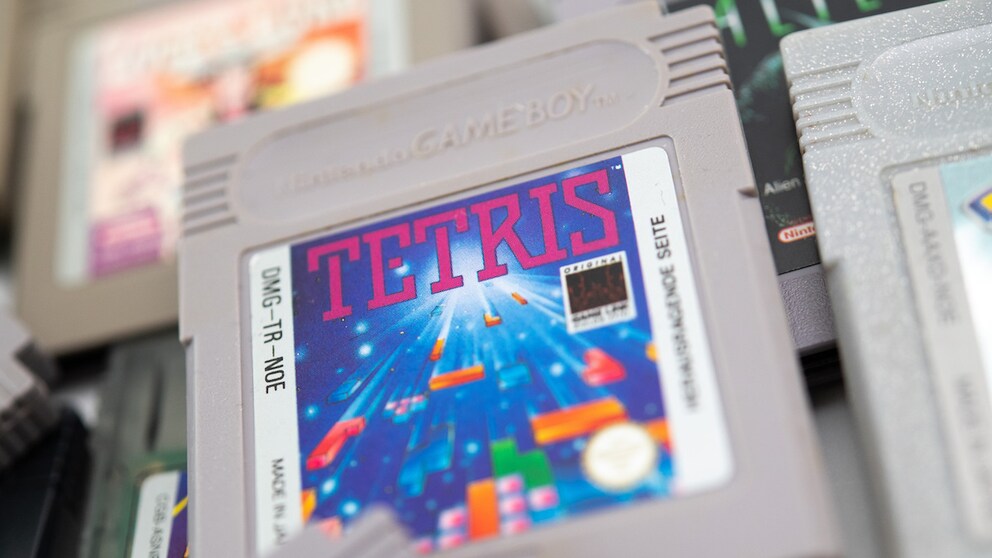
Some love it, others find it frustrating, but everyone knows it: Tetris. With approximately 500 million sales across its various versions, the game is one of the best-selling computer games worldwide. The term “computer game” is used broadly here, as Tetris’s rise to success occurred in the 1990s with Nintendo’s Game Boy. Since then, the iconic game has been considered the mother of casual games, entertaining countless players–even in space. However, Tetris creator Alexey Pajitnov did not initially become wealthy. TECHBOOK takes a look at the eventful history of this classic game.
Overview
A Game You Can’t Win
The concept of Tetris is self-explanatory: The small blocks falling from the top of the screen must be arranged as efficiently as possible. A complete row disappears, but if the blocks pile up to the top, you lose. The absence of narrative elements, cultural references, and complex learning requirements makes the game accessible worldwide and popular across many age groups. And that’s despite the fact that you can’t actually win Tetris, which tests players’ patience. The increasingly fast-paced music adds to the stress level. But that’s also part of Tetris.
It takes exceptional dexterity to beat Tetris. Yet, in late 2023, 13-year-old Willis Gibson managed to do just that, as TECHBOOK reported. After a 40-minute game, he reached level 157 and the so-called “killscreen.” At this point, the game is overwhelmed by the player’s performance, and the screen freezes. This set a world record for Willis Gibson, as it is technically not intended for Tetris to be completed regularly. Among those who congratulated the young gamer was Henk Rogers, the head of the Tetris Company and a friend of the creator Alexey Pajitnov.

What Ever Happened to the Sega Genesis?

35 Years of NES: How Nintendo’s Iconic Console Shaped Our Childhood
From the Soviet Union to Japan
In the 1980s, Alexey Pajitnov worked as a programmer at the Computing Center of the Soviet Academy of Sciences in Moscow. To test the computing power of the personal computers of the time, he programmed a simple game. Pajitnov was inspired by the game Pentomino, where players assemble shapes made of five cubes into a form. For Tetris, Pajitnov limited himself to seven two-dimensional shapes, each made of four squares. The name Tetris combines “tetra” (Greek for four) and tennis, the inventor’s favorite sport.
The first version ran on June 6, 1984, on an Elektronika 60, initially without sound and color. The new game quickly became popular among Pajitnov’s colleagues. By the summer of the following year, Pajitnov developed the first color version. Through copies, the game soon spread throughout the Soviet Union and eventually to other Eastern Bloc countries–until businessman Robert Stein discovered it in Hungary and recognized its great potential. What followed was a struggle over the Tetris licenses that even involved Mikhail Gorbachev.
Read also: Great Tamagotchi Mystery Solved After Almost 30 Years
Business Thriller Over Tetris Licenses
The drama over the Tetris licenses is literally worthy of a film. In 2023, British director Jon S. Baird dedicated a feature film to the events, starring Taron Egerton and Nikita Efremov. After Tetris was developed to market readiness, Pajitnov had to relinquish all rights to the state foreign trade company Elektronorgtechnika (Elorg). Meanwhile, Robert Stein verbally secured the computer rights to Tetris for the company Mirrorsoft at the Computing Center of the Soviet Academy of Sciences. Mirrorsoft was a British computer game publisher that belonged to Robert Maxwell’s media empire.
Whether due to a misunderstanding or a very generous interpretation of the agreement, Mirrorsoft saw itself as authorized to sell further sublicenses in the U.S., Europe, and Asia. Together with the American game developer Atari Games, Mirrorsoft also developed a Tetris version for game consoles. However, this was done without the knowledge of the Soviet Elorg.
Meanwhile, Henk Rogers, the later co-founder of the Tetris Company, acquired the Tetris license for the Famicom console from Atari Games on behalf of Nintendo. Neither Nintendo nor Atari Games seemed aware that Atari Games did not own console licenses and therefore could not resell them. When Henk Rogers wanted to acquire the handheld licenses for Nintendo’s Game Boy, he couldn’t reach an agreement with Robert Stein. So Rogers decided to fly to Moscow and buy the licenses directly from Elorg.

Three Businessmen Go to Moscow …
During this period, Elorg was already investigating the Tetris license case, as outstanding Tetris royalties had not yet been paid to the Soviet Union. What Rogers did not know was that he was not the only Western businessman interested in the Tetris licenses in Moscow. Elorg received Rogers from Nintendo, Robert Stein, and finally, as a Mirrorsoft representative, Kevin Maxwell, the son of Maxwell Company owner Robert Maxwell, all on the same day. However, the three did not meet at Elorg.
When Rogers was the first to speak with Elorg, he promoted the Japanese version, whose license he had purchased from Atari Games and thus indirectly from Robert Stein. Finally, the whole scheme was exposed: Atari Games did not own the rights to the console versions, and Nintendo’s Tetris versions were therefore illegal. However, Rogers managed to capitalize on the shock. With the console giant Nintendo backing him, he was able to acquire licenses for both mobile and stationary consoles. The result was the first Game Boy in 1989 with Tetris as the standard game, leading to 70 million Game Boys sold.
The negotiations were far less favorable for Robert Stein, who faced accusations of unpaid royalties and unauthorized license sales. Kevin Maxwell was the last to appear, learning for the first time about the license violations and breaking off negotiations to consult further. Elorg decided to sell the handheld licenses to Rogers–likely also because Maxwell appeared unpleasantly arrogant. Not even Robert Maxwell’s protest to Mikhail Gorbachev, with whom he had good contacts, could change that.
Tetris in Space
Overall, the Moscow interlude was a complete success for Henk Rogers and Nintendo. Rogers also gained personally, as he befriended Tetris creator Pajitnov–in classic fashion over Russian vodka. When Pajitnov emigrated to the U.S. in 1991 after the collapse of the Soviet Union, he and Rogers founded the Tetris Company. Pajitnov only began receiving royalties for Tetris after the license expired in 1996. Today, his wealth is estimated at about $21 billion.
Tetris’s success is not only due to its appearance on the Game Boy but also to its catchy music. The classic Tetris sound of the Game Boy version is based on the Russian song “Korobeiniki,” which in turn is based on the poem of the same name by Nikolai Alexeyevich Nekrasov from 1861. The song describes a nighttime tryst, characterized by an increasingly fast melody.
Even after its bustling early years, Tetris can look back on a dynamic and record-rich history. In 1993, it became the first computer game to reach space. Russian cosmonaut Alexander Serebrov traveled to the Mir space station with his Game Boy and, of course, Tetris in tow. This record was recognized in the “Guinness World Records 2014 Gamer’s Edition.”
However, less glorious phenomena are also closely linked to the game, such as the Tetris effect. In this phenomenon, Tetris players begin to adapt their thinking, dreaming, and visual imagination to the game. This effect does not occur only with Tetris but has been studied in participants using this game. Therefore, even on the 40th anniversary of the successful game, the saying holds true: Less is sometimes more. Tetris’s status as a cross-cultural and cross-generational phenomenon is undeniable.