


February 3, 2026, 4:35 pm | Read time: 4 minutes
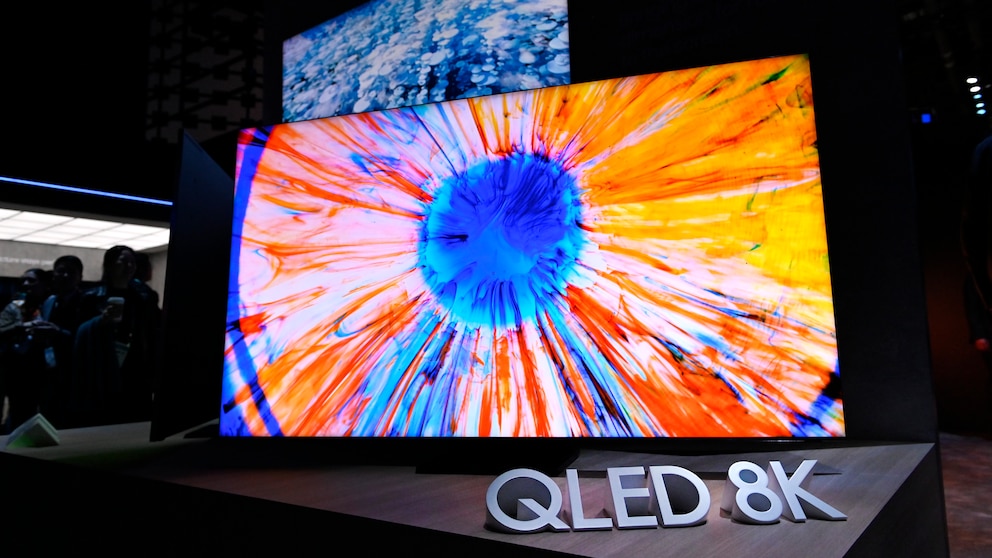
For a long time, TV manufacturers pushed 8K resolution as the future of home theater. Eleven years ago, Sharp introduced the first 8K TV for consumers. But it wasn’t until three years later that Samsung truly made the technology mainstream. Other manufacturers like Sony, LG, TCL, and Hisense followed, sparking a race for market leadership. However, the hype didn’t last long. Since 2023, only Samsung has been producing new models, while other manufacturers have withdrawn from the 8K segment.
No 8K Market for Consumers
Samsung is the only manufacturer to announce a new 8K device for 2026, the Neo QLED 8K QN990H. However, this is merely an evolution of the QN900 series. The competition has either announced their withdrawal from the market or hasn’t announced a new model in years:
- Sony withdrew from the market in 2025 and ceased production of its last remaining 8K device (Z9K).
- TCL had only one 8K model in its portfolio, the 6-Series R648 from 2021, but has not produced new devices since 2023.
- Sharp and Xiaomi introduced their own 8K TVs in 2020, and Hisense in 2021, but now sell their devices only in regional markets.
Now, Samsung’s biggest TV rival, LG, is also shutting down its 8K business, as reported by “FlatpanelsHD.” LG Display confirmed at CES 2026 that the development of new 8K panels has been paused: “Since our technical readiness is already fully established, LG Display is well-prepared to respond immediately once the market and customers determine the right timing.”
LG Scales Down 8K Business
LG was the only manufacturer offering a globally available 8K device with an OLED panel, the Z3. Originally, the company refreshed the Z series annually with new models since its launch in 2019. However, by 2024, the Z3 was carried over to the next year as LG had no successor.
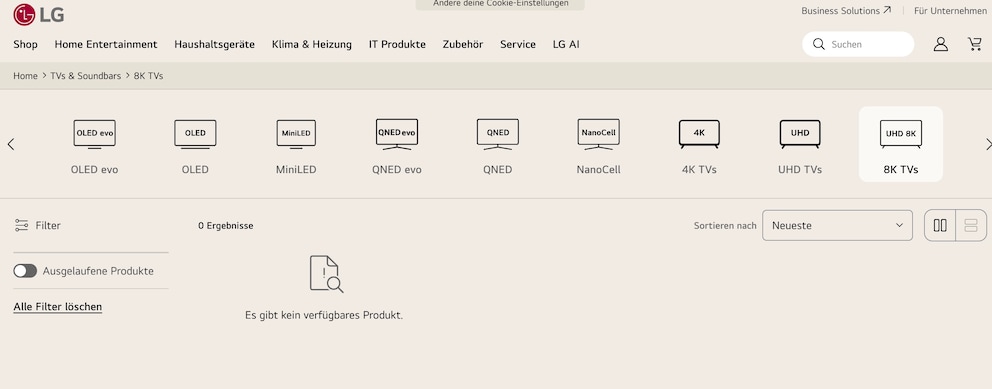
Like Samsung, LG also sold an LCD model, the QNED99T, which hit the market in 2024 but received no successor in 2025. The device is still available regionally. In Germany, however, neither the Z3 nor the QNED99T is available through the LG website.
Limited Spread Despite Years of Marketing
In 2020-2021, the 8K market boomed as the technology seemed promising. LG, Sony, and Samsung expanded their offerings with new, sometimes cheaper products. 8K appeared to be on the verge of becoming truly mainstream. Sales projections anticipated an increase from 520,000 units in 2021 to almost 4.5 million in 2026. Instead, the curve remained flat. As of 2024, only 1.6 million 8K TVs had been sold.
The weak demand is also evident in the 8K Association. Founded primarily by Samsung, the association aimed to promote the technology. In 2022, notable companies like TCL, panel manufacturers BOE and Samsung Display, and partners like Prime Video were among the members. Now, only Samsung and Panasonic remain as manufacturers—even Samsung Display has left the 8K Association.

QLED, 8K, HDR, Micro-LED: What Do These TV Acronyms Mean?
Samsung Unveils New TV Models for 2026
Lack of Content and Limited Usefulness
A central issue is the lack of native 8K content. Streaming, television, and gaming predominantly continue to rely on 1080p, 1440p, or 4K. The amount of 8K resolution content on YouTube is very limited. Apart from that, there is no significant streaming service offering 8K. Even the PS5 couldn’t make 8K gaming available to the masses. Due to compatibility issues with available devices, Sony quietly removed the 8K logo from the packaging.
Additionally, the difference between 4K and 8K resolution is barely noticeable for many. A study by the University of Cambridge from 2025 shows that 8K only offers advantages with very large screen sizes and close seating distances. At a distance of more than one meter from a 65-inch 8K TV, test participants could no longer discern any difference.
Of course, there’s the price factor. In times when decent 4K TVs are available for a few hundred euros, 8K devices can only position themselves in a very limited premium segment. Even Samsung’s cheapest 8K model, the QN900F, costs over 1,500 euros, nearly twice as much as a comparable Neo-QLED model with a 4K panel.
Other Features Are More Important Than Resolution
Instead of higher resolution, TV manufacturers are now focusing on other features—primarily contrast and brightness. OLED has long been considered the de facto standard for high-contrast images, but a problem with organic light-emitting diodes is limited brightness. Nowadays, Mini-LED TVs offer similarly good images with significantly higher brightness. The current market leader is TCL with the X11L, which reaches a maximum brightness of up to 10,000 nits.
Micro-LED technology is still in its infancy and extremely expensive to produce, but it combines the advantages of OLED and LED. Since the pixels here emit light themselves, no backlighting is necessary, as with OLED panels. However, the micro-lights do not have the burn-in problem of their organic counterparts, allowing them to shine much brighter.