

February 28, 2026, 2:19 pm | Read time: 4 minutes
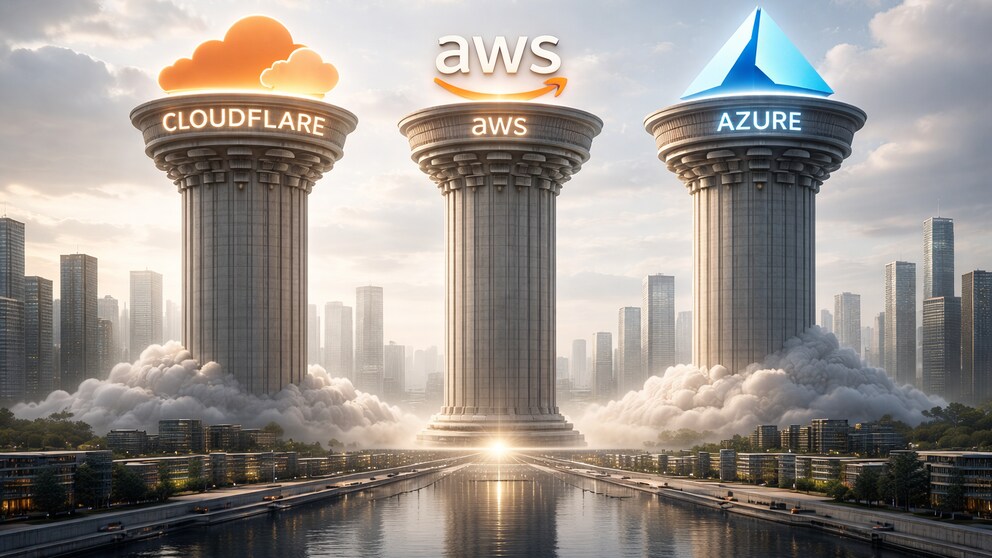
When major cloud providers have issues, internet users worldwide feel the impact. Cloudflare, Amazon Web Services (AWS), and Microsoft Azure now form the technical backbone of countless websites and apps. If one of these providers goes down, music services, payment systems, or chatbots often disappear from the web suddenly. This was evident recently in fall 2025, when several large-scale disruptions affected millions of users simultaneously.
In November 2025, an outage at Cloudflare caused services like ChatGPT to be temporarily unavailable. Spotify, Shopify, and X (formerly Twitter) also reported issues. Just a month earlier, a disruption at AWS had massive effects: Prime Video and Alexa were down, as were services like Venmo, Perplexity, PayPal, and the cryptocurrency exchange Coinbase. As a result, outage platforms such as Downdetector quickly filled with reports.
Who Cloudflare, AWS, and Azure Are
Cloudflare often plays a protective and intermediary role on the internet. The service checks incoming requests and filters out harmful traffic, such as during DDoS attacks. Distributed Denial of Service is a coordinated attack where a server is overwhelmed and incapacitated by many simultaneous requests. At the same time, Cloudflare distributes content like images or scripts through a global content delivery network, allowing websites to load faster and reducing the load on origin servers. About one-fifth of global internet traffic runs through this infrastructure.
AWS and Azure, on the other hand, are massive data center platforms. They provide storage, computing power, databases, and AI services. Many websites and apps exist physically only in the data centers of these providers. Azure is particularly attractive to companies already using Microsoft services like Office 365.
Simplified, a page request works like this: The user makes a request, Cloudflare checks and protects it, and AWS or Azure deliver the content. If one component fails, the effects are immediately visible.
Why the Internet Is Built This Way
The strong centralization has practical reasons. Cloud services allow companies to scale flexibly without having to operate their own servers. During extreme load peaks, such as the launch of a major concert ticket sale, these platforms can handle the surge. Infrastructure of this scale would be economically impossible for most providers.
There’s also the security aspect. Small and medium-sized businesses often cannot adequately secure their systems. Providers like Cloudflare take on this task collectively, protecting millions of websites simultaneously.
When the Backbone Fails
The downside of this structure is domino effects. A single error can impact numerous industries. Companies then have to switch to emergency solutions, support hotlines collapse, or revenues are lost. In public perception, such outages are often equated with cyberattacks, but they are often configuration errors.
Alexander Rabe, managing director of the eco Association of the Internet Industry, warns against too much dependency: Central infrastructure increases efficiency but also raises the risk of disruptions affecting many areas simultaneously.
What Solutions Are Being Discussed
Large companies are already relying on redundancy, such as multiple content delivery networks. For smaller firms, this is hardly affordable. Therefore, politics and business are discussing stricter regulations for system-relevant cloud services, similar to the financial sector. These include reporting obligations, resilience requirements, and transparent emergency plans.
European alternatives are also gaining importance. According to Rabe, diversity is more important than the origin of individual providers. Projects like the announced European Sovereign Cloud by AWS could help create more independence, provided they are part of a broader infrastructure strategy.

Server Outages at Amazon and Others

Cloudflare Outage Disrupts Parts of the Internet
What Politics and Companies Can Do
From the perspective of the internet industry, reliable conditions are needed for the expansion of data centers and digital infrastructure. This includes faster approval processes, predictable investments, and as uniform rules as possible within the EU. Public procurement should also focus more on promoting fail-safe and well-combinable solutions, rather than committing early to individual providers.
At the same time, companies should take precautions themselves. Important measures include regularly tested backups outside their main cloud, clearly defined procedures for disruptions, and as few dependencies as possible on a single provider. Those who also monitor the status pages of cloud services and outage portals like Downdetector or StatusGator can react more quickly in an emergency.
What Users Can Do
For private users, the impacts are usually manageable. Outages often last only a few hours. Nevertheless, it makes sense to back up important data locally. For companies, however, preparation and emergency planning are crucial to avoid being caught off guard by the next disruption.
The recent outages show: The internet functions efficiently–but it is not automatically resilient.