

September 26, 2026, 10:55 am | Read time: 6 minutes
Bluetooth connects devices in a room, Wi-Fi throughout the entire home, but how do computers in Africa or America connect with those in Europe? A wireless connection is no longer sufficient. A simple cable wouldn’t do either. That’s why digital undersea cables, often called submarine cables, are needed. But what distinguishes these cables, and how are they laid in the sea?
In mid-March 2024, the internet goes completely down in many West and Central African countries. From Gambia to Cameroon, digital life comes to a standstill. Several hundred million people suddenly find themselves without an internet connection. The cause of the massive digital blackout is an underwater earthquake off the coast of Ivory Coast, which severely damaged four submarine cables.
Dense Network of Cables
Such an incident shows how vulnerable entire countries are when several of these submarine cables fail. However, such events are extremely rare because the entire system of submarine cables now forms a dense network. This means that if one cable fails, internet providers can easily switch to other cables.
According to the industry service “TeleGeography,” there are currently about 600 active or planned submarine cables. If all the cables were laid end to end, they would total 1.5 million kilometers. This would be enough to wrap around the Earth at the equator almost 38 times.
Some of these cables are very short, as can be seen on a special map. For example, CeltixConnect, which connects Ireland with Great Britain, is just 131 kilometers long. Others are extremely long, like the Asia-America Gateway, which stretches nearly 20,000 kilometers and connects the Asian and American continents. Regardless of their length, modern internet would be unthinkable today without this invisible infrastructure.
How Is a Digital Submarine Cable Constructed?
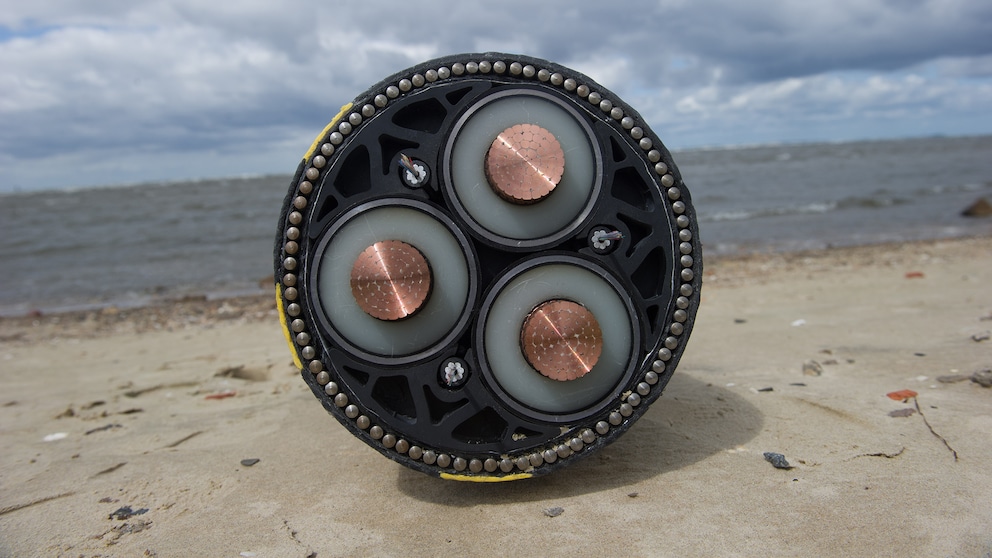
From the outside, a submarine cable looks like a thick garden hose. At its core are several hair-thin optical fibers through which light pulses race, transporting data. Each fiber consists of a thin glass core and a cladding with lower light refraction. This keeps the light trapped inside, allowing it to travel thousands of kilometers with minimal loss.
This bundle of optical fibers is protected by several layers:
- a waterproof jacket,
- a copper layer for powering the amplifiers,
- steel wires for tensile strength, and
- a plastic sheath.
Near the coast, where ship anchors and fishing nets might come into contact with the cables, an additional steel armor is added.
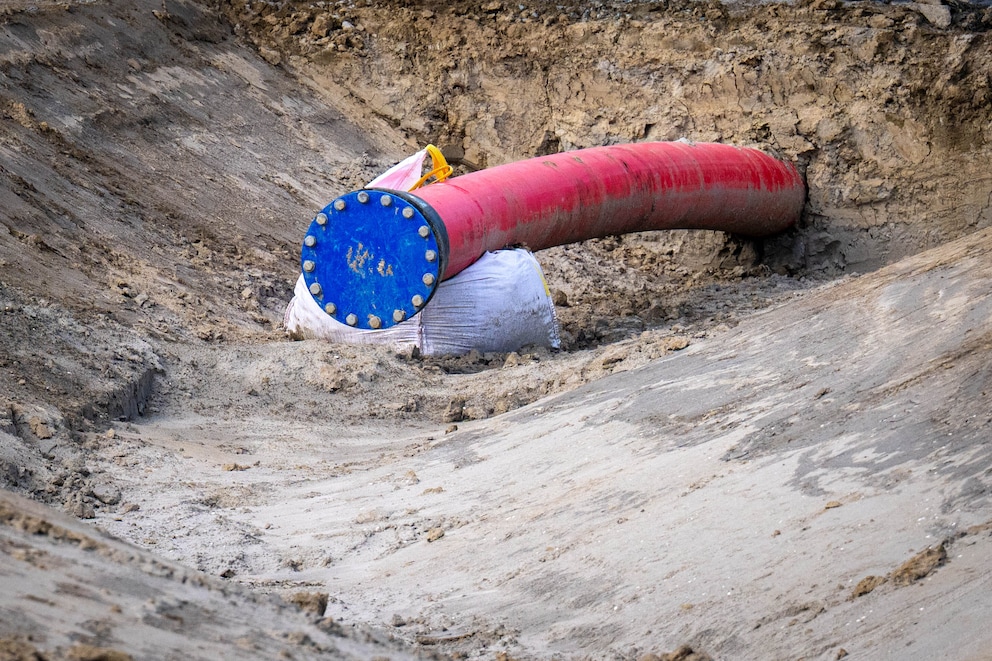
Within the cable, repeaters are installed at regular intervals. These amplify the light signal, which weakens over very long distances. This way, the signal from an office in Berlin arrives almost loss-free on a computer in New York.
How Is a Digital Submarine Cable Laid?
Specialized ships handle the laying of digital submarine cables. Onboard, they carry huge drums with 50 to 150 kilometers of cable each. At sea, the ship carefully lowers the cable to the seabed. In shallower coastal waters, often still about a kilometer deep, an underwater plow digs a trench in the seabed and buries the cable up to three meters deep. Satellite navigation keeps the ship precisely on course, accurate to a few centimeters.
The depth at which a submarine cable is laid depends on the region. Near the coast, it often runs in shallow water of a few hundred meters. In the Atlantic or Pacific, depths of 6,000 to 8,000 meters are not uncommon.
Which Companies Lay Digital Submarine Cables?
When telephony began its triumphant advance in the mid-19th century, larger telephone companies took care of laying submarine cables. With the advent of the internet age, traditional telecommunications companies have been replaced by Google, Meta, Microsoft, or Amazon in cable laying. Additionally, there are specialized cable manufacturers like ASN from France, SubCom from the U.S., NEC from Japan, and the Chinese provider HMN Technologies.

Fiber Optic Cables Could Be Misused as Microphones

How Much Internet Speed Do You Really Need?
How Protected Are Submarine Cables and What Happens in Case of Damage?
There can be no 100 percent protection against damage. This is evident from the initial underwater earthquake off the Ivory Coast. No steel armor can withstand a natural disaster.
There are also only limited protective measures against external sabotage. At least the EU is trying to raise awareness of the issue. In 2025, the EU Commission presented an action plan for the security of submarine cables.
Damage is not uncommon. According to the International Cable Protection Committee, there were 204 repairs to submarine cables worldwide in 2024. Most damages have a harmless origin and are caused by the aforementioned fishing nets and ship anchors.
Repairs can take time depending on the location and nature of the damage. It can take up to a month from the damage report to the arrival of the specialized ship on site. The crew then brings the cable on board with a grappling hook, cuts out the defective section, and reconnects the optical fibers.
If the damaged submarine cable is at a very deep location, remotely operated underwater robots take over the work. Worldwide, only about 60 specialized ships are available for repairs, a scarce resource given the growing number of cables.
Also of interest: Can the internet in Germany be shut down at the push of a button?
Why Aren’t Satellites Used to Digitally Connect the World?
Satellites handle only a tiny fraction of global data traffic. There’s a reason for this: Fiber optic cables transport significantly larger amounts of data per second than even the most powerful communication satellites.
Additionally, a light signal in a cable travels faster than a radio signal over a geostationary satellite, which orbits about 36,000 kilometers above the Earth. Time is increasingly important in digital connections, such as in online financial trading, where every second counts in the sale of securities, or in video conferences.
Moreover, the cost: Operating a submarine cable is cheaper over its entire lifespan than comparable satellite capacity. Elon Musk’s Starlink satellite network is a massive loss-making venture. Financial experts have calculated that launching the planned 12,000 satellites into space will cost $19 billion. The lifespan of a single satellite averages five years. Therefore, it is necessary to replace 2,400 satellites each year, which in turn costs $3.9 billion annually.
Internet from space only makes sense in regions where there is currently no adequate cable infrastructure. Therefore, digital submarine cables continue to form the backbone of the global internet.
Meta, for example, plans to lay a 50,000-kilometer cable. The project “Waterworth” aims to connect five continents.